Spurs' Backcourt Collapses as Harper Joins Fox on Sideline
By Erik Schwartz ·
San Antonio has lost both starting guards to lower-body injuries mid-series, forcing an untested rotation into the Western Conference finals against Oklahoma City.
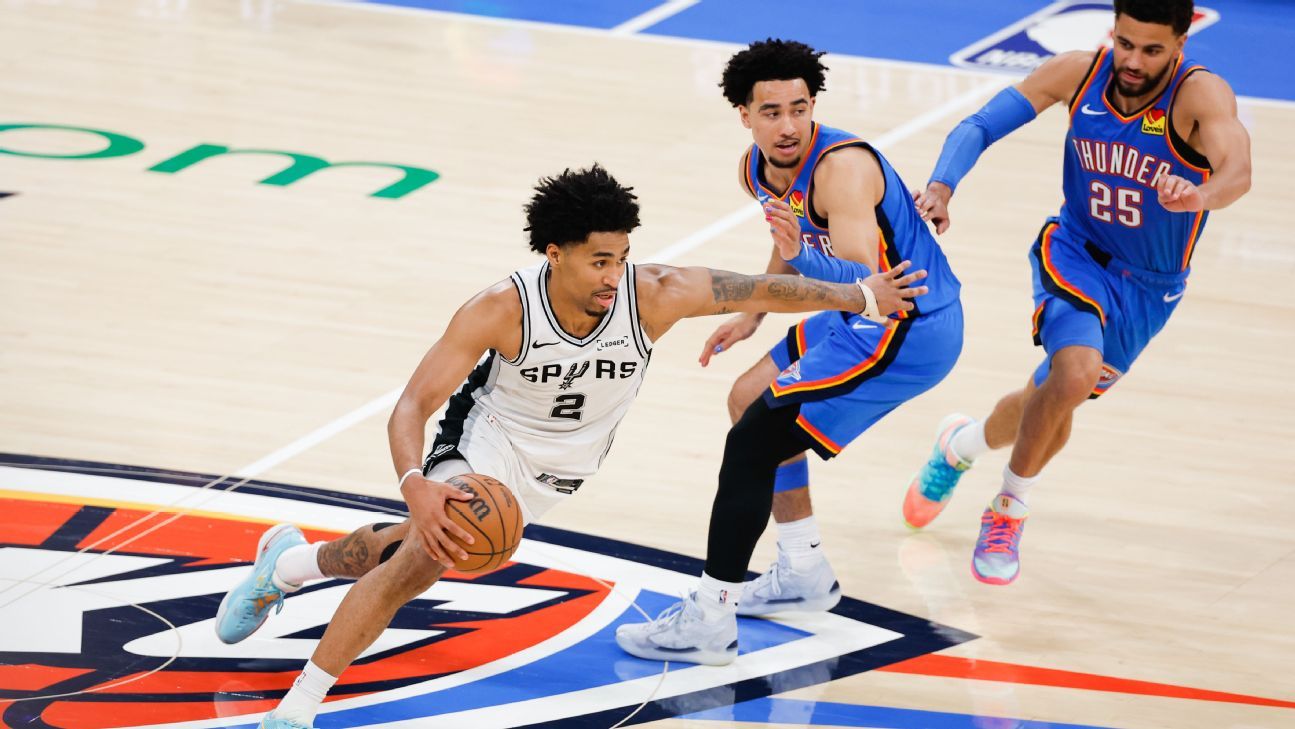
Dylan Harper's right hamstring injury in Game 2 of the Western Conference finals marks the second significant backcourt loss for the Spurs in as many weeks. The rookie guard went down in the third quarter against Oklahoma City after being blocked by Shai Gilgeous-Alexander on a drive to the basket, and despite briefly returning to the bench, did not play the remainder of San Antonio's 122-113 loss. Harper had stepped into the starting role after De'Aaron Fox suffered a right high ankle sprain in the second round, and the timing of this injury—with the series now knotted at one game apiece—creates a depth crisis the Spurs cannot absorb.
The injury exposes a critical vulnerability in San Antonio's construction. Fox was already a question mark for Game 3 and beyond, and Harper's removal from the rotation strips the Spurs of redundancy at guard. Carter Bryant entered the game as Harper's replacement, but a rookie filling in for a injured rookie in a conference finals is a margin-of-error scenario the Spurs' offense cannot afford. Oklahoma City's depth advantage—particularly Jalen Williams' presence as a secondary creator—now tips the scales further in the Thunder's favor. San Antonio's third-quarter breakdown (when Harper exited) may have been as much a product of that moment of chaos as defensive execution.
For prop bettors, the injury immediately reshapes game-to-game leverage. If Fox remains unavailable for Game 3, the Spurs' point total and spread face downward pressure not because San Antonio's ceiling has dropped, but because the probability of executing their offensive scheme—pick-and-roll heavy, guard-dependent—has deteriorated. Harper's 12 points and 3 assists in 25 minutes of Game 2 represent a modest baseline, but the role itself (initiating offense, running secondary pick-and-rolls) carries disproportionate weight in the Spurs' flow. His absence forces minutes to splinter across a thinner rotation, increasing the odds of fourth-quarter crunch-time units built around players the Thunder have not yet scouted heavily in high-leverage settings.
The market may already be pricing some Spurs decline into Game 3 numbers, but it's worth monitoring whether Fox's status update (expected before tipoff) triggers a sharp move. If both guards are ruled out, San Antonio's team total should trade 3-5 points lower than pre-injury projections, and the spread (likely favoring Oklahoma City) will tighten by a half-point or more. The Thunder, by contrast, reported their own hamstring issue with Jalen Williams, though he remained in the game longer—a potential signal that OKC's medical staff assessed it as precautionary rather than structural. Watch the public adjustment carefully: sloppy backcourt health often triggers soft money onto the healthier team, which may overcorrect the spread before the Spurs' depth truly reveals itself.