Nuggets Absorb $32M Tax Hit to Keep Jones, Entering Second Apron for First Time
By PropBetEdge Editorial Team ·
Denver's decision to match Spencer Jones' offer sheet signals organizational commitment to depth shooting, but the financial toll reshapes their 2026-27 roster construction options.
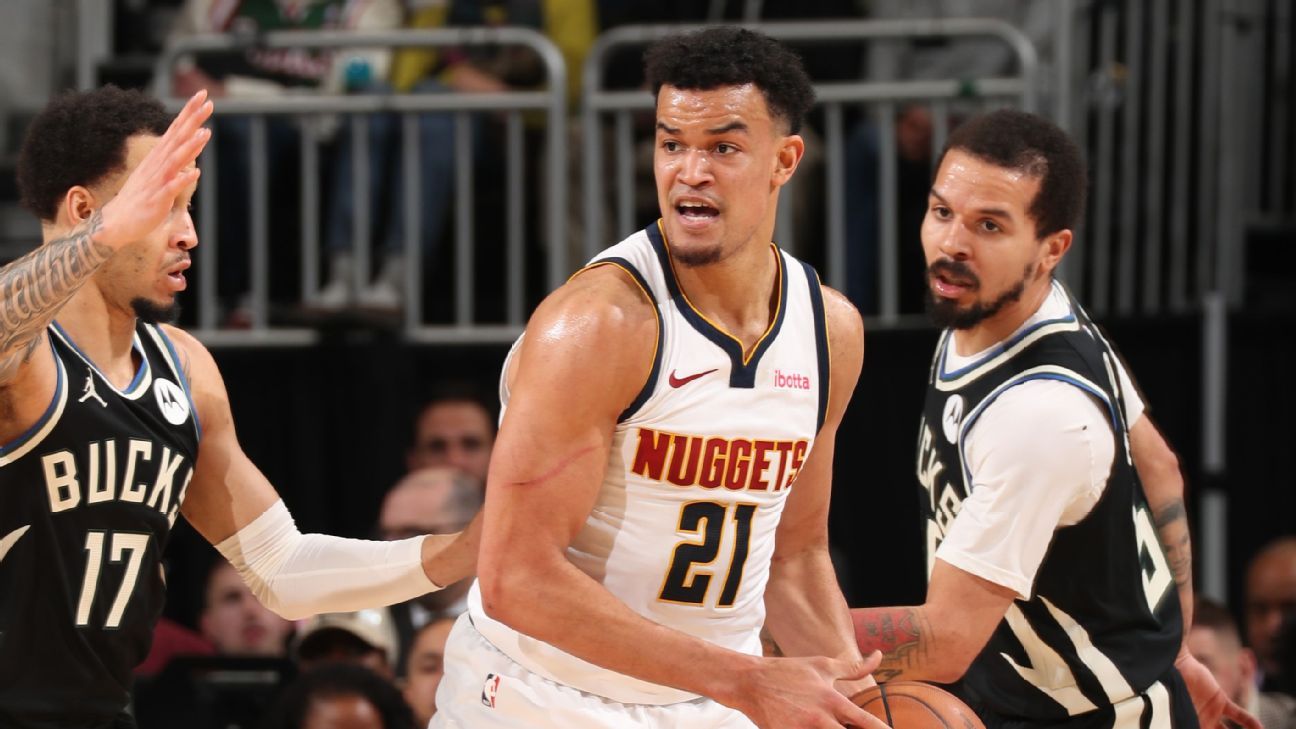
The Denver Nuggets matched Oklahoma City's fully guaranteed two-year, $12 million offer sheet for Spencer Jones on Sunday night, retaining the undrafted 2024 signing and accepting a projected $32 million increase to their luxury tax penalty. The move pushes Denver into the second apron for the first time under the current collective bargaining agreement, escalating their tax bill from $36 million to $68 million. Denver becomes the sole NBA team currently operating in the second apron tier, a structural threshold that constrains roster flexibility for the remainder of the offseason and season.
Jones, drafted as an undrafted free agent in 2024, proved his three-point shooting has legitimate NBA utility. During the 2025-26 regular season, he averaged 5.5 points and 3.3 rebounds across 64 games, including 37 starts. His calling card emerged in the playoffs: a league-leading 69.2% conversion rate from three-point range. That production profile—high-volume floor spacing with minimal creation burden—addresses a specific offensive role that the Nuggets value, particularly given Nikola Jokic's need for capable perimeter shooters in pick-and-roll environments.
The financial commitment reveals how Denver weighs restricted free agency decisions under hard cap constraints. Rather than let Jones walk to Oklahoma City, the organization determined that retaining a 40% three-point threat at reasonable salary was worth the tax acceleration. However, the Nuggets must now navigate additional cap pressure while simultaneously pursuing restricted free agent Peyton Watson—another homegrown forward the team wants to retain. If Watson signs an offer sheet elsewhere and Denver matches, their tax penalty could exceed $100 million, forcing mid-season trades to create relief.
From a betting lens, Jones' retention changes Denver's closing lineups and spacing dynamics for next season. His 69% playoff three-point rate is unsustainable variance—career 40% range is the floor—but even normalized to 38-39% from three, he impacts how defenses can sag on Jokic and Murray. This directly influences Jokic's assist opportunity set and scoring efficiency in specific matchups. Monitor whether Jones' role expands to 30+ minutes next season; if Denver's offensive three-point rate improves from its 2025-26 mark and Jokic's assist line ticks upward by 0.5-1.0 per game, the Jones investment will have validated itself on the court. The second apron status, however, may force Denver to shed rotation depth elsewhere, potentially lowering bench scoring contributions—a tangible offset to Jones' individual production gains.