Lakers Mortgage the Future on Kessler to Anchor Post-LeBron Rebuild
By PropBetEdge Editorial Team ·
Los Angeles gives up four first-round assets for a rim-protecting big while signing three rotation wings—a validation of Doncic's center demand and a radical shift in roster construction that restructures offensive glass and defensive anchor dynamics.
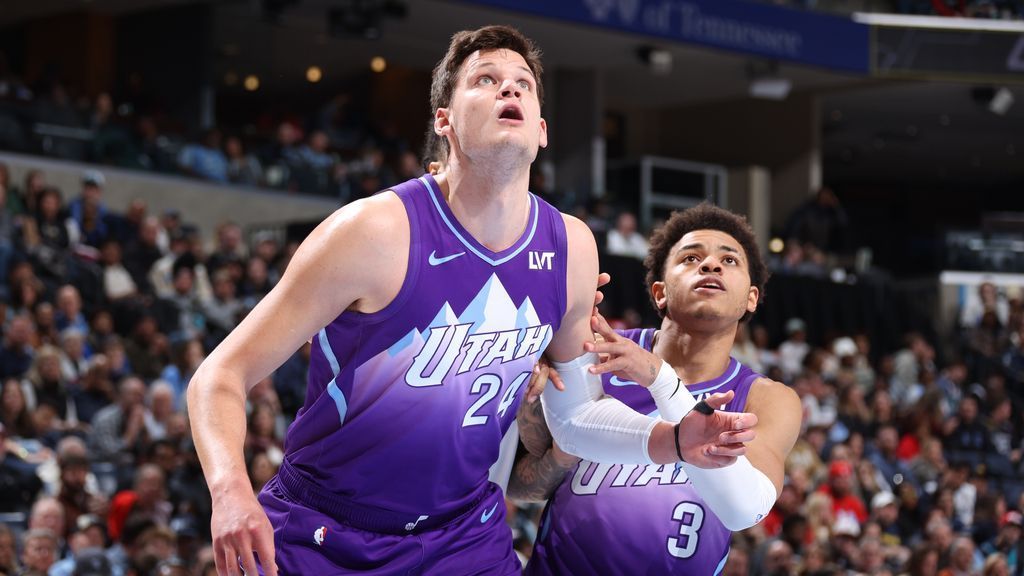
The Lakers completed a blockbuster trade for Walker Kessler on Wednesday, sending Utah four first-round assets—unprotected picks in 2031 and 2033 plus swaps in 2028 and 2030—in exchange for the Jazz's 7-foot-2 rim protector. Kessler signed a four-year, $130 million deal with a player option in year four, immediately becoming the anchor of Los Angeles's post-LeBron rebuild. The move signals a tectonic shift in how the organization intends to construct its supporting cast around Luka Doncic, who had specifically requested an "A-list center" to work alongside him.
Kessler's arrival addresses a structural weakness that plagued the Lakers last season: they ranked 29th in offensive rebounds per game, a gap that compounds when you're asking a perimeter-heavy offense to generate second-chance scoring. In 2024-25—his last fully healthy season—Kessler averaged 12.2 rebounds per game with an NBA-leading 4.6 offensive boards, a number that stands apart even among elite offensive rebounders. His 2.4 blocks per game rank second in the league since 2022-23, exceeded only by Victor Wembanyama. At 26, he slots into the timeline of Doncic's peak years. The full financial commitment—four years, $130M—plus the sacrifice of future draft capital underscores how seriously the front office views this pairing. Utah, meanwhile, had already crowded its frontcourt with Jaren Jackson Jr. and Jusuf Nurkic, making Kessler expendable despite his contract rejection (he turned down a five-year, $140M offer from the Jazz).
Along with Kessler, the Lakers signed three complementary wings: Sandro Mamukelashvili (four years, $52M), Quentin Grimes (four years, $60M), and Collin Sexton (two years, $19M). Mamukelashvili, a 27-year-old 6-foot-9 sharpshooter, shot 38.9% from three on 3.7 attempts for Toronto last season while averaging 11.2 points off the bench. Grimes averaged 13.3 points across 75 games for Philadelphia, thriving in a sixth-man role. Sexton contributed 15.4 points per game last season across Charlotte and Chicago. The signings signal a depth-over-star approach to filling out the rotation—no singular marquee free-agent signing, but rather a coalition of reliable secondary scorers and floor spacers.
From a prop lens, Kessler's arrival directly affects two critical Lakers offensive metrics. His offensive rebounding prowess means more second-chance opportunities, which will elevate the team's offensive efficiency and compress possessions—good for boosting pace-adjusted scoring lines when Kessler is on court. More mechanically, his rim-running threat in pick-and-roll actions gives Doncic a vertical finishing option he lacked, which should increase Doncic's assist volume in games where Kessler is healthy and on the floor. Expect Doncic's PRA prop to spike on nights Kessler plays; the two-man game becomes a more diverse attack vector. Conversely, Kessler's limited offensive range—he will rarely step outside the paint—means the Lakers cannot simply plug him in and expect the spacing to improve; the three-point shooting from Mamukelashvili and Grimes becomes load-bearing. Monitor early-season team total movement: if books initially price the Lakers at 115-117 points per game, that number should drift higher once Kessler's offensive glass production enters the model, but only if the wing shooters stay healthy and keep defenses honest. The risk is that Doncic's usage remains immense (he will still shoulder playmaking and shot creation), which could cap the assist gains in the 7.5-8.5 range rather than pushing above 9.
The future-pick sacrifice is the story beneath the story. Los Angeles gave Utah unprotected firsts in years when contention windows traditionally close—2031 and 2033 are five and seven years out—betting that Doncic and Kessler's timeline will produce playoff runs within the next two years. If the Lakers fall into rebuild mode by 2030, those picks become conveyable assets. If they contend, the picks become irrelevant footnotes. That binary outcome is already baked into the market; books will not know which timeline unfolds until we see actual games played. For prop players, the edge lies in short-term performance: Kessler's first 10 games will reveal his conditioning and pick-and-roll timing with Doncic. If he plays 30+ minutes and hits the 11+ rebound total in three of his first five starts, the Lakers' offensive rebounding rank will climb, and their pace-adjusted scoring will tick up. That's the information advantage the market will underprice on opening night.