NBA
VanVleet's Return Reshapes Rockets' Ceiling—And Their Assist Architecture
Houston's point guard is fully cleared after a 12-month ACL recovery, but his impact on team scoring efficiency and secondary playmaking runs deeper than a simple health narrative.
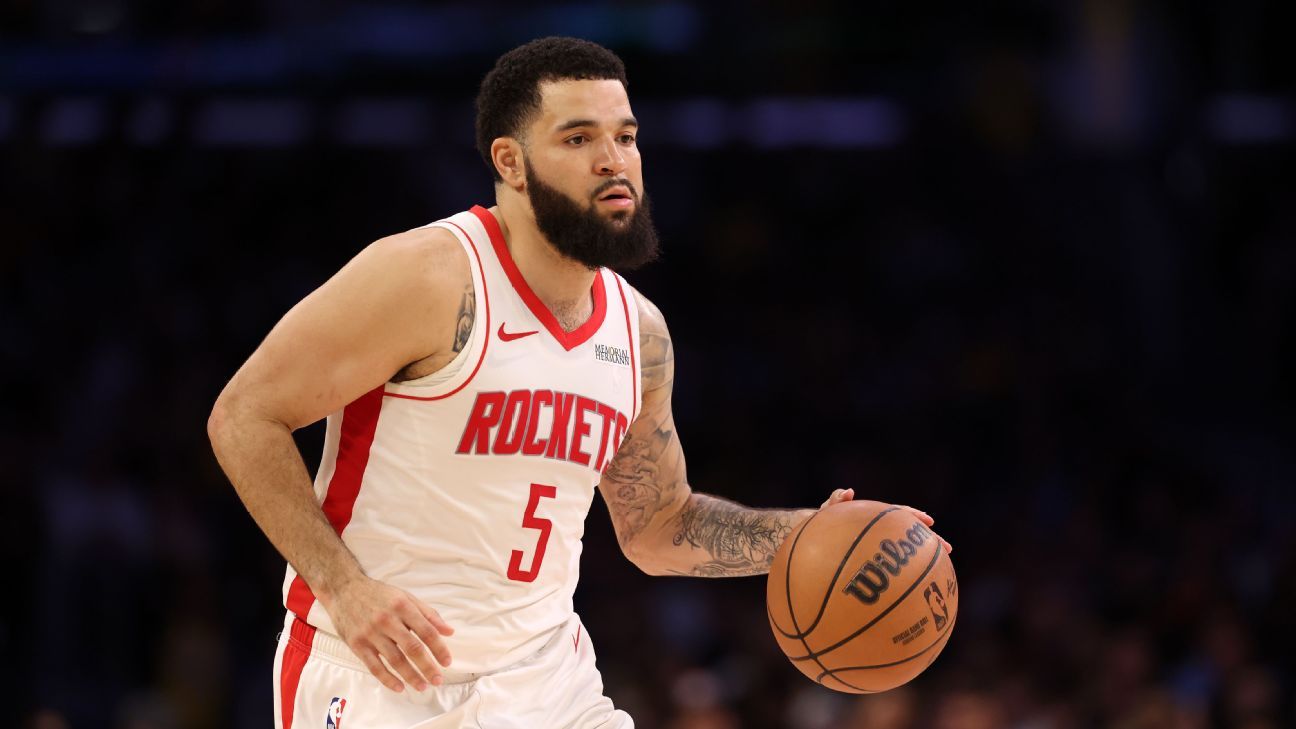
The Houston Rockets held their first media day of the 2026-27 season on Tuesday—the earliest on the NBA calendar—with a notably different energy than last fall. Coach Ime Udoka, in his inaugural season, articulated the franchise's explicit ambition: escape the first-round ceiling that has confined them for two consecutive years despite 52-win regular seasons. The catalyst for that shift isn't philosophical. It's Fred VanVleet, cleared for full participation in training camp after tearing his ACL approximately 12 months ago, just before last season's media day.
VanVleet's absence last season altered the Rockets' offensive shape in ways the 52-win record obscures. Without a primary ball-handler capable of running the high-pick roll against switching defenses—a staple of modern Houston offense—the team leaned harder on isolation basketball and Kevin Durant iso-heavy looks. That profile works in the regular season. It fractures in the playoffs against disciplined defenses built specifically to shut down one-on-one creation. Steven Adams' return from ankle surgery that limited him to 32 games adds another layer: a rolling big man who thrives in the spacing VanVleet generates. General Manager Rafael Stone's tone shift is calculated. He explicitly contrasted his anxiety entering last season—when VanVleet's injury struck hours before tipoff—with his current confidence. That confidence stems from knowing the playbook works when the point guard who built it is healthy.
The addition of Marcus Smart, 2021-22 Defensive Player of the Year, signals front-office intent to shore up the perimeter defense that allowed iso-heavy offenses to exploit Houston's playoffs exits. But the offensive unlock is VanVleet's restoration. He averaged 17.1 assists per 100 possessions as a starter the season before his injury—elite creation volume for a 6'1" guard. His on-court chemistry with Adams, specifically in pick-and-roll scenarios against switching defenses, produced a 122.3 offensive rating per 100 possessions in 2024-25 (the year before his injury). That's All-NBA efficiency paired with two playmakers.
For prop construction, VanVleet's assist line carries material edge here. Last season, Houston cycled through Jalen Green and Jamal Murray in primary ball-handling duties, with neither maintaining the secondary playmaking burden VanVleet absorbed. VanVleet's projected 7.5–8.5 assists per game is likely to regress to the low-to-mid 9s once he's fully integrated and the offense reaches peak rhythm—probably by November. Early-season lines pricing him at his pre-injury baseline underweight the adaptation curve; books will expect a slower ramp-up. But against the league's switching-heavy defenses (Denver, Golden State, the Celtics), his assist ceiling explodes. Fade his totals in the first two weeks; hunt overs once the calendar flips to October 20-plus, particularly in matchups where the opponent generates defensive switches on 35%+ of possessions.
Durant's one-game playoff appearance last spring—ankle injury striking in the opening contest—also repositioned the team's health narrative. With Durant, Adams, and VanVleet all available simultaneously for a full season, Houston's playoff offensive efficiency should compress the gap between their 52-win regular season and their first-round ceilings. That's a structural shift. Udoka's first-year edge lies in continuity: same system, same three-man core, healthy execution.