Rajaković Extension Signals Raptors' Championship Window—and Market Repricing
By Ty Whitney ·
Toronto's commitment to its first-round coach, paired with Kawhi Leonard's reported arrival, reshapes the team's competitive trajectory and the betting calculus around their 2026-27 ceiling.
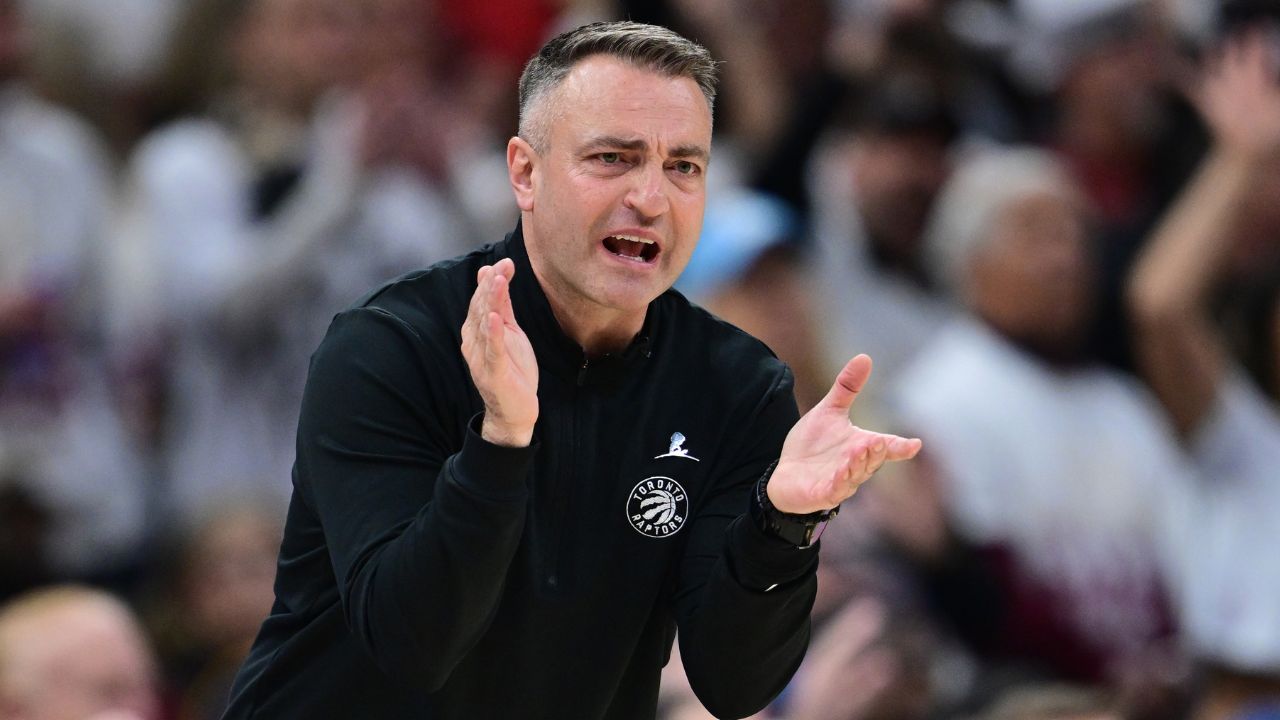
Darko Rajaković's multi-year extension with the Raptors, announced Thursday, is less about rewarding past performance and more about staking the franchise's next chapter on stability and continuity. The 47-year-old Serbian has grown the team's win total from 25 to 46 over three seasons—a 21-win improvement—and guided Toronto to its first playoff appearance under his watch last season before losing a seven-game series to Cleveland. That trajectory is linear and measurable. Keeping him in place signals confidence in the system, not complacency with the current roster.
The timing matters. Kawhi Leonard's reported trade from the Clippers arrives alongside this extension, creating a rare alignment: a coach entering his fourth season with a suddenly augmented core, no carousel of philosophical churn, and a front office (Bobby Webster received his own multi-year deal earlier in the off-season) synchronized around a singular vision. Rajaković's development philosophy has already proven durable across three coaching stops—Oklahoma City, Phoenix, Memphis—before landing the head role. His players defend with intensity and execute within structure. That's not flashy; it's sustainable.
For bettors, the extension erases one layer of organizational volatility. Coaching uncertainty is real currency in prop markets—it creates noise around player usage, closing lineups, and fourth-quarter decision-making. When a coach has a two-year horizon (likely remaining on his contract after a slow start), his late-game substitutions may reflect desperation. When he's anchored to a five-plus-year commitment alongside his GM, those moves reflect confidence in a system. Rajaković's defensive schemes, predicated on switching and perimeter-heavy coverage, will persist. His reliance on ball movement and role-player spacing won't vanish when Leonard arrives. That consistency is edge material: season-long assist totals, three-point volume, and team-pace projections become more predictable because the framework doesn't reset.
The reported Leonard trade also recontextualizes the Raptors' ceiling. A 46-win team becomes a title contender overnight—or at minimum, a 55-plus-win lock if health cooperates. That's the market catalyst: preseason win totals and playoff odds will see sharp movement before opening bell. Early-season moneylines and spreads against weaker competition may lag that adjustment for 48-72 hours. Additionally, Leonard's court fit with a possession-light, switching-heavy defense raises clear prop angles: his minutes load (will Rajaković lean on rest management?), his three-point attempts (does Leonard shoot more or fewer threes in a spacing-flexible system?), and team assist distribution (does Leonard operate as a volume scorer or as a distributor within structure?). Those are the questions Rajaković's retention helps answer—because continuity makes the coach's historical patterns the best available baseline.