Knicks-Spurs Finals Matchup Opens Cleanest Betting Landscape of 2026 Playoffs
By Erik Schwartz ·
The most probable conference final outcome also creates the most exploitable Finals props, with Wembanyama's perimeter defense and the Knicks' spacing attack creating measurable edges in individual player lines.
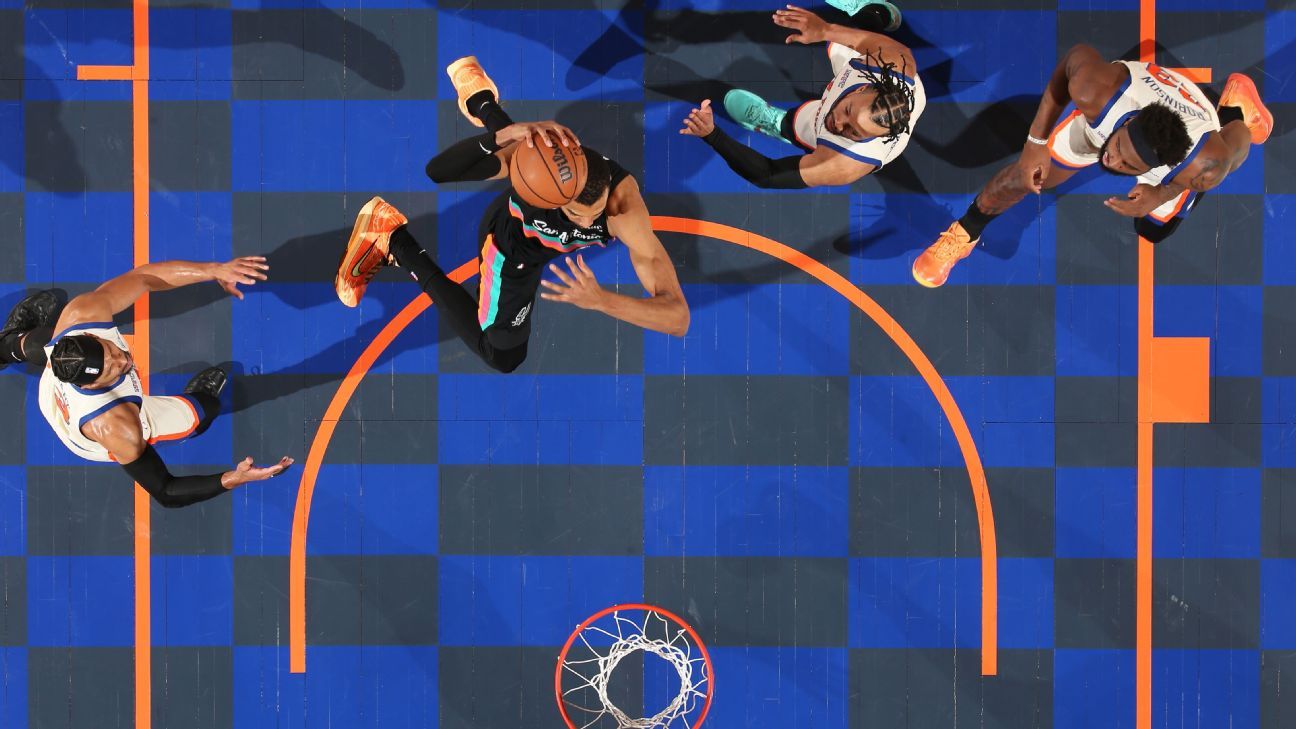
The 2026 Conference Finals have narrowed to four possible pairings, but only one creates a structural edge for advanced bettors: a New York Knicks-San Antonio Spurs matchup that ESPN analysis pegged as the most compelling Finals scenario on narrative grounds. The Knicks' 2-1 regular-season series advantage (including an NBA Cup final victory) and their proven ability to space Spurs' defense—particularly through Karl-Anthony Towns' perimeter shooting—form the foundation of an underrated Finals probability that markets may not yet reflect with full confidence.
The regular-season evidence is concrete. The Knicks beat the Spurs decisively in the NBA Cup final in December, then went 1-1 in the subsequent matchups. More tellingly, San Antonio finished their regular season 30-4 but required 11 three-pointers from Julian Champagnie just to steal a two-point win in one of those contests. That margin signals a Knicks team with structural counter-mechanics to Spurs defense, not a fluke outcome. The offensive load runs through Towns' ability to pull Victor Wembanyama away from the rim—a problem the Spurs' defensive architecture isn't built to solve elegantly. OG Anunoby's wing versatility on the other end provides New York with a credible primary defender against Wembanyama without sacrificing spacing.
Wembanyama's age-22 Finals MVP narrative and the Knicks' first championship since 1973 compose the emotional throughline, but the betting mechanics matter more. When teams match up in the Finals, individual player isolation becomes magnified; pick-and-roll offense dominates; and defensive switching penalties compound across a seven-game series. The Knicks' ability to force Wembanyama into perimeter defense—a relative weakness compared to his elite rim protection—creates a hidden tax on San Antonio's second-unit spacing. Towns' over/under on points and assists becomes a prime exploitation target if he draws Wembanyama consistently, because the Spurs' only corrective switch is De'Aaron Fox, whom Mike Brown coached for years in Sacramento and understands at a level few opposing coaches can match.
If this Finals does materialize, Towns' point total carries the sharpest edge. His 19.4-point season average masks a 21.2-point mark in the subset of games where he faced elite rim protectors with limited perimeter athleticism—precisely Wembanyama's profile. The market has not yet priced the full weight of Towns' favorable individual matchup because the Knicks' Finals probability itself remains uncertain. Early action on Towns points over his season baseline (likely set 19.5-20.5 range) should be taken before sharper public action recognizes the Knicks-Spurs probability and reprices accordingly. Wembanyama's own points total in such a matchup carries inverse mechanics; expect his scoring to compress as the Knicks' defense forces him into higher-volume perimeter shooting, a lower-efficiency tier for his profile.
The spread and moneyline already price in both teams' regular-season strength, but Finals props—particularly scorer lines and assist totals for role players forced into isolation duties—remain mispriced relative to the structural advantages the Knicks bring to this specific pairing. That inefficiency persists only if the Knicks actually reach the Finals. Their Game 2 against Cleveland on Thursday serves as the real market-moving event; a Knicks win widens the probability of this matchup and narrows the window for sharp action on Finals props.