Watson's Qualifying Offer Gamble: The Restricted Free Agent's Bet on His Own Growth
By Erik Schwartz ·
By turning down Denver's $70M extension to chase unrestricted free agency in 2027, Peyton Watson is betting his market value will improve faster than the Nuggets' willingness to pay.
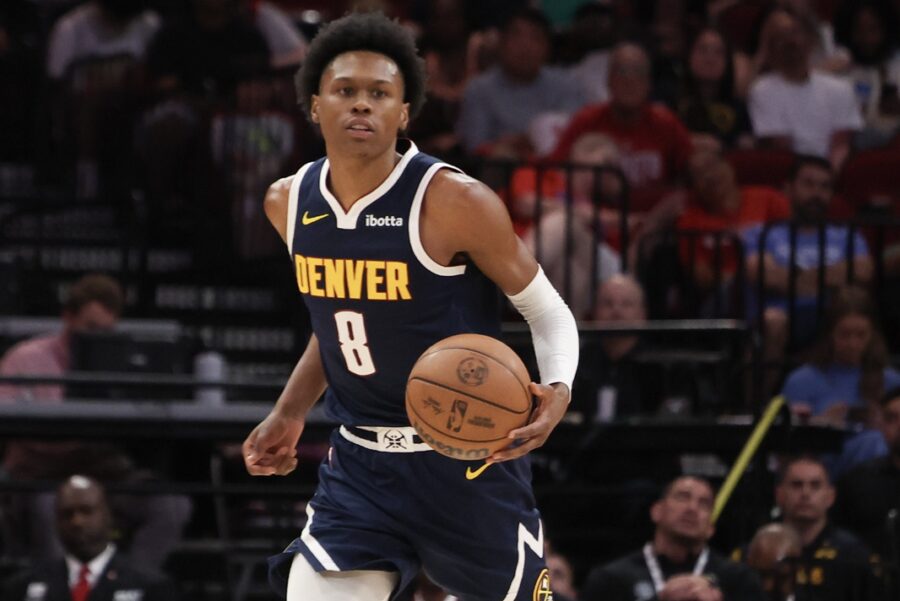
Peyton Watson is seriously considering accepting Denver's $6.5 million qualifying offer rather than signing a long-term deal, sources told Marc Stein. The move would keep Watson under contract through the 2026-27 season before he hits unrestricted free agency next summer. The Nuggets' initial extension offer reportedly hovered around $70 million over four years—a number Watson and his camp apparently viewed as insufficient given his trajectory and the evolving market for wing players his age and archetype.
This is a calculated rejection of guaranteed money in service of optionality. Watson, 23, has become a functional piece in Denver's rotation: a 6'8" wing who can defend multiple positions, knock down corner threes at a reasonable clip, and provide bench depth behind Jamal Murray and the Nuggets' core. Taking the QO doesn't signal distrust in Denver; it signals confidence that playing another season in the NBA's best organization—under Mike Malone, alongside Jokic and Caldwell-Pope—will increase his market value more than a four-year, $70M extension would lock in. The math assumes his three-point volume and efficiency, combined with defensive versatility, will command premium rates in July 2027's free agency when teams have cap space and urgency.
The risk calculus is stark. One serious injury wipes out the leverage entirely. A down shooting year—or reduced minutes if Denver's roster shifts—tanks his leverage before unrestricted free agency arrives. But the upside is equally clear: if Watson maintains his current trajectory, unrestricted free agency could fetch him $15M+ annually in a market where wing depth is perpetually short. The Nuggets' $70M offer likely represents their internal ceiling; accepting the QO and hitting the open market gives him exposure to teams with higher willingness to pay for his skill set.
For bettors tracking Denver's roster composition and bench production, Watson's decision carries weight. If he accepts the QO, the Nuggets enter 2026-27 knowing they have an expiring contract in Watson—meaning trade deadline optionality if the team pursues upgrades. That scenario increases the likelihood of bench rotation churn late in the season, which can suppress individual prop consistency. Conversely, if Watson signs an extension, Denver locks in its wing depth, creating more stable minutes and on-court pairings. The betting edge here isn't in prop volume on Watson himself (a 23-year-old reserve's scoring and assist totals are inherently volatile); it's in how his contract status shapes Denver's late-season behavior and trade-market positioning, which ripples into depth-chart stability for teammates.
Watson's choice also signals something about Denver's internal valuation: the front office refused to stretch to $80M+ for a player it drafted, meaning the Nuggets are already comfortable with his exit ramp. That's not damning, but it's worth noting for anyone tracking salary-cap flexibility and the organization's appetite to retain cost-controlled talent. If Watson hits unrestricted free agency next summer and receives overtures from rebuilding teams or playoff contenders with cap room, Denver will face a clear choice: match an offer or wave goodbye to a homegrown wing. The QO path is Watson saying he's confident Denver won't want to pay market rate—and that's a bet worth watching.