Spencer Jones to Thunder: Denver's Luxury Math Gets Messier
By Erik Schwartz ·
Denver faces a Sunday deadline to retain a playoff shooting specialist or let Oklahoma City poach a low-salary rotation piece as the Nuggets navigate deepening tax consequences.
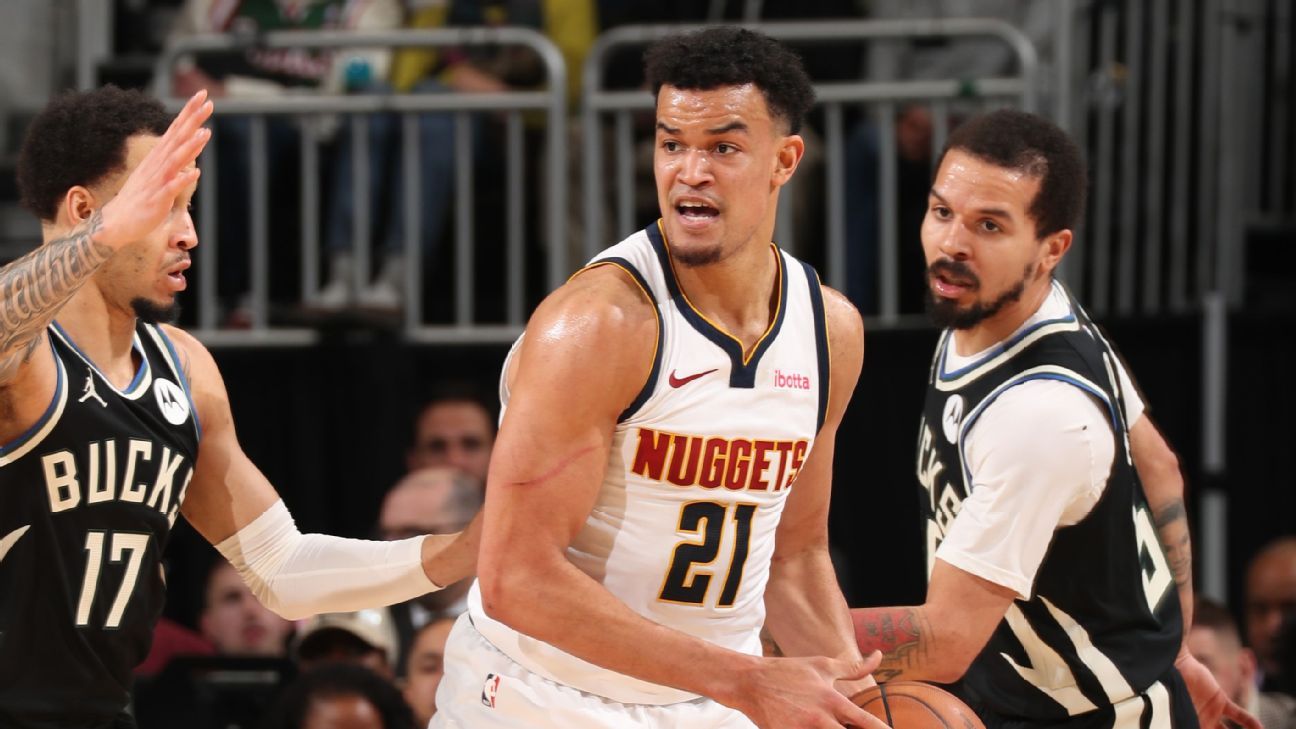
Spencer Jones agreed to a two-year, $12 million offer sheet with the Oklahoma City Thunder on Saturday, forcing Denver's hand with a 36-hour matching window that closes Sunday at 11:59 p.m. ET. The contract is fully guaranteed, making it a clean financial commitment for either franchise—and a straightforward decision tree for the Nuggets' front office.
Context matters here. Jones was a fixture in Denver's rotation last season, averaging 5.5 points and 3.3 rebounds across 64 games (37 starts). His playoff résumé is what caught OKC's attention: he shot 69.2% from three-point range in the postseason, an elite mark that validates his spacing value in a playoff rotation. At $6 million per year on a fully guaranteed deal, Jones represents the kind of low-mid-tier salary that Oklahoma City has been aggressive about in free agency—depth moves that don't strain cap flexibility but improve winning probability in October and June.
Denver's calculus is not about Jones's talent. It's about luxury tax exposure. The Nuggets are already navigating steep tax bills with Jokic, Murray, and their core intact. Every additional salary dollar compounds their bill at a punitive rate—roughly $1.50 in tax for every $1 in salary once you exceed the second apron. Losing Jones to a $12 million two-year sheet, painful as it is, might be the financial relief the front office needs. Watson's own restricted free agency situation adds pressure; Denver can't retain everyone on favorable terms. If they're forced to choose between matching Jones and preserving flexibility for Watson or other moves, letting him walk saves $12 million in direct salary plus the cascading tax consequence—call it $18 million in total hit avoided.
For betting purposes, this swap has modest but real implications for OKC's spacing and Denver's perimeter depth going into next season. If Denver matches—which remains a live possibility—their offensive three-point gravity remains intact, but their tax bill becomes even more punitive, potentially limiting trades or midseason acquisitions. If they decline, OKC gains a proven playoff three-point threat at below-market cost, marginally improving their shooting profile against switching defenses. The Thunder's offensive efficiency line and team total for 2026-27 could drift slightly higher if Jones lands there; Denver's total might compress if they cede him. However, neither effect is large enough to move lines substantially on its own. Jones is a rotation piece, not a star. The real edge is in team-context props—watching whether OKC's three-point volume and efficiency shift after the signing, and whether Denver's perimeter bench shooting dips if they let him go. That second-order move is where sharp action could emerge once rosters solidify and preseason data arrives.