The Knicks Found Cleveland's Defensive Weak Point—And the Market Hasn't Caught Up Yet
By Erik Schwartz ·
New York's historic fourth-quarter comeback in Game 1 wasn't chaos; it was surgical targeting of James Harden on pick-and-roll, a blueprint that rewires how to price Cavaliers defense going forward.
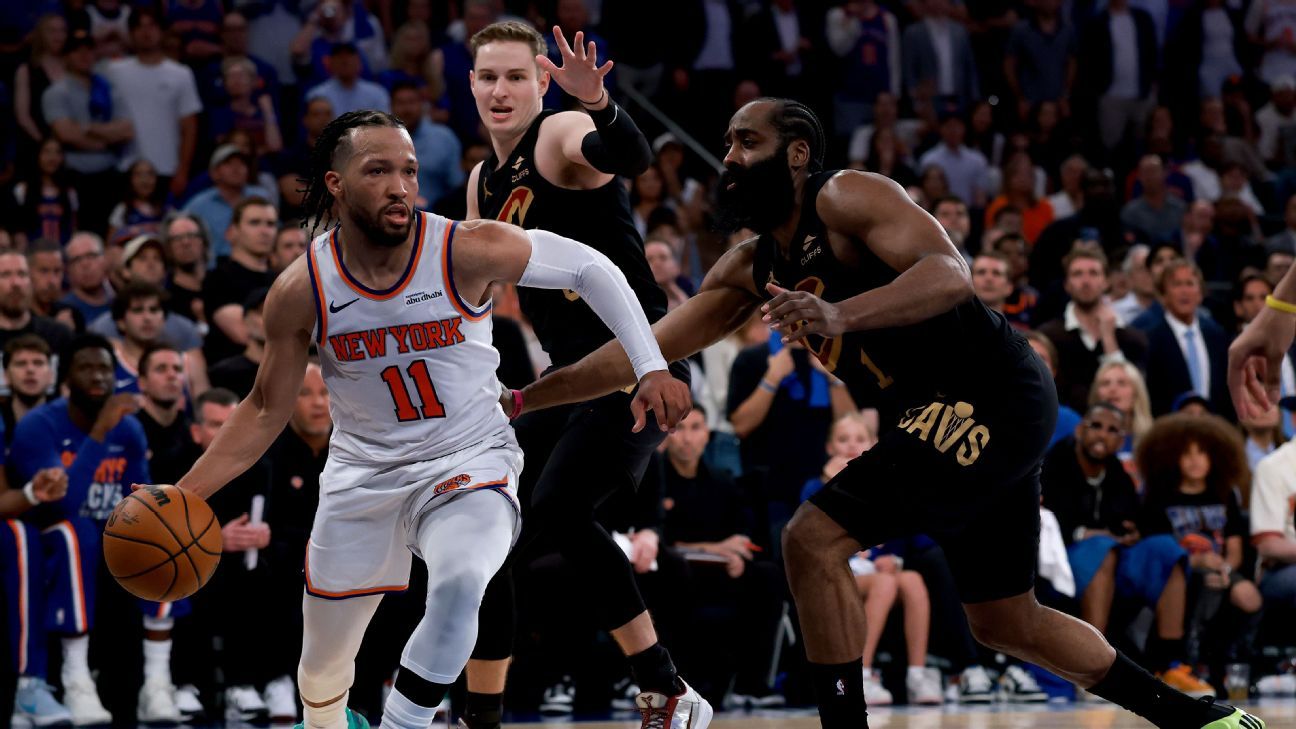
The Knicks ran 16 pick-and-roll screens on James Harden in the fourth quarter of Game 1—the most any guard had defended in a single playoff quarter since tracking began in 2013-14. That wasn't accident or desperation. Coach Mike Brown made no bones about it: New York was hunting. And for 10 consecutive possessions down the stretch, the Knicks forced switches that put Harden on Jalen Brunson, a matchup that generated 22 points off picks in the fourth quarter alone. The strategy worked because Harden, now 17 years into his career, no longer has the lateral quickness to fight through screens or the offensive instincts to recover defensively the way he did in Houston or Golden State. Brunson's pick-and-roll game—efficient, high-volume, unforgiving against larger, slower defenders—is built to exploit exactly this window.
What makes this tactically valuable isn't just that it worked once. The Knicks are deploying a principle that compounds: every time Cleveland adjusts by bringing help, the offense swings to unguarded shooters (Karl-Anthony Towns, Mikal Bridges, OG Anunoby). Every time Cleveland tightens the perimeter, Brunson attacks downhill. This isn't a scheme that relies on random shooting variance or Harden having an off night. It's a forcing mechanism that puts Cleveland's roster in a bind—either expose Harden or concede perimeter spacing. Both options hurt.
The precedent matters. In the tracking era, Stephen Curry was screened 10+ times in a quarter only 42 times; over half involved the Warriors, and Harden was often the one weaponizing that exact weakness when he played in Houston. The difference then was that Curry's teammates included Draymond Green, Kevin Durant, and Andre Iguodala to mask his defensive deficiencies. Harden, operating in a less star-laden Cavaliers core, has no such safety net. Cleveland's defense ranks among the league's best in the regular season, but pick-and-roll efficiency has been their structural vulnerability all season—they're in the 35th percentile in points allowed per possession on guards running P&R, per Synergy Sports.
For prop bettors, the implication cascades across multiple angles. Brunson's assist total becomes a rhythm play: when he gets space to operate the offense (which switching against Harden guarantees), his assist rate historically jumps to 8.5+ per game versus his season average of 7.4. Cleveland will likely adjust in Game 2 by either going smaller (accepting perimeter volume) or doubling earlier (accepting Brunson's playmaking). Neither adjustment erases the advantage; it only shifts where New York's offense generates points. The broader takeaway: any prop that bakes in "Cavaliers tight perimeter defense" should be faded, because that defense has a known breaking point, and the Knicks have now televised exactly where and how to break it.
Market pricing on Cavaliers team defense spreads and team total unders in Game 2 likely hasn't fully recalibrated yet. The news cycle moves fast; sharp money has already adjusted, but recreational limits and opening lines from Tuesday evening may still carry assumptions baked in from the regular season or Game 1's first three quarters. By Game 3 and beyond, expect Cleveland to either patch the leak or accept higher offensive totals. But in the 24-36 hours after this tape hits, there's real value in fading unders on Knicks team totals and overs on Brunson assists—not because the Knicks got hot, but because the Cavaliers have a documented structural hole that won't close without sacrificing something else.