Nets Add Playmaking Wing Jefferson in Randle Trade, Reshaping Frontcourt Depth
By Erik Schwartz ·
Brooklyn's acquisition of a four-year college player signals a shift toward longer developmental curves and secondary creation, complicating the path to minutes for both established veterans and lottery talent.
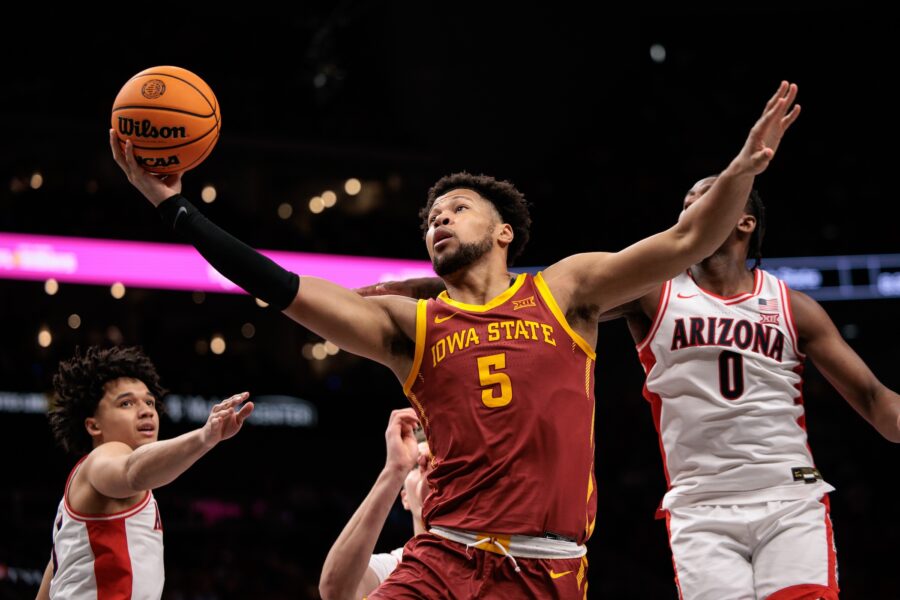
The Nets used the 28th overall pick to select Iowa State forward Joshua Jefferson, completing the first tangible piece of a three-team Julius Randle trade with Minnesota. The Timberwolves made the selection on Brooklyn's behalf, anchoring a deal that will funnel Randle into Brooklyn's roster once it becomes official. Jefferson—a 6'8" forward who developed through four college seasons, two at St. Mary's and two at Iowa State—finished his senior year averaging 16.4 points, 7.4 rebounds, 4.8 assists, and 1.6 steals in 30.9 minutes per game while connecting on 34.5 percent of his three-point attempts. He was a consensus All-America Second Team selection.
The profile here matters. Unlike one-and-done lottery picks or high school transitions, Jefferson's four-year arc reveals a player who acclimated slowly to elevated competition, added range late (the three-point shot materialized in year four), and developed playmaking instincts from the wing. That last skill—4.8 assists from a forward—positions him as a potential secondary creator, not a defensive specialist or spot-up shooter. The Nets are now stocked with backcourt ball-handlers (Mikel Brown Jr. at No. 6, guard depth from prior drafts), so Jefferson's value isn't as a primary initiator but as a wing who can move the ball and occupy flexible minutes.
Here's where the roster math becomes tight. Randle arrives as an established 24-25 PPG scorer and rebounder. Michael Porter Jr. holds down a wing spot. And now Jefferson enters a pipeline with seven first-round picks across the last two drafts competing for playing time. The Nets are building for versatility, not immediate impact. Jefferson will need to prove NBA athleticism and perimeter defense to carve out regular minutes—a process that typically unfolds over a full season or longer for college seniors. His assist rate in college (4.8 APG on a Cyclones team) will not translate directly; he'll be running actions in pick-and-roll coverings and spot-starting scenarios, not orchestrating half-court sets.
From a betting lens, this move tilts Brooklyn's player prop environment toward volatility and usage compression over the next 12 months. Randle's scoring line will anchor the Nets' offensive load, but Jefferson's development introduces roster flexibility that lowers predictability in role distribution. If you're buying into Randle's scoring floors (25+ PPG range) as a centerpiece, the addition of a secondary creator capable of 10-12 PPG off the bench is a stabilizing force—the Nets won't rely on Randle to create for everyone. Conversely, if Jefferson accelerates his adjustment and earns 25+ MPG faster than typical for a college senior, his assist projection (3.5-4.5 APG in a reserve role) could carry early-season intrigue. The caution: college playmakers often produce assists in volume-based systems; the NBA's half-court spacing and switching mechanics typically suppress those totals by 1-2 per game for wings in transition. Jefferson's 4.8 APG in college is his ceiling in an optimal NBA role, not his floor.