Towns, Bridges, Wembanyama Drive Game 3 Props as Knicks Host Spurs in Finals Tipping Point
By Erik Schwartz ·
The Finals are evenly poised heading into Monday's Game 3, and the offensive load distribution will determine which players clear their lines.
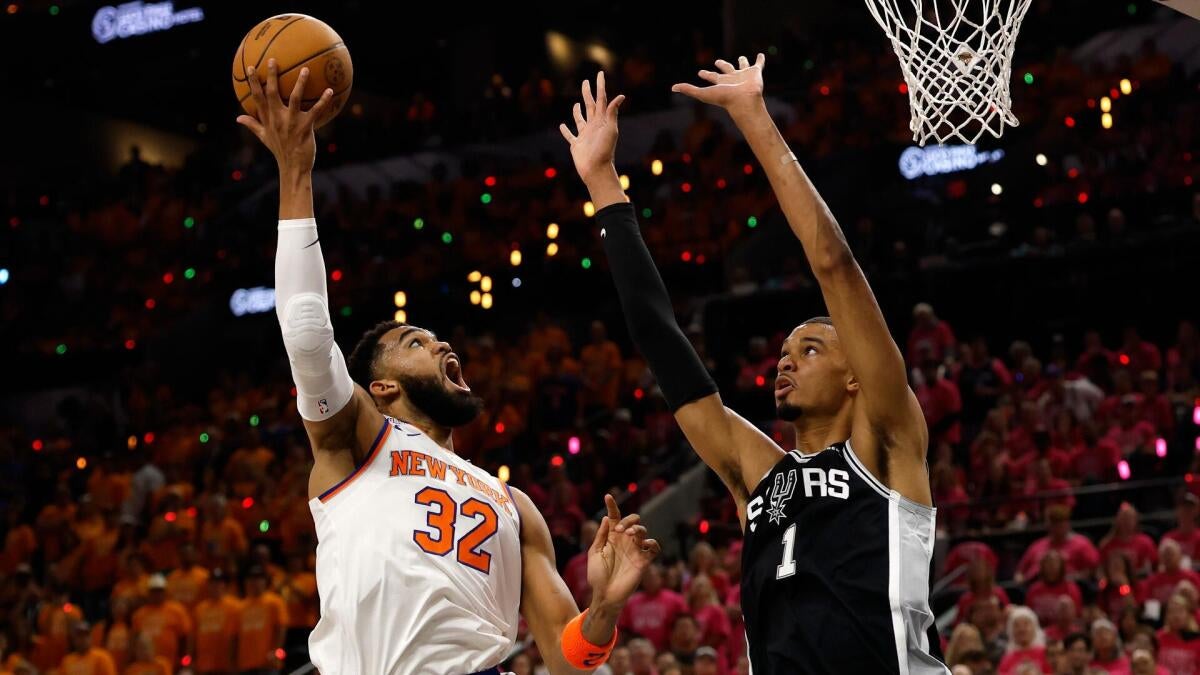
The Knicks host the Spurs at 8:30 p.m. ET on Monday in Game 3 of the NBA Finals, with San Antonio trailing 0-2 in the series. The matchup shapes up as a pivotal moment for both offenses, and three player props stand out as exploitable.
Karl-Anthony Towns has been the engine in New York's first two games, posting 19.5 ppg, 12.5 rpg, and 4.0 apg through the series. His Game 2 performance—21 points and 13 rebounds—validates what his regular-season profile already suggested: he's a versatile scoring threat with positional versatility. The over/under on his total points sits at 17.5. The mechanism here is volume and efficiency. Towns averaged 20.1 ppg in the regular season and the SportsLine projection model forecasts 19.6 ppg for Game 3. Critically, his performance isn't luck or variance—it's the natural extension of a player capable of winning matchups on both ends. Against a Spurs defense that has struggled to contain multi-dimensional big men in the postseason, Towns will remain the focal point of the Knicks' halfcourt offense. The over at 17.5 reflects market skepticism born from early-series fatigue assumptions rather than actual defensive adjustments.
Mikal Bridges presents a different profile: a role player entering a favorable matchup after finding consistency late in the season. After an underwhelming Game 1, Bridges erupted for 20 points on 8-of-13 shooting in Game 2. He's now cleared the 13.5-point line in nine of his last eleven games dating back to the Hawks series—a substantial track record. The Spurs ranked in the bottom five defensively against mid-range jumpers during the regular season, and Bridges' shot diet tilts heavily toward that range. This is a durable edge because it combines recent form (Bridges' late-season arc), a consistent role (he's locked into heavy fourth-quarter minutes in this series), and a specific defensive vulnerability in the opposing team's scheme. The 13.5 line underprices his probability of success.
Victor Wembanyama operates under different pressure. Down 0-2 and facing potential elimination in his first Finals appearance, the Spurs will funnel more volume through him, whether via touches in isolation or in pick-and-roll situations. His Game 2 line—29 points, 9 rebounds for a 38-point-plus-rebound total—sits above the posted 38.5 line. The SportsLine model projects 39.7 combined, suggesting the market has underestimated how much offensive responsibility will shift to him as San Antonio tightens its rotation. Wembanyama has also logged double-digit rebounds in 10 postseason games already, meaning the rebound portion of this prop is not a reach. The edge here is opportunity: when teams face elimination, role allocation shifts visibly, and Wembanyama's defensive intensity combined with increased offensive touches creates a floor effect around this line.
All three props share a common thread: they're built on durable player profiles and matchup characteristics, not noise from a single outlier game. Towns' consistency, Bridges' late-season resurgence paired with Spurs' mid-range weakness, and Wembanyama's forced volume spike under elimination pressure each survive reasonable line movement. The market prices these props as if each player is regressing to a worse mean, when the actual mechanics suggest progression or stability instead.