Mikal Bridges' Playoff Metamorphosis Is Reshaping Knicks Scoring Math
By Erik Schwartz ·
From a scoreless Game 3 to historic efficiency over 10 straight wins, Bridges' shift toward attacking the paint is no variance spike—it's a sustainable structural change that has concrete prop implications.
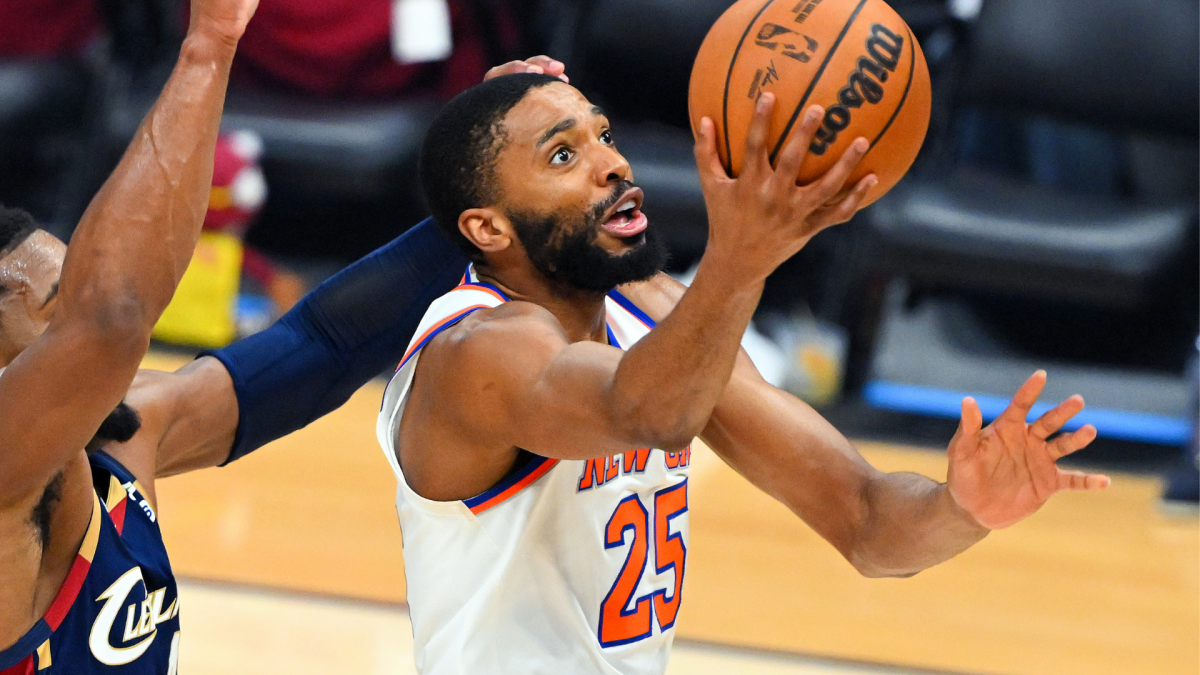
Mikal Bridges scored zero points in Game 3 of the Knicks' first-round series against Atlanta. That moment, combined with the five-pick acquisition cost that brought him to New York, looked like organizational miscalculation. Ten games later—three to finish the Hawks, four in a Philadelphia sweep, and now three of the Eastern Conference Finals against Cleveland—that narrative has inverted completely. The Knicks are one win from the Finals. Bridges is a primary reason why.
The statistical record is unambiguous. Over his last eight games, Bridges has averaged 19.1 points on 69% FG, 48% from three, and 100% from the free-throw line. Per available historical analysis, no player has ever maintained those shooting splits while averaging 15+ PPG over an eight-game playoff span. Across the full 10-game winning streak, he has shot at least 50% from the field in each game—a feat matched only by LeBron James in 2017. On Saturday against Cleveland, he registered 22 points on 11-of-15 shooting (73.3% TS), adding six rebounds, three steals, and two blocks. This is not noise. This is a player operating at a level that transcends normal variance.
What makes this run analytically interesting—beyond the raw numbers—is the mechanism driving it. Bridges has fundamentally restructured his shot diet. In the regular season, he attempted 5.1 three-pointers per game. In the playoffs, that rate has compressed to under three. His volume has instead migrated toward the rim and mid-range: 89.7% conversion rate inside the restricted area (35-of-39), 61.7% in the paint (13-of-21), 56.3% from mid-range (9-of-16). Game tape reveals the shift is deliberate, not accidental. He's probing into the paint off screens rather than resetting to the perimeter. He's hunting floaters and bank shots off hesitation moves. He's sprinting in transition rather than settling. This is not a player waiting for threes to fall; it's a player who has identified where the Knicks' offense finds him most efficient and is hunting those spots relentlessly.
For prop bettors, the distinction matters immensely. A 10-game efficiency spike built on a single outlier performance (one historic shooting night, then reversion) typically evaporates within 48-72 hours as the market adjusts. But Bridges' edge is structural: it's rooted in a repeatable approach that the Knicks are enabling and that opposing defenses haven't solved. The Cavaliers' scheme didn't shut it down on Saturday. Neither did Philadelphia's switching defense in the sweep. This pattern has survived multiple defensive systems over three playoff series. His assists remain modest (2.9 per game in the eight-game window), so combo props that require playmaking contribution carry less upside. But his points and shooting-efficiency combinations—props that ask simply whether Bridges will score in a particular range or hit a certain FG% threshold—are becoming underpriced relative to the causal reality of his approach. The market may still be anchoring to his regular-season usage (14.5 PPG) rather than recognizing that the playoff environment and the Knicks' offensive structure have unlocked a more aggressive, higher-volume version. If Bridges plays Game 4, his point total should be priced as a 19-22 PPG player operating at 60%+ TS, not a 15-17 PPG player on average efficiency.
The Knicks are one win from the Finals for the first time in 27 years, and Bridges is one of the architects of that run. The early-playoffs narrative—a five-pick acquisition that looked questionable—has been replaced by something rarer: a player who identified a weakness in his own approach and exploited it at playoff intensity. That kind of agency and refinement doesn't vanish in Game 4.