Watson's Five-Year Nuggets Deal Opens Sign-and-Trade Window
By Erik Schwartz ·
Denver's $70M offer to Peyton Watson reframes his restricted free agency and surfaces alternative bidding routes that could reshape his market.
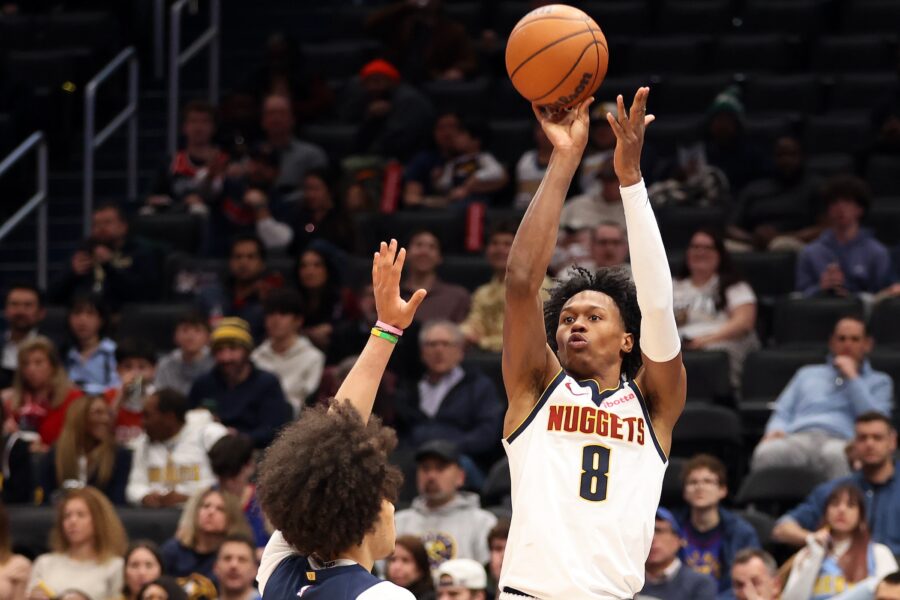
The Nuggets' restricted free agent offer to Peyton Watson sits at $70 million over five years—$14 million AAV—per Tony Jones of The Athletic, a correction to earlier reporting that had pegged the deal at four years. That structure matters because it changes Watson's leverage calculus and opens the door to sign-and-trade scenarios that reshape where he lands.
Watson, 23, was a lottery pick in 2023 and has developed into a switchable wing defender capable of spacing the floor. He averaged 5.2 points on 37% from three last season in a limited bench role. For the Nuggets, extending him at $14M AAV keeps salary flexibility intact while Denver prioritizes retaining Jamal Murray and Nikola Jokic. The five-year term also suggests Denver views Watson as part of the long-term core, not a short-term rental—a valuation signal worth noting.
But the math invites outside teams to circle. A rival equipped with the full $15 million mid-level exception could structure a competing offer—say, three years and $47 million with a player option in year three—that front-loads cash and preserves Watson's path to unrestricted free agency sooner. That structure gives Watson $31 million guaranteed over two years before his option decision, materially more certain than Denver's $28 million over the same window. Teams with cap room but no star power (or those seeking a defensive complementary wing at reasonable cost) have real leverage here. Denver can match any offer sheet, but the choice to accept a five-year, $14M deal from the Nuggets versus a three-year, backloaded bid from a contender becomes a player-agency calculation about optionality and market timing.
From a roster-construction angle, Watson's availability via sign-and-trade—should he sign elsewhere and Denver declines to match—could function as acquisition currency for contenders looking to move salary. A team acquiring Watson in a deal could package him alongside picks or younger assets to facilitate a midseason upgrade without hard-capping itself. That scenario remains speculative until an offer sheet lands, but the five-year Nuggets frame suggests Watson's agent is shopping around rather than accepting Denver's initial opening.
For betting purposes, Watson's resolution impacts Denver's bench depth and spacing. If he re-signs with the Nuggets, their bench scoring floor stays steady. If he signs elsewhere, the Nuggets' second-unit efficiency erodes, which could nudge their team total under-overs downward depending on matchup. His 5.2 PPG doesn't move entire game totals, but in tight playoff-series contexts where bench production tilts rest-of-the-floor variance, Watson's destination carries downstream effects on team prop pricing.