Bufkin's Summer League Spark Lands Him in New Orleans—But Don't Expect Consistent Minutes
By PropBetEdge Editorial Team ·
A three-game Las Vegas performance earned Kobe Bufkin a one-year Pelicans deal, yet his path to meaningful backcourt minutes remains narrow and conditional.
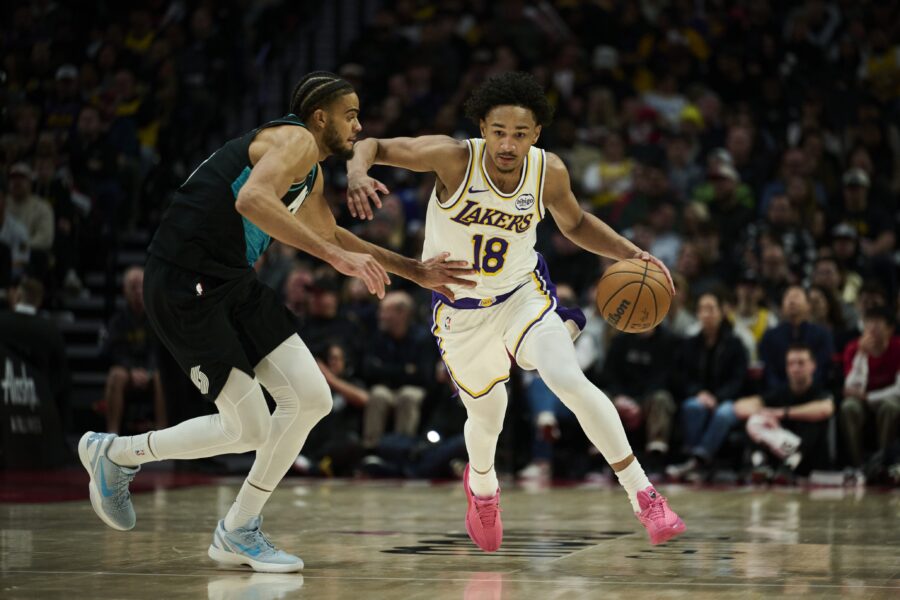
Kobe Bufkin signed a one-year contract with the New Orleans Pelicans on Friday, capping a summer league audition that positioned him for another NBA opportunity. The 22-year-old guard posted 21.3 points, 5.3 rebounds, and 3.0 assists across three games in Las Vegas—eye-catching volume that translated into a deal after spending last season on the margins of the Lakers' rotation.
Context matters here. Bufkin's 2025-26 campaign with Los Angeles was a cautionary tale: he appeared in 16 games after signing a 10-day contract in mid-January, converting that into a standard deal by early February, only to be waived April 10 as the regular season wound down. His actual NBA impact was negligible—2.9 points in 7.4 minutes per night on 30% shooting and a brutal 19.2% from three. Summer league numbers are built on different quality of opposition and usage patterns; that 21.3-point average came against reserve-heavy lineups with minimal defensive cohesion. The gap between summer success and regular-season viability is rarely smaller than it appears.
New Orleans has legitimate depth concerns in its backcourt rotation, which creates a narrow lane for Bufkin's opportunity. The Pelicans' investment in a one-year contract signals they view him as a development gamble with upside rather than a rotation lock. He'll compete for bench minutes alongside whatever veteran depth the team assembles, and his shooting percentage against NBA-caliber perimeter defense will be the decisive metric. For bettors, the real question is whether Bufkin's summer league efficiency translates to a meaningful role or whether he becomes another end-of-bench rotational casualty—a designation that would limit his prop relevance to spot appearances or garbage-time blowouts.
From a New Orleans offensive perspective, Bufkin's ceiling role would be as a secondary ball-handler off the bench in short bursts. His summer league assist numbers (3.0 per game) are inflated by unlimited offensive creation; in an NBA context where he's likely to handle the ball 40-50% of possessions if active, that rate will compress sharply. His rebounding (5.3 in summer) also benefits from low-rim protection. Any prop interest in Bufkin relies on him earning sustained rotation minutes—a condition that depends entirely on performance against NBA competition and injuries ahead of him in the depth chart. Until he logs consistent regular-season minutes over multiple weeks, single-game props carry too much variance to exploit as a strategy.
The Pelicans' one-year structure also telegraphs their patience ceiling. This is an evaluation contract, not a commitment to development. If Bufkin doesn't demonstrate NBA-viable shooting and decision-making within the first month of regular season play, his minutes will evaporate. Bettors should treat Bufkin props as a fade until his role solidifies and he establishes a floor of 15+ minutes per game over a three-to-five game sample. Early-season under props on his point totals (if they appear) will likely have value as the market prices in summer league momentum he hasn't yet earned against first-unit defense.