Brunson's Game 1 explosion sets a ceiling the Spurs must defend in Finals Game 2
By Ty Whitney ·
New York's offensive template in San Antonio—high-volume looks for its lead guard—worked once; the Spurs' adjustment window is 24 hours, and it will determine whether this series tilts toward Manhattan.
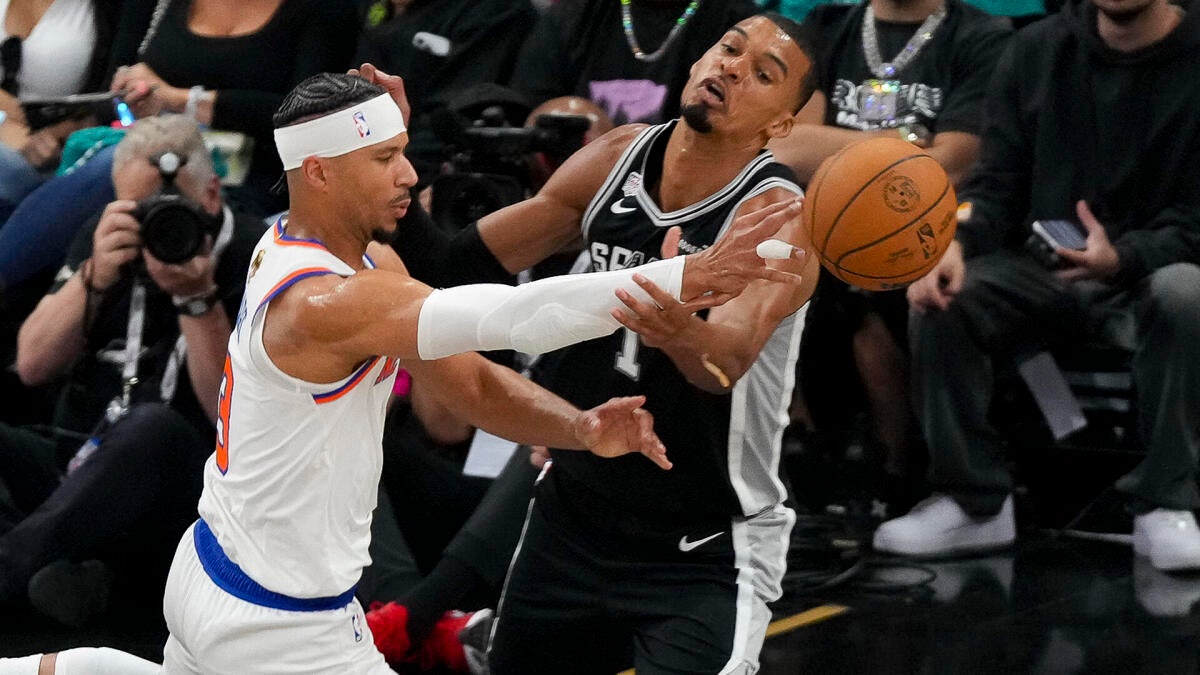
Jalen Brunson posted 30 points in the Knicks' Game 1 victory over San Antonio, a statement that reframed the 2026 Finals before it truly began. The Spurs, favored by 5.5 points at FanDuel for Game 2 on Friday, must answer a straightforward question: how much of Brunson's offensive workload was a one-time peak, and how much was exploitable design?
The Knicks' offense in Game 1 ran almost entirely through Brunson in pick-and-roll. The Spurs' rim-protection scheme—anchored around Victor Wembanyama—was designed to funnel drives and create passing lanes, not to wall off a perimeter scorer operating with the ball in his hands for 30+ possessions. Brunson, averaging 18.4 points per game during the regular season, found space in those gaps. Game 1's final score was 200 combined points, well below the 214.5-point total for Friday night. That under-hit result carries a trap signal: four of the Knicks' final six regular-season games cleared the total, and the two teams combined to allow 219 points per game defensively while scoring 236.6 ppg—both well above Friday's number. The frame matters. Game 1 was an outlier in pace and efficiency relative to season trends, not a baseline.
The Spurs' offensive projection centers on Wembanyama generating 29 points across six teammates reaching double figures. That math—six scorers in double figures—assumes the Knicks' defense stays spread and reactive rather than tightening in a contain-Brunson shell. If New York pivots to funnel more possessions away from its primary initiator, the Spurs' secondary scorers face tighter windows. Conversely, if the Knicks maintain Game 1's perimeter-heavy attack, Brunson's 25-point projection may understate his usage: a 30-point repeat is well within variance for a player in rhythm against a defense that showed one hand first.
The model's over call on 214.5 rests on the assumption that season-long offensive profiles override a single-game defensive setup. That's mechanically sound—teams do revert to seasonal scoring rates over series length—but it ignores the lag time inherent in live series adjustment. The Spurs have 24 hours to implement a Brunson cage; the Knicks have 24 hours to counter it. Whichever staff executes the adjustment first gains Friday's edge. Taking the over at 214.5 assumes the Knicks' Game 1 offensive template persists and Wembanyama's six-scorer projection holds. But if the Spurs compress their perimeter D and force Brunson into more ball-movement, the total could stall closer to Game 1's 200-point marker. The line already priced in the season-long regression; it did not price in the possibility that one game's scheme adjustment cascades into a lower-scoring Game 2.
Brunson's 25-point Game 2 projection is the hinge. If he posts 28-30 (in line with his Game 1), the over lands easily. If the Spurs' adjustment holds him to 20-22 and force the Knicks into a four-scorers-in-double-figures game instead of five, the under becomes the safer lane. The market has already moved 0.5 points in favor of San Antonio from the game's opening; it will move another full point if sharp action hammers the under overnight. Early over bets are a pure bet on Brunson repeating his Game 1 usage and the Spurs' defense staying unchanged. That's a one-game recency trap unless you believe the Knicks' staff has zero adjustment of their own in store.