Wembanyama's Paint Pivot Resets the Finals: Why the Spurs' Game 3 Adjustment Matters for Game 4
By PropBetEdge Editorial Team ·
San Antonio cracked the Knicks' perimeter defense by moving Wembanyama into the dunker's spot; if the adjustment sticks, New York's rim protection becomes the series fulcrum.
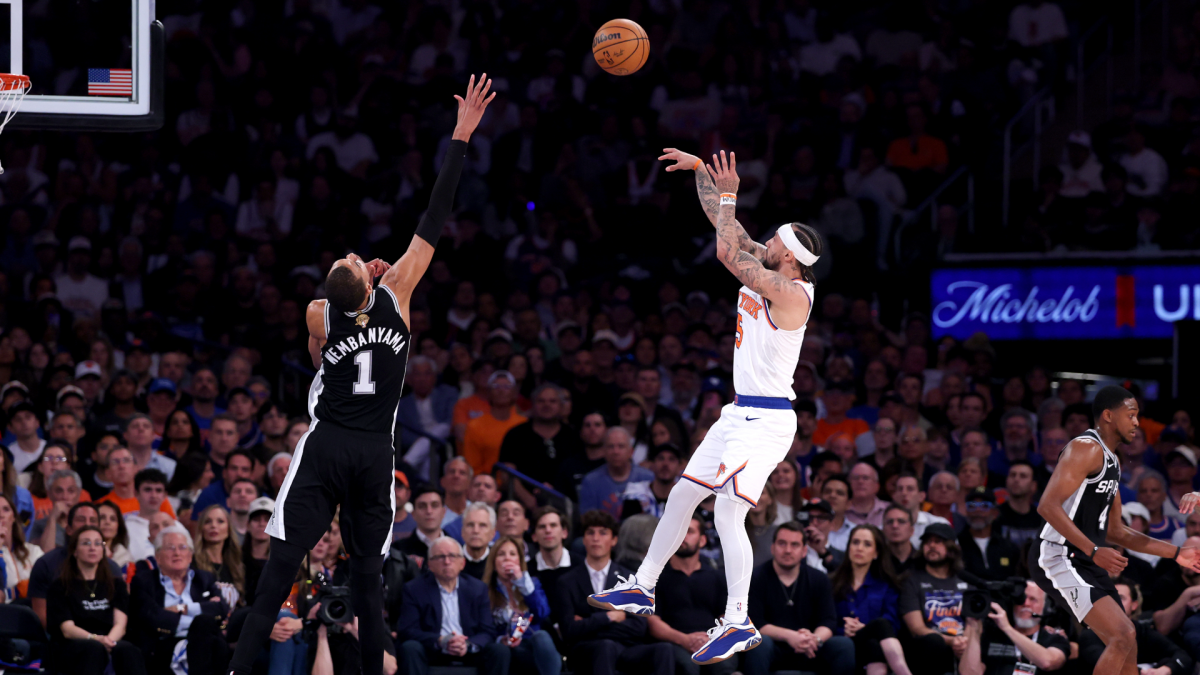
The Spurs walked out of Madison Square Garden on Monday with a Game 3 steal, and they did it by solving a problem that had plagued them for 144 minutes: what to do with Victor Wembanyama when Karl-Anthony Towns can mirror him on the perimeter. San Antonio's answer was structural. Instead of chasing KAT around the three-point line, the Spurs posted Wembanyama in the dunker's spot—the short corner or mid-post area on the weak side—where his 7-foot-4 frame became a vertical wall that Towns, for all his defensive effort, could not credibly contest. Wembanyama's aggression spiked as a result, and the Knicks' paint defense fractured in crunch time when it mattered most.
What makes this adjustment dangerous heading into Game 4 is not just Wembanyama's scoring upside—though a 7-footer getting deep post touches against a perimeter-oriented defender always projects to points. It's that the adjustment targets a structural weakness the Knicks have yet to address. Towns is a versatile defender, but he is also a perimeter player at heart; his center-of-gravity sits higher than a traditional big, and when Wembanyama operates from the dunker's spot or mid-post with a running start, Towns becomes a liability rather than a solution. The Knicks could counter by bringing Julius Randle or another interior defender to the weak side, but that risks leaving the perimeter open for Stephon Castle or Chris Paul to operate. The adjustment is clean because it doesn't require the Spurs to break rhythm—it simply asks them to run their offense differently.
The Knicks' response on Monday was predictable and telling: turnovers, missed open threes, and a creeping sense of frustration. Those are symptoms of a team forced to improvise on defense rather than execute a plan. If the Spurs repeat this formula—Wembanyama in the dunker's spot, Castle attacking mismatches in transition, and their defense staying locked in on Brunson—the Knicks face a choice: overhaul their defensive scheme between games, or accept that their lead shrinks to 2-2 heading to San Antonio. Neither option is comfortable for a team that entered this series as favorites.
From a prop perspective, this adjustment tilts the leverage in Wembanyama's scoring line. In Games 1 and 2, he took 16 and 14 field-goal attempts respectively; in Game 3, that number jumped to 21, and his efficiency improved because the looks were higher-percentage. The Knicks' total points allowed in the third and fourth quarters of Game 3 were the lowest of the series, driven largely by San Antonio's execution in the paint. If this pattern holds in Game 4, Wembanyama's over on his points line becomes more attractive, particularly if it's set at his series average or lower. Equally worth monitoring: the Spurs' team total. They scored 108 points on Monday without Chris Paul shooting efficiently (2-for-9 from three). If Castle or Paul stabilizes from range—and Game 4 odds suggest the Knicks defense will be even more focused on the paint—Spurs team totals in the 106-108 range offer value on the over against a Knicks offense that, for all its firepower, has been inconsistent in third and fourth quarters across this series.