Brunson's Fourth-Quarter Takeover Reshapes Knicks Ceiling—and Next Game Expectations
By Erik Schwartz ·
A 22-point fourth-quarter deficit erased on the back of Jalen Brunson's relentless attacking reveals both a championship-caliber closer and a team composition that may hinge on isolation scoring when the shot falls.
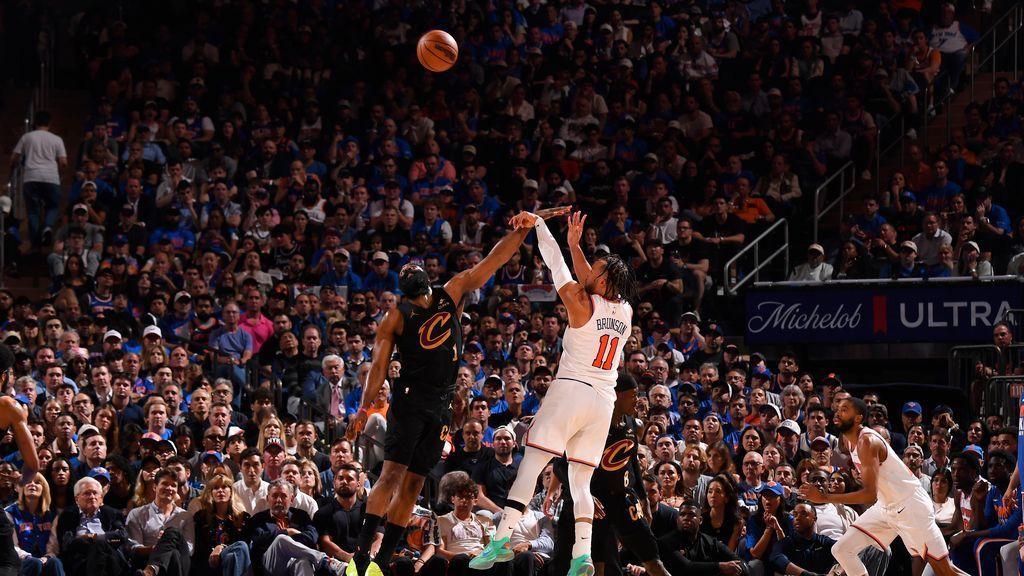
The Knicks trailed 93-71 with 7:52 remaining in Game 1 of the Eastern Conference Finals. By the end of regulation, they were knotted at 101. Jalen Brunson finished with 38 points, methodically attacking James Harden on switches and generating the offensive rhythm that had eluded New York through three quarters of rust-laden basketball. The Knicks won 115-104 in overtime, claiming the second-biggest fourth-quarter playoff comeback in 30 years and moving within three wins of their first Finals berth since 1999.
What happened in those final eight minutes matters less for its drama than for what it exposes. The Knicks had dominated Atlanta and Philadelphia by a combined 194 points through 10 playoff games—the largest margin in any team's first 10 postseason games on record. But nine days of rest before facing Cleveland produced a listless first 40 minutes: 4 of 23 from three through three quarters, a slow fourth-quarter start, and an offense that looked unmoored without the rhythm that carried them past the 76ers. The Cavaliers, meanwhile, had Mitchell scoring 29 and were executing in transition and halfcourt sets. Then Brunson decided isolation was the answer, attacking downhill against smaller defenders and generating either buckets or kickouts that sparked an 18-1 run. It worked because Cleveland's perimeter defense tightened without the personnel flexibility to hide on the switches Brunson kept forcing.
The larger question for Game 2 and beyond: is this a repeatable edge or a one-night salvation built on Brunson's individual brilliance and Cavaliers' fourth-quarter execution collapse? The Knicks have thrived on balanced offensive flow—Brunson's playmaking into role-player spot-ups, Mikal Bridges' transition scoring, OG Anunoby's two-way flexibility. When Bridges added only 18 points and Anunoby returned but struggled early (finishing with 13), the Knicks' offensive geometry compressed. Brunson isolation scoring at 38 points on 60% shooting (on heavy volume down the stretch) is not a sustainable offensive model, even against a Cavaliers team that looked soft in crunch time.
For bettors, the immediate angle lies in Game 2's pricing. Books will likely inflate Knicks team total and Brunson scoring props based on a 38-point, OT-win narrative—recency bias applied to a team that had not played in nine days and faced a defensive scheme that will adjust. Brunson's isolation effectiveness against Harden switches is real, but the Cavaliers will likely play tighter rotations and switch less aggressively next time. More important: the Knicks' three-point shooting (4 of 23 through three quarters Tuesday) will almost certainly improve, meaning Brunson's offensive load should decrease as role players find rhythm. Game 1 was variance-heavy; Game 2 pricing may not reflect the reversion.
The bet is not to fade Brunson's ability—he showed championship-level aggression and execution in crunch time. The bet is to recognize that Game 2 totals and Brunson points props will likely overcorrect upward off a single 38-point performance with the game's variance (late deficit, overtime, rust context) baked into the line. Lean unders on both Knicks team total and Brunson 35+ points in the 24-48 hour window before Game 2, but expect the market to tighten as sharps recognize the unsustainability of Tuesday's offensive isolation burden.