Towns' Point-Center Experiment Meets Its Match: What the Cavaliers' Game 1 Blueprint Means for the Series
By Ty Whitney ·
Cleveland's frontcourt neutralized Karl-Anthony Towns in Game 1, but the Knicks' 22-point fourth-quarter comeback papered over a fundamental offensive vulnerability the market hasn't fully priced yet.
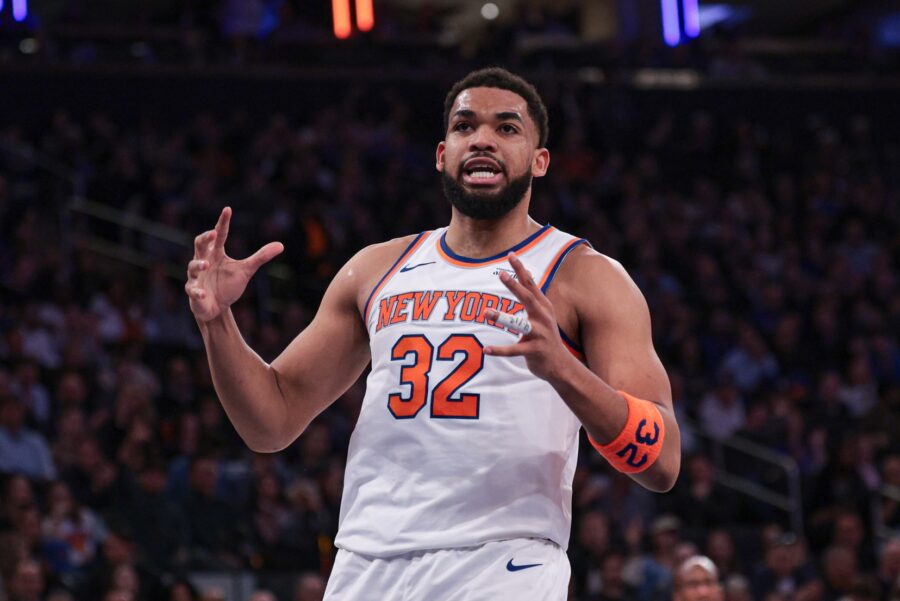
The Knicks' orchestrated shift to Karl-Anthony Towns as a quasi-point center had been humming for seven straight games, pushing their offensive rating to 130.5 and reshaping how defenses had to account for him in space. Then the Cavaliers arrived with Evan Mobley and Jarrett Allen—two big-bodied, versatile defenders willing to chase Towns off the ball and collapse on penetration—and the entire premise fractured in Game 1 of the Eastern Conference finals. Towns finished with 13 points on 14 shots and five assists, his lowest single-game assist total since the Knicks installed the new system. That's not a statistical aberration; it's a proof of concept that elite frontcourt depth can suffocate the architecture.
Yet the narrative emerging from the Knicks' comeback victory obscures the real structural problem. Jalen Brunson's historic fourth-quarter explosion and Landry Shamet's clutch three-point shooting have already begun reframing Game 1 as "the Knicks found a way," when the underlying issue is that when Towns can't operate as a playmaker in space, New York's offensive floor drops substantially. Brown and the Knicks will almost certainly adjust—moving Towns around, mixing in more traditional high-low looks, perhaps leaning harder on Brunson isolation ball—but Game 1 exposed that this system has a hard counter. Mobley's lateral quickness and Allen's rim protection stripped away the spacing advantage the Knicks had manufactured.
OG Anunoby's return from his hamstring injury adds another layer. He finished with four points and two boards in his first 29 minutes, then exploded for nine points and three boards in the fourth quarter and overtime. That's not just rust shaking off; it's a player who needed game rhythm to reset his aggression. Over the next two games, expect Anunoby's minutes and shot volume to climb as he approaches full availability. Shamet's emergence as a fourth-quarter closer (14 of 17 minutes played in the final period and OT, three crucial threes) also signals that the Knicks are loading more shot-creation into their bench unit, especially when Towns' playmaking gets clogged. Mitchell Robinson's return to the bench in the second half after Cleveland started intentionally fouling him (2-for-8 from the line) further reflects how the Cavaliers are systematically attacking New York's center rotation.
For prop players, the Towns assist line becomes a critical tell moving forward. His 5.2 assists per game over the seven-game sample before Game 1 is a ceiling, not a floor. Against switching-heavy defenses that force Towns into more traditional screening roles, that number will compress toward his 4.5 career average. Tonight he hit that ceiling; in Game 2, expect the Cavaliers to double-down on Mobley and Allen's pressure approach, which means the market may initially price Towns assists too high based on the recent seven-game peak. The edge isn't in Game 1 alone—it's in understanding that the Knicks' offensive rating (130.5) was dependent on Towns operating in space, and Cleveland has already shown it can deny him that luxury. Teams with comparable defensive personnel and switching tendencies will continue to target this vulnerability. Short-term: take unders on Towns assists in Games 2 and 3 of this series if the market adjusts linearly rather than accounting for the Cavaliers' specific scheme. Longer term: if the Knicks advance, monitor whether Towns' assist line inflates against teams without Mobley-Allen-caliber frontcourt mobility.