Shamet's Playoff Lifeline Ends as Anunoby Returns; Knicks Rotation Tightens Before Conference Finals
By Ty Whitney ·
OG Anunoby's return from hamstring injury will push Landry Shamet back to the bench, but his 37-minute audition against Philadelphia proved he can still move the needle in playoff rotations.
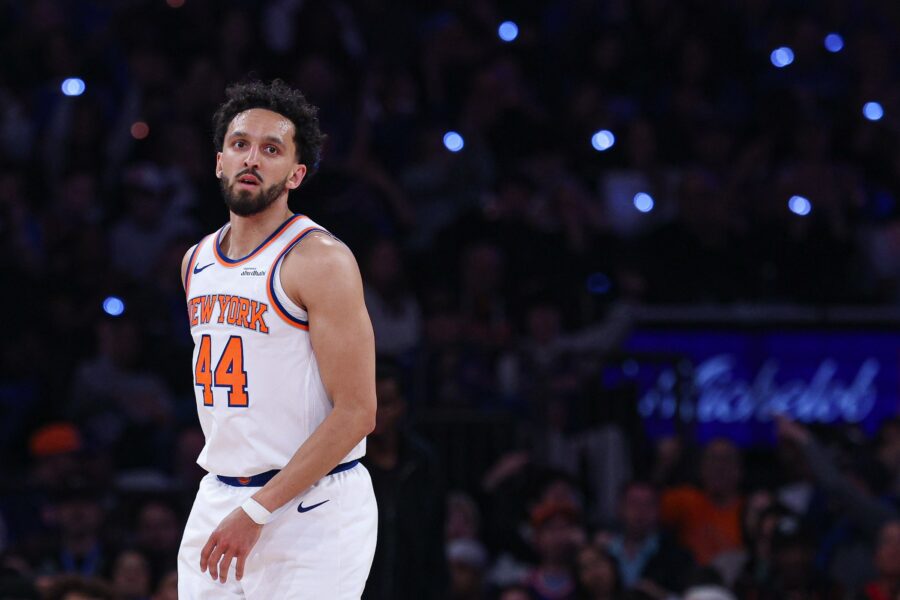
The Knicks' rotation picture clarifies heading into the Eastern Conference Finals: OG Anunoby's return from his right hamstring strain will relegate Landry Shamet back to reserve duty, likely below Miles McBride, Jordan Clarkson, and Jose Alvarado on Mike Brown's depth chart. Shamet had barely played in the first eight games of the postseason, averaging 9.3 minutes per night, until Anunoby's injury forced Brown to activate him. Over Games 3 and 4 against Philadelphia, Shamet logged 37 total minutes and scored 27 points on 9-of-13 shooting—a reminder that even marginal rotational tweaks can surface hidden value in a compressed playoff environment.
What makes Shamet's brief window instructive is the mechanism behind his efficiency. After six games of rust, he didn't need time to find his footing; he simply stepped into open threes and executed on limited offensive touches. "Landry hadn't played a drop all playoffs," Brown said of the two-game stretch. "He was huge on both ends of the floor." This pattern—a sharpshooting reserve inserted into playoff games and immediately productive—tells you something about the marginal players who survive deep runs. Shamet's absence from the rotation had nothing to do with his ability; it was pure depth. Once activated, his conditioning and shot mechanics translated instantly to playoff-speed execution.
The deeper roster storyline confirms the Knicks' construction is working. Karl-Anthony Towns, acquired in last year's blockbuster swap for Julius Randle and Donte DiVincenzo, has posted a pristine .587/.483/.897 shooting line across both rounds while averaging 10.0 rebounds and 6.6 assists per game—modest scoring (17.4 PPG) but elite playmaking and gravity. The Knicks' +24.8 net rating with Towns on the floor through the first two rounds tells you the trade won. New York's three-point rate has climbed from 37.3% in the regular season to 40.8% in the postseason, a league-leading clip. Shooting coach Peter Patton has become the operational heartbeat; McBride alone improved to a career-best 41.3% from three, and the coaching staff's granular attention to release point and footwork has compounded across the entire roster.
From a betting perspective, the rotation tightening around Anunoby's return carries immediate implication for bench scoring volumes. Shamet's +27-point outburst in Philadelphia won't repeat; the market may have priced slight inflation into Knicks bench total props if sportsbooks tracked his recent usage spike. That inflation evaporates the moment Anunoby checks in. Conversely, Anunoby's return doesn't materially expand New York's scoring ceiling—it stabilizes it. His two-way defense and secondary creation simply allow Brown to rest Towns and core guys in stretches without losing net rating. The Knicks' ability to preserve three-point percentage while tightening rotation minutes creates a floor for team scoring props; they won't bleed points through careless bench usage the way some deep teams do. The core five (Brunson, Towns, Anunoby, McBride as the reliable fourth option, and one of Clarkson/Alvarado) can execute the offense for 40 minutes without degradation.
The Conference Finals matchup—likely Detroit or Cleveland—will test whether New York's shooting volume and efficiency hold in a series. Detroit has matched up better historically despite looking like the softer opponent; Cleveland looks deeper and tougher on paper. Either way, the Knicks should be favored. For prop bettors, that confidence flows from Towns' elite efficiency and shooting volume, not just offensive firepower. A team that converts 40.8% from three with a +24.8 net rating when its second-best player is on the floor doesn't crater in tight playoff moments. Monitor team total overs in the 110-115 range; the Knicks' spacing and shooting coach pedigree are sticky enough to sustain that volume even against defensive-first opponents.