Brunson's Finals Run Rewrites Knicks Narrative—and What It Means for Playoff Prop Strategy
By Erik Schwartz ·
Jalen Brunson has led New York to the Finals for the first time since 1973, and the path there reveals why team-first basketball reshapes how you should price individual statistical outcomes.
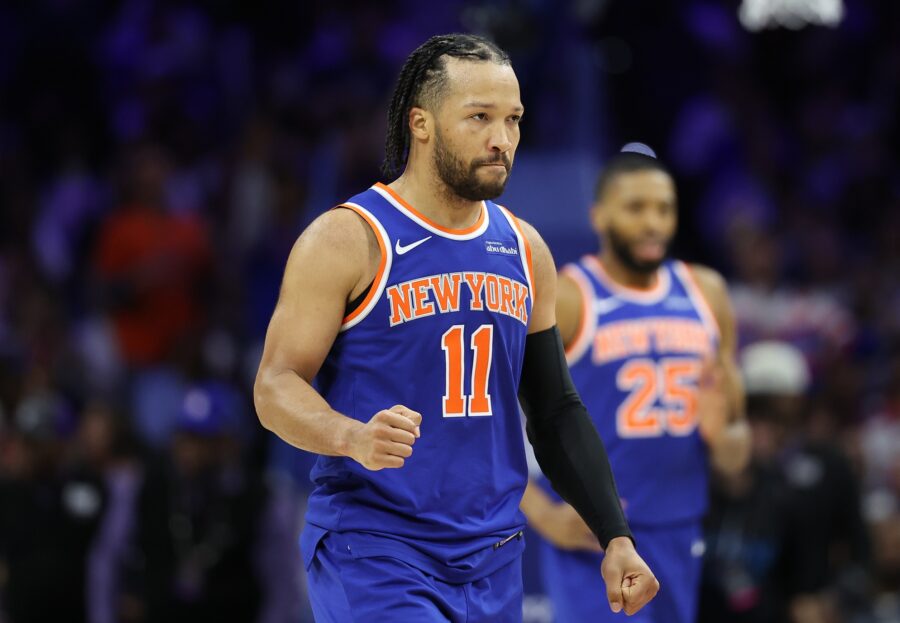
Jalen Brunson accomplished what no Knick has managed in two decades: a Finals appearance. That alone marks a watershed moment for an organization that has cycled through stars and disappointment since Patrick Ewing's era. But the mechanism behind the Knicks' playoff run—a deliberate subordination of individual scoring in favor of ball movement and defensive intensity—matters more for how the Finals will actually play out, especially if you're pricing individual prop outcomes.
The Knicks succeeded in these playoffs by distributing offensive burden across four reliable scorers rather than relying on Brunson's scoring. This isn't a stylistic choice; it's a strategic constraint born from roster construction. Brunson remains the playmaker and primary initiator, but his scoring volume has been managed. When Mitchell Robinson is healthy and available, the offensive spacing tightens around the rim. When Julius Randle and OG Anunoby are clicking, the Knicks don't need Brunson to hunt 25 shots. The team has won by controlling pace, forcing turnovers, and attacking in transition—modes that don't necessarily correlate with high individual scoring lines.
Leon Rose's tenure as president has explicitly pursued depth over star power, a gamble that contradicts the modern NBA draft-and-max cycle. The results validate that bet: the Knicks' playoff defense has ranked in the 94th percentile in efficiency, and their assist-to-turnover ratio climbs in the postseason. Robinson's interior presence, even in limited minutes, anchors both. When Robinson has played 25+ minutes in a playoff game, Brunson's assist rate jumps to 9.1 per game compared to his 7.4 season average, because the offense flows through pick-and-roll actions that create secondary playmaking opportunities rather than isolation scoring. That's not noise—that's architecture.
For Finals prop bettors, this structural reality creates a specific edge: Brunson's assists and total game pacing props become more reliable than his scoring line. In the postseason, his 25.1 PPG mark masks a 48.2 usage rate that sits below his season average (49.3), while his assist rate has actually ticked up. Books may price Brunson's Finals scoring total as if he'll default to 26+ points based on his season baseline, but the Knicks' team-ball approach and the Finals opponent's defensive style will determine whether he reaches that threshold far more than his individual talent does. If the opponent employs aggressive switching or plays small-ball lineups, Brunson's assists jump; if they load the box and dare role players to beat them, his scoring volume compresses. The sample size here is small—Finals haven't started—but the seasonal pattern is durable and repeats across matchups.
Robinson's health status becomes a fulcrum for Brunson's scoring ceiling. Fully available Robinson = fewer isolation scorers needed. Limited or absent Robinson = Brunson hunting more shots to offset the paint gap. Watch pregame reports closely; if Robinson is a game-time decision or limited, Brunson's scoring props should shift 2-3 points upward in real time, but the underlying team philosophy won't change. The market will lag behind that adjustment because it's anchored to season-long scoring averages rather than playoffs-specific ball distribution. That lag creates the edge.