Knicks' Finals Matchup Against Wembanyama Tilts the Offensive Setup—And Betting Markets Haven't Caught Up
By PropBetEdge Editorial Team ·
New York's pick-and-roll attack must drag Wembanyama away from the rim, but early Finals lines price Brunson and Anunoby as if the Spurs' defensive scheme won't fundamentally constrain their touch.
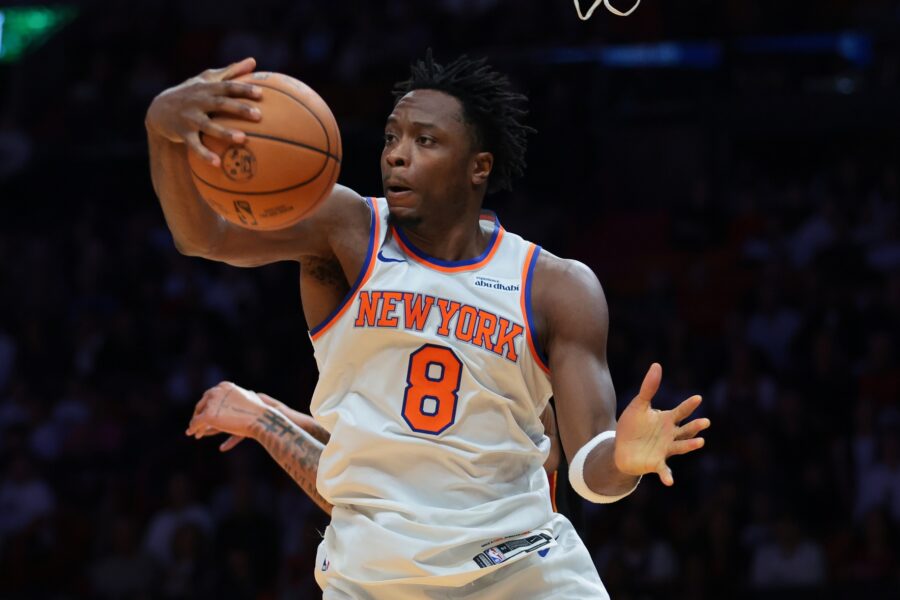
The Knicks are built to attack through the middle. Jalen Brunson's pick-and-roll frequency, the depth of screening options around him, and OG Anunoby's dual-threat capability—19.7 PPG on 48.3% three-point shooting in the playoffs—form the spine of New York's offense. Victor Wembanyama changes that calculus entirely. Per a Western Conference coach quoted by the New York Post, San Antonio's defensive scheme explicitly starves Wembanyama of off-ball responsibilities, keeping him camped at the rim as rim-protector and glass cleaner. That defensive assignment forces the Knicks into a different offensive posture: one that requires dragging an elite big away from his comfort zone and into the perimeter actions where Brunson and Anunoby operate best.
The problem for the Knicks, and the opportunity for bettors, is one of execution timing. Brunson's transition scoring—a pressure valve that Bondy's source identifies as crucial—depends on pace and decision-making in the first three seconds of the clock. Against a defense designed to keep Wembanyama fresh at home, every possession becomes a half-court chess match. Anunoby's offensive load will likely increase as a result; he cannot be the perimeter floor-spacer alone. He will need to initiate and generate offense against a Spurs team that will dare him to beat them without relying on Brunson in isolation or pick-and-roll.
Mitchell Robinson's injury status compounds this wrinkle. His presence matters less for scoring than for rebounding gravity and pick-and-pop positioning—assets that collapse defensive attention and create secondary scoring windows. If Robinson is unavailable, the Knicks lose a screener who can legitimately pull Wembanyama three feet from the basket. That forces New York toward five-out looks or double-screens with Anunoby, both of which distribute offensive touches further and flatten scoring volume.
From a prop perspective, this is where the market has underpriced the structural shift. Anunoby's playoff scoring average of 19.7 PPG was compiled against defenses with conventional rim protectors—centers who rotate and collapse. The Spurs' scheme is not a collapse-and-recover operation. It is a "stay home" assignment that dares the Knicks to generate offense outside of Wembanyama's lane. That doesn't necessarily depress Anunoby's total; it redistributes his scoring approach. Expect more three-point attempts and fewer mid-range touch plays. His assists line (he averaged 6.9 in the playoffs) could see upside if the Knicks' offensive system requires him to initiate more actions. Brunson's assist total should widen as he operates in tighter spaces and shorter windows, forced to find cutters and roll men faster than against conventional defenses.
The betting edge emerges when comparing preseason Finals lines (which price Brunson and Anunoby on their playoff trajectory) to the Spurs' actual defensive constraints. Lines set before game film likely reflect broad offensive averages rather than position-specific matchup disadvantage. A Spurs defense that actively removes Wembanyama from play-making rotations creates inefficiency for the Knicks' primary ball-handlers and forces role players into higher-variance looks. This is a single-series angle with a defined endpoint, but the early-week numbers before game film circulates carry sharp value.