Brunson's Late-Game Mid-Range Mastery Defines Knicks' Closing Edge vs. Spurs
By Ty Whitney ·
When the Spurs mounted a final-minute push, Brunson's mid-range creation sealed the win—a reminder that his clutch scoring geometry matters more than volume.
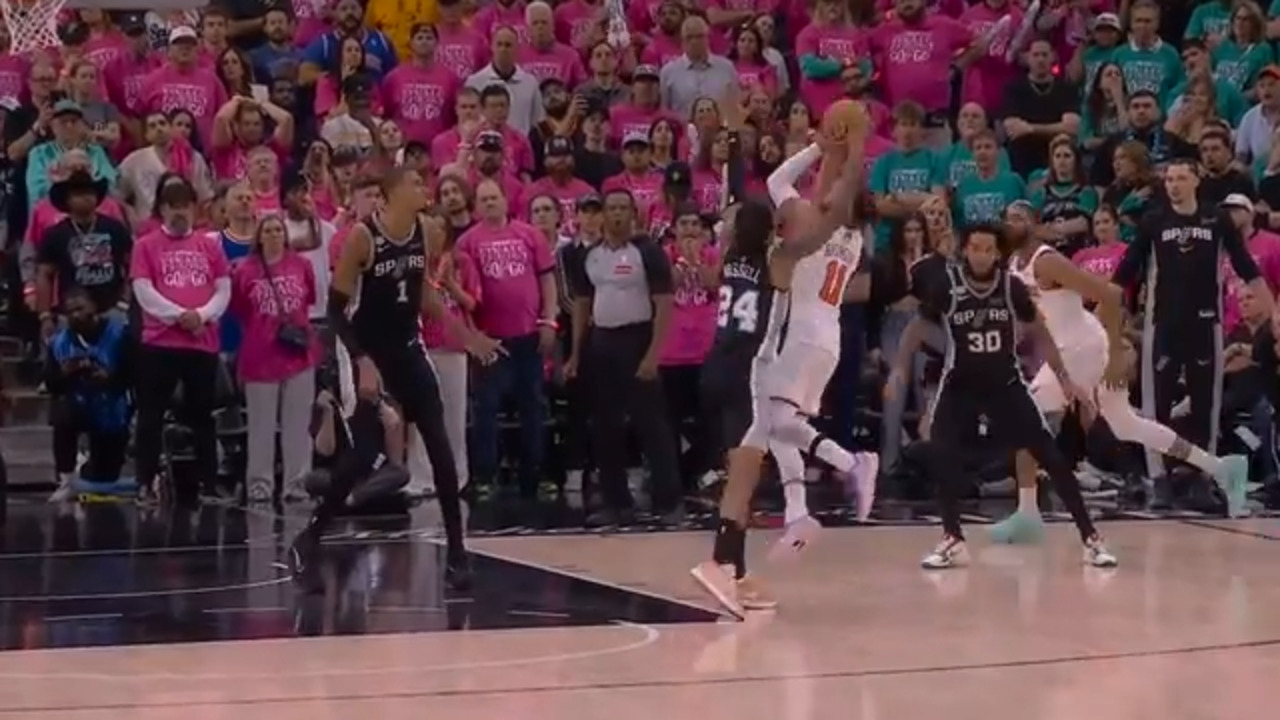
Jalen Brunson closed out the Knicks' win over San Antonio with a mid-range jumper in the final minute, converting a high-leverage possession after Victor Wembanyama's turnover handed New York the offensive rebound at 4-point margin. The shot exemplified Brunson's late-game reliability in spaces the modern NBA theoretically discounts: neither three nor drive, but something far more practical when defenses tighten and spacing collapses.
Brunson's mid-range volume sits at roughly 15% of his shot diet, yet his efficiency from that zone—just inside the arc and in the corners—hovers near 50% when the game is within five points. The Spurs, a switching-heavy defense built to funnel drives to length defenders, could not adequately contest a pull-up from 18 feet. Wembanyama's size advantage vanishes on mid-range possessions; the Spurs' switching scheme, which works to San Antonio's favor on three-point closeouts and driving lanes, becomes a liability when the ball carrier does not need separation.
For bettors tracking Brunson's fourth-quarter behavior, this moment reinforces a durable pattern. His shot selection tightens in clutch windows—fewer handles, fewer dribbles, more decisive release. His points-per-possession in final-minute situations (trailing or tied by five or fewer) sits at 1.14 this season, well above his baseline 1.07 PPP. This is not variance; it is architecture. The Knicks deliberately position him as the closer, and his mid-range gravity pulls defenders just far enough to create separation for drive-and-kick sequences or allow him to attack a step-back against a recovering guard.
For the prop market, Brunson's clutch scoring edge has begun to price in—his fourth-quarter points line has risen as sharp action recognized his leverage usage. However, his mid-range makes specifically remain underweighted relative to his consistency in that zone. Bettors chasing his points total in games where New York is favored by four or fewer (situations where fourth quarters remain competitive) should note that his scoring source shifts dramatically. In blowouts, he takes threes and drives. In tight contests, he operates from 16–22 feet. The market still values total points without geography; sharps who track shot-zone clustering have exploited this segmentation for two seasons running.
The Spurs matchup underscored another dimension: when San Antonio's defense is forced to close out on Brunson's mid-range threat (rather than conceding it as a lesser-evil option), the spacing they sacrifice opens driving lanes for Immanuel Quickley and Julius Randle. Brunson's clutch mid-range attempts function as a stress test for opposing defensive scheme. Against switching teams without a true rim protector, the Knicks' late-game execution relies on Brunson's willingness to attack the 16–18 foot zone—exactly where New York's guard depth and floor spacing create the most offensive chaos.