Anunoby Returns to Starting Five for Knicks in Conference Finals; Scoring Line Faces Upward Pressure
By Ty Whitney ·
The Knicks' star wing takes the court for Game 1 against Cleveland carrying elite postseason efficiency that the market may not have fully repriced.
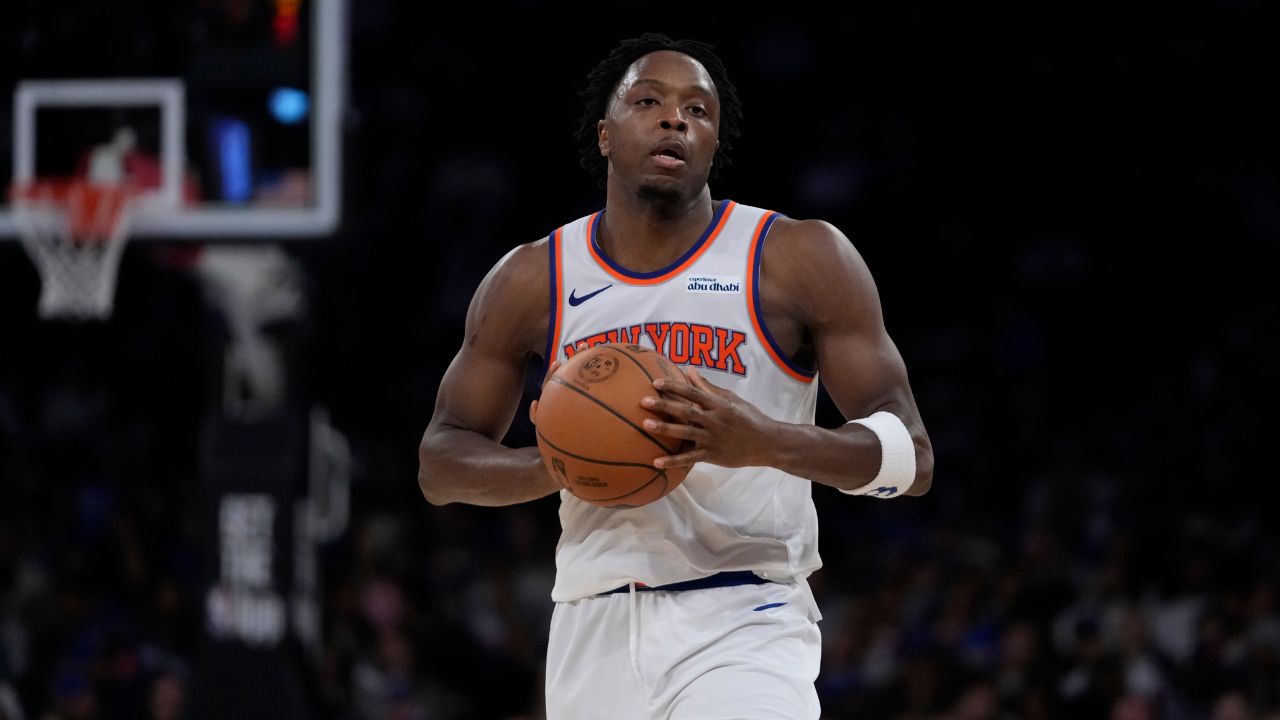
OG Anunoby is active for Game 1 of the Eastern Conference Finals. The New York Knicks announced 30 minutes before tipoff that their wing would start against the Cleveland Cavaliers after a hamstring injury sidelined him for Games 3 and 4 of the Philadelphia series. Coach Mike Brown had withheld the call until warmups, a standard precaution, but three consecutive practice days and team medical clearance removed real doubt.
Anunoby's postseason résumé is remarkable. He's shooting 61.9% from the field and 53.8% from three while averaging 21.4 points per game—production that sits in the 85th percentile league-wide for wings in playoff basketball. Those aren't volume-inflated numbers; they reflect sustained efficiency against playoff-caliber perimeter defense. His 7.5 rebounding average and 1.9 steals per game anchor a two-way impact that Cleveland's offense will feel immediately. The Cavaliers' scheme relies on spacing and pace; Anunoby's length and activity disrupt both.
The injury absence created a natural market recalibration. Sportsbooks likely priced Anunoby's scoring prop—whether individual points or team-total component—with some discount for uncertainty. His return, especially at starting minutes (implied 35+ on the floor), restores the full production engine. Cleveland's perimeter defense, while competent, hasn't faced sustained offensive pressure from a shooter of Anunoby's caliber on 61.9% accuracy. The Cavaliers' top guard-oriented defense is built for pick-and-roll disruption, not containing elite wings in isolation or spot-up situations.
The mechanical advantage here is clean. Anunoby practices three days at full intensity, gets medical clearance, and returns to a lineup that's already proven it can reach the Conference Finals. His 21.4 ppg postseason average is not a spike—it's consistent across four series rounds. Cleveland allows 107.8 points per 100 possessions in the playoffs, slightly above league average for a Finals-bound defense. Against an offense anchored by Brunson's playmaking and Julius Randle's rebounding, Anunoby becomes a secondary scoring valve that switches fewer times and faces fewer elite perimeter defenders than he would against Philadelphia's two-at-a-time wing rotation.
The prop edge tilts toward overs on Anunoby's individual scoring. Early numbers will likely come in under his postseason average (20.5–21.5 range) because books adjust for availability risk and single-game variance. But a returning 61.9% three-point shooter in a starting role against a defense that's not specifically built to contain that profile carries durable value. This isn't a blowup-game bet; it's a recognition that the market left a discount on the floor because of the injury window.