Peterson's Summer Arc and the Jazz's Backcourt Gamble
By PropBetEdge Editorial Team ·
Utah's freshly minted franchise centerpiece is already the organization's ambassador; what it means for his rookie-year assist volume.
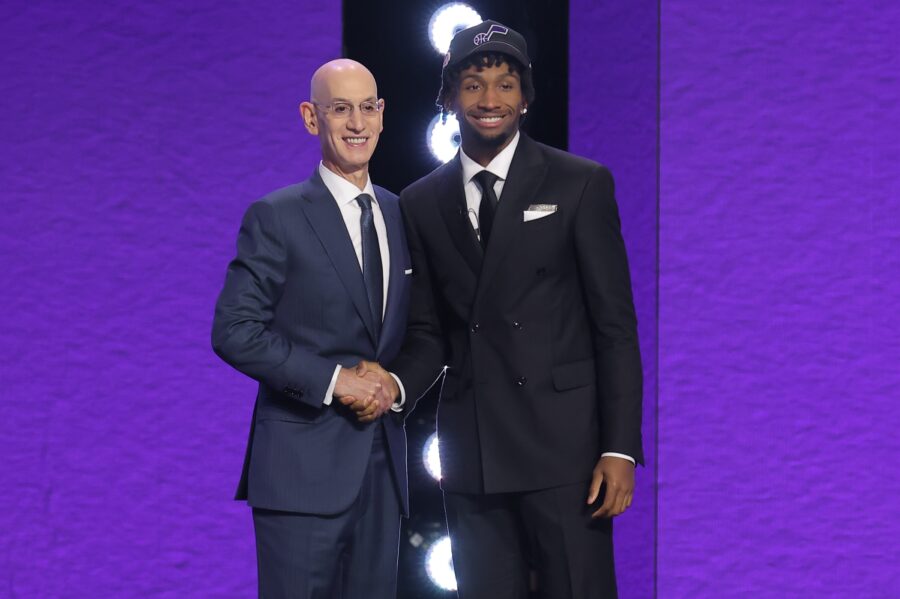
Darryn Peterson arrived in Salt Lake City reluctant. The Kansas guard skipped his pre-draft workout with the Jazz, a cold signal from a prospect who had leverage and options. But in the month since Utah selected him second overall, Peterson has flipped the script entirely—embracing not just the organization but actively evangelizing it. His performance at the Salt Lake City Summer League (53 points, 14 assists across 55 minutes in two games) coupled with his public enthusiasm suggests the Jazz may have correctly read a prospect who needed to find his own landing, not be sold one.
What Utah is building around Peterson and fourth-year guard Keyonte George represents a calculated departure from the franchise's rebuild script. Coach Will Hardy is explicitly rejecting the traditional "point guard" designation, instead plotting a two-man handling system where both guards initiate offense and distribute. Hardy's candor about the learning curve—"It's going to take a little bit of time for us to get the rhythm of it perfect"—is honest, but the infrastructure bet is clear: George's mentorship (he's been a constant at Summer League practices) combined with Peterson's playmaking instincts creates a backcourt with dual creation pathways. This matters tactically because it dilutes defensive pressure on either player and allows the Jazz to run more concurrent ball-handlers, a trend toward positional fluidity that defines modern NBA offense.
George's presence off the court carries outsized weight here. At four seasons in, he's functioning as Peterson's accelerant—their shared skills trainer Phil Beckner provided a continuity thread, but George's daily feedback at Summer League signals a veteran anchor who understands the organizational culture and can decode it for the rookie. The NBA initially green-lit George as a formal assistant coach for the Las Vegas Summer League games before reversing course on precedent grounds, but his informal mentorship role is arguably more valuable anyway. It positions Peterson to arrive at October training camp with a pre-installed understanding of Utah's expectations and habits.
For prop purposes, Peterson's assist line carries a timing and conditioning angle worth isolating. His 14 assists across 55 Summer League minutes (2.8 per 20 minutes pace-adjusted) is a small sample in a low-intensity setting, but it telegraphs the role architecture Hardy envisions. Peterson is being asked to operate closer to a 6-7 assists per game floor as a rookie than to a 4-5 assist ceiling—the defensive load on Utah's backcourt will rotate, and George's year-four maturity should keep the second-unit rhythm stable. If Peterson's opening-night assist line opens at 5.5 or lower, the risk of undervaluation is real. The Jazz are not hiding the fact that he's a creator, not a scorer-first guard playing into passing situations. Summer League efficiency metrics rarely translate 1:1 to regular season, but the coaching philosophy overlay does. A rookie in a dual-handling system with an embedded veteran mentor typically sees assist volume arrive faster than market anticipation allows.
Utah also generated a $15.054 million trade exception from the Kessler sign-and-trade, midrange ammunition that keeps the organization flexible if a rotation upgrade emerges mid-season. This backstory matters less for Peterson props directly but signals that Hardy has roster runway to build around the core rather than scramble for fixes. That stability should benefit Peterson's playmaking—fewer late-season desperation lineups mean more consistent spacing and role clarity.