Jazz Bet Big On Kessler's Ceiling With $140M Offer; Market Should Price Durability Risk
By Erik Schwartz ·
Utah's five-year, $140 million qualifying offer to Walker Kessler locks in a restricted free agent with injury red flags that may not yet be fully priced into team total and playoff win projections.
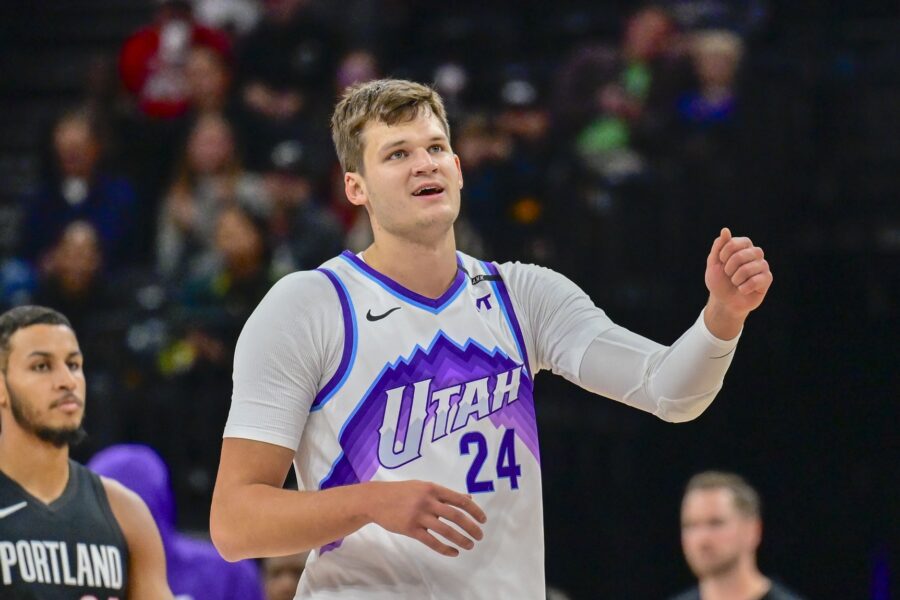
The Jazz formally issued Walker Kessler a qualifying offer Monday, converting him to restricted free agent status after negotiations during Utah's exclusive window yielded a five-year, $140 million offer on the table. The move signals the organization views Kessler, a 7-foot defensive anchor, as a foundational piece worth long-term capital—even as the center's injury history casts a shadow over the deal's true value. Kessler missed extended stretches last season with a knee injury and has been in and out of the lineup repeatedly since entering the league, a pattern that doesn't disappear because Utah committed $28 million per year to it.
The structure of the offer—five years, front-loaded into a restricted free agent deal—reveals Utah's internal confidence in Kessler's future availability and ceiling. The Jazz clearly believe the market for his services remains depressed enough that keeping him locked down at $28M/year is an asset rather than an anchor. That calculation works if Kessler plays 65+ games annually and maintains his rim protection at or above current levels. It breaks if the injury carousel continues or if his defensive versatility fails to evolve as Utah hopes.
From a cap perspective, Utah is spending premium money on a player whose durability remains unproven. The NBA's betting market has historically underpriced injury risk in long-term contracts—the gap between what teams pay for upside and what bettors price into win totals and playoff probabilities often tilts toward the team's view. Here, that gap is meaningful. If Kessler plays 55 games next season instead of 70, Utah's depth plummets, and their perimeter-dependent offense loses its only true rim protector. Jazz total wins projections and playoff odds should incorporate a meaningful durability discount that may not yet be embedded in current numbers.
The prop lens widens when you consider roster construction. Kessler's injury absences force Utah to lean heavier on wings and guards to generate offense, shifting offensive touches away from the post and toward higher-volume perimeter scoring. If Kessler is sidelined, Jazz guards see elevated assist and scoring opportunities; when he's healthy and on-court, those same guards see their volumes compress. Bettors targeting Jazz player props in the coming season should monitor Kessler's preseason availability closely. A recurring soft-tissue issue or setback would immediately widen player prop trading ranges for teammates like Simone Fontecchio and others in Utah's rotation.
Ultimately, the Jazz have priced Kessler as if durability risk is low. The market may follow suit at season open, especially if Kessler strings together healthy preseason games. That's the inflection point: if early-season odds price Utah's playoff window and regular-season total wins assuming 65+ Kessler games, and he falls to 55, overs on Jazz team totals become vulnerable. Short-term, fade overs on Jazz win totals if preseason injury noise emerges; longer-term, the durability tax on this deal will become visible only when Kessler misses games again.