Caruso's Bench-to-Crunch Pipeline: How Thunder Depth Flipped the Spurs Series
By Erik Schwartz ·
Oklahoma City's unlikely offensive spark isn't SGA or Williams—it's a 32-year-old defender who spent the regular season in limited minutes, now shooting 58% from three and dragging the Spurs to elimination.
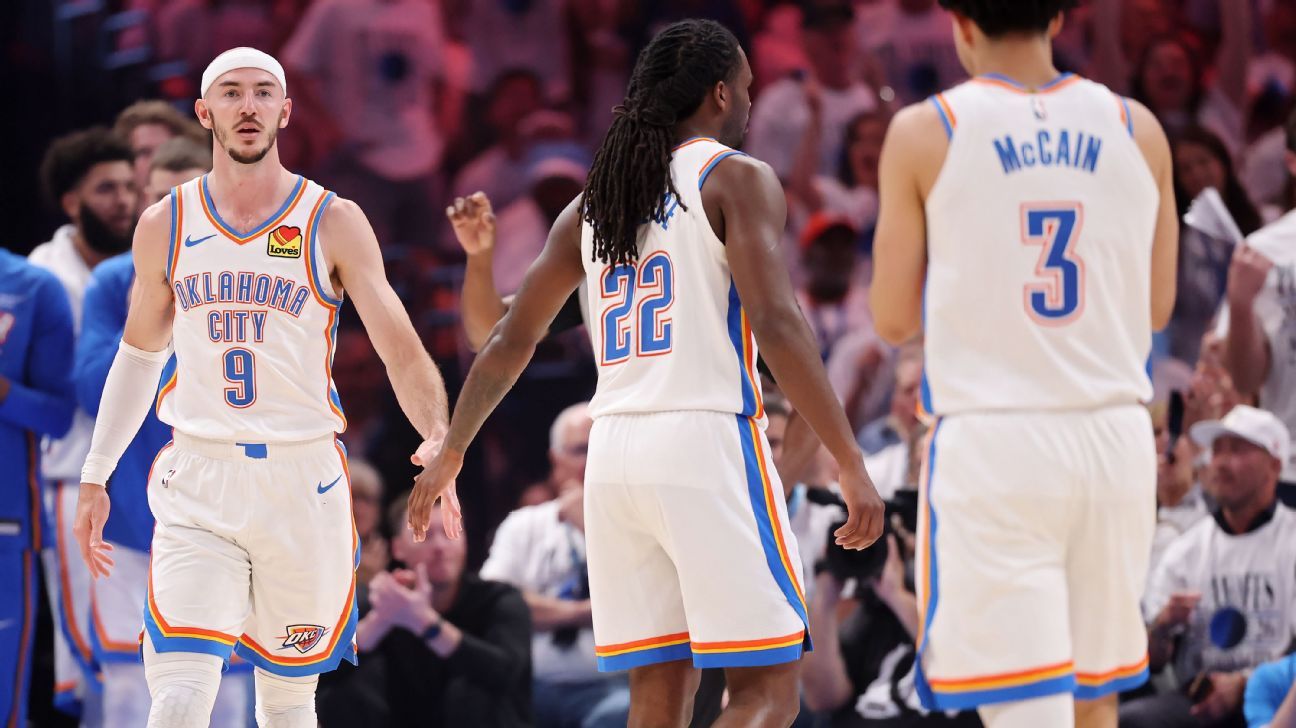
Alex Caruso spent the 2025-26 regular season in carefully managed restraint. Thunder coach Mark Daigneault treated the nine-year veteran like a luxury asset, keeping him under 25 minutes per game in nearly every contest during the regular season and coasting through two playoff sweeps with minimal mileage. Then Oklahoma City hit a problem: San Antonio had won four of five matchups against the defending champs, including a stunning NBA Cup semifinal victory when Wembanyama returned from his month-long absence. Gilgeous-Alexander flagged the issue publicly after a December loss. Something had to change.
What changed wasn't scheme or tempo—it was deployment. Daigneault simply unlocked Caruso. In the Western Conference Finals, the 32-year-old has averaged 17 points per game on 58.1% three-point shooting while playing 24.7 minutes per contest. Compare that to his 9.5-point average in 20.6 minutes during four regular-season games against San Antonio. The offensive efficiency is a secondary surprise; the primary one is that this performance came from a roster slot the Thunder had essentially preserved as a luxury item. With Shai Gilgeous-Alexander firing inefficiently and Jalen Williams sidelined again by a hamstring injury, Caruso became the third and fourth option Thunder games required. Game 5's 127-114 victory that pushed the Spurs to the brink rested on Caruso's 17 points and relentless screening defense—the kind of two-way gravity that doesn't register in box scores until you look at plus-minus: Oklahoma City sits plus-45 with Caruso on court, minus-36 with him off it.
The betting implication is straightforward but structural. Caruso's regular-season minutes restriction created a massive statistical discount in the odds markets. His three-point line heading into this series reflected his capped regular-season usage and limited sample size against San Antonio specifically. Books had no model for "Caruso unleashed in a closing round with stars struggling," because that never happened in the regular season. The market priced him as a third-string contributor with elderly durability concerns. The Thunder, meanwhile, had run the calculation differently: he's the most impactful defender on their roster and can still shoot at an elite rate. Once Daigneault committed to 25-minute nights, Caruso's per-36 output (25.4 PPG on 58% threes) made him one of the series' most efficient offensive pieces.
For Game 6 and beyond, the adjustment persists because it solves a real tactical problem. Wembanyama has struggled to contain Caruso's movement off-ball, and the Spurs' perimeter defenders lack the lateral agility to chase him around screens. If Caruso's line drifts back toward his regular-season baseline (reflecting market lag and recency bias favoring SGA's return to form), there's an edge on his point total props—not because he'll maintain 58% three-point splits forever, but because the Thunder have identified him as mission-critical in this series and will resource him accordingly. The market will eventually adjust, but series-clinching games often move slowly. Early numbers on Caruso's point total before Game 6 oddsmakers fully repriced represent the kind of inefficiency that persists only until the next adjustment.