Hawks-Hornets Swap Could Reshape Atlanta's Backcourt Floor-Spacing Math
By PropBetEdge Editorial Team ·
A late-summer trade framework swapping Buddy Hield's deteriorating shooting for Dorian Finney-Smith's salary flexibility exposes how much Atlanta's spacing game has already eroded.
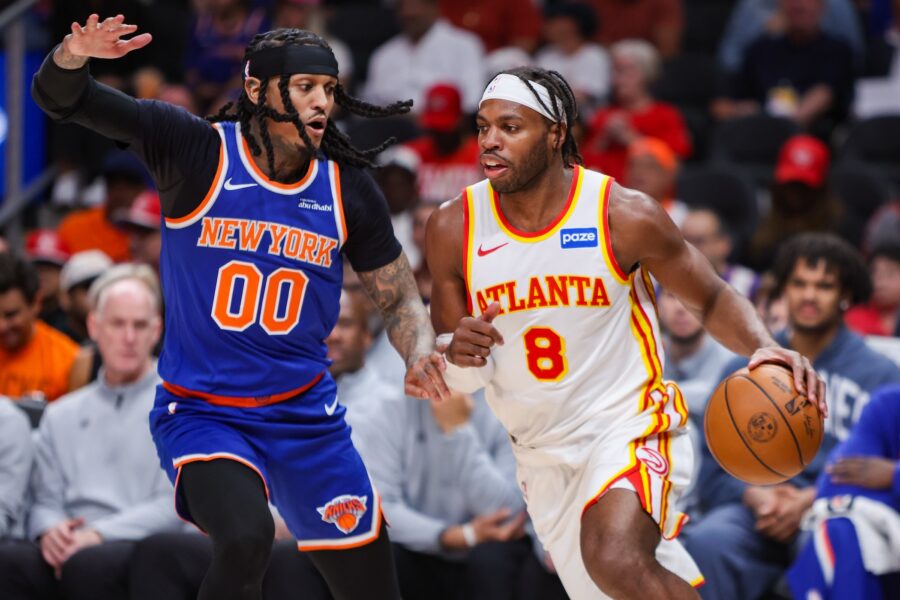
The Hawks and Hornets are actively exploring a trade centered on sending Buddy Hield to Charlotte in exchange for Dorian Finney-Smith, according to reporting by Marc Stein. The deal hinges partly on salary relief: Hield carries a $9.7MM salary Atlanta has been eager to move all offseason, while Finney-Smith's $13.3MM contract for 2027/28 is non-guaranteed, giving the Hawks exit flexibility into next season. This late-summer negotiation signals both teams are still hunting for rotational tweaks with the 2026/27 season just weeks away.
But the mechanics of this swap expose a real floor-spacing problem in Atlanta. Hield, once a reliable 40% three-point threat in Sacramento and Indiana, has cratered to 34.9% last season—a 6+ percentage-point cliff. He split time between Golden State and Atlanta, averaging just 7.6 points and firing fewer efficient looks than he has in years. The Hawks aren't trading him because he's valuable; they're moving him because his presence no longer justifies the salary. Finney-Smith, meanwhile, muscled through a down year with Houston—37 games played, 3.3 points per game in just 16.8 minutes—suggesting the Rockets themselves had moved him to the periphery. Neither player is a creator. Both are complementary pieces clinging to playoff-rotation relevance.
What matters for lineup projection: if Atlanta pulls the trigger, Trae Young's offensive initiation gains no ground. The shot-creation burden stays entirely on Young and De'Andre Hunter; the secondary ball-handler role remains a weakness. Finney-Smith brings defensive positional value and switchability that Hield's 33-year-old legs no longer provide, but he doesn't space the floor the way the Hawks need. This trade, should it happen, is defensive chemistry and cap positioning masquerading as offensive upgrade—and the market will price Atlanta's total offensive ceiling accordingly.
For prop purposes, the path is clear: if this deal closes before tip, expect Atlanta's team total to hold flat or tick slightly down despite any narrative optimism around "new depth." Young's assist rate becomes the real tell. Against the teams Charlotte faced last season—mostly switching, high-ball-screen coverage—Young was already operating in tighter windows. Subtract Hield's gravity (flawed as it was) and add Finney-Smith's non-shooting profile, and Young's assist variance ticks up. Bettors should monitor how Atlanta's o-rating opens at sportsbooks if this trade becomes official; the market may overweight the defensive floor-tightening and underprice the offensive simplification. Young's assist floor on nights with fewer spacing options is historically lower than his season average.
Devin Carter's absence from the final framework is also instructive. The Hawks waived Carter rather than route him into this deal, suggesting Atlanta's front office believes the youth-lottery narrative doesn't fit their win-now timeline or salary structure. That's a vote of non-confidence in internal depth that usually precedes a team tightening rotations around its stars—which, in prop terms, means Young takes more usage but with less room to create around him. The 2026/27 season hasn't begun, and the Hawks are already signaling they're working backward from payroll constraints, not forward from championship roster construction.