Horford's $14M Return to Golden State Signals Stability—and Hidden Depth Bet
By Ty Whitney ·
Al Horford is staying put in San Francisco on a two-year deal, but his injury management plan and late-game usage against Phoenix reveal why Warriors bench scoring props just got more volatile.
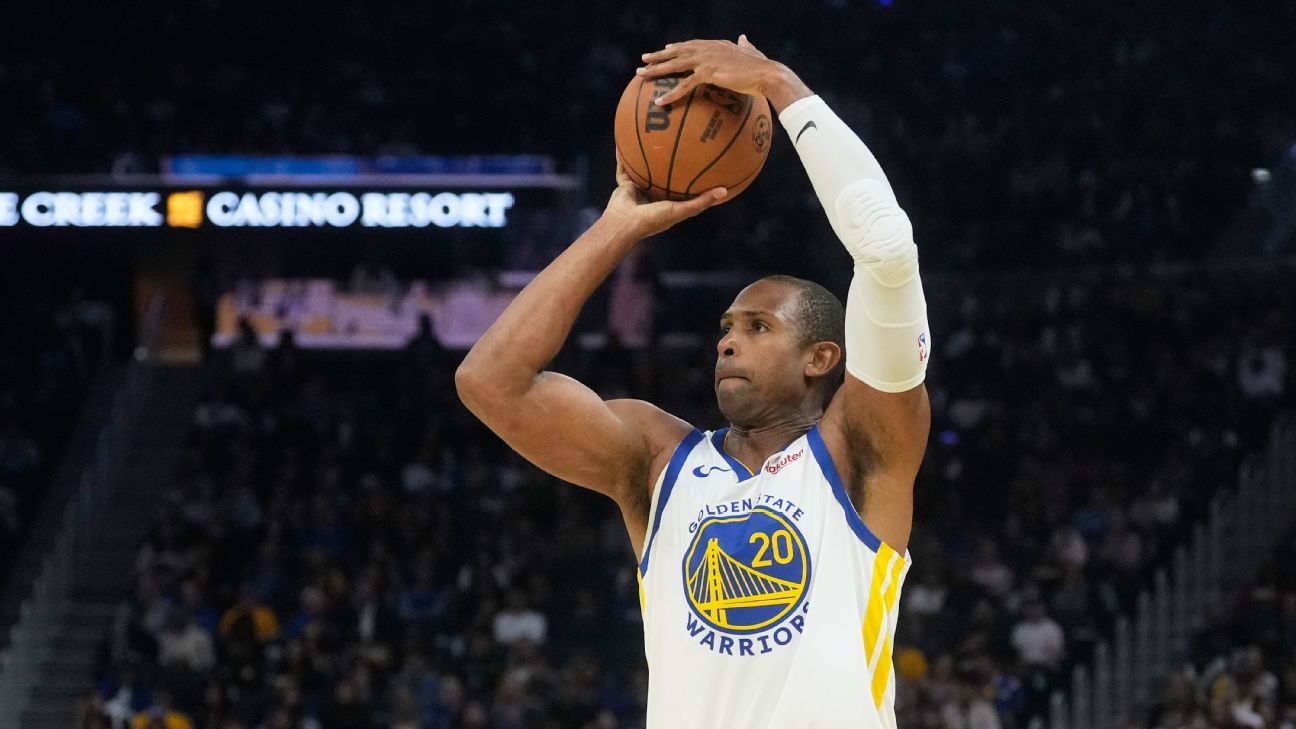
Al Horford is returning to the Golden State Warriors for his 20th NBA season, declining his $6 million player option to sign a fully guaranteed two-year, $14 million deal with a trade kicker once free agency opens next month. At 40 years old, he joins a 13-player club in league history—Kareem, Kobe, LeBron, Dirk, Kevin Garnett, and a handful of others—who have sustained NBA-level contribution into their third decade. The Warriors' early vote of confidence matters less for the aging-veteran narrative than for what it says about roster construction: Golden State is banking on health and continuity over turnover.
Last season exposed the Warriors' fragility. Jimmy Butler's ACL tear in January derailed a 12-4 start. Stephen Curry missed two months with knee inflammation. The team finished 37-45, the 10th seed, and was eliminated in the play-in by Phoenix. Horford appeared in only 45 games due to sciatica and a late-season calf strain—well below his career norm. That's the asterisk on his return: the Warriors aren't just re-signing a veteran mentor; they're betting heavily on his availability. To ensure it, Horford and the organization are building a customized strength-and-conditioning program around him for the entire offseason. He's even skipping international play with the Dominican national team to remain in San Francisco. The medical staff, led by Rick Celebrini, has earned a reputation for meticulous veteran management. If that protocol works, Horford becomes a legitimate fourth option in a Curry-Green-Porzingis core.
The prop layer should focus on Horford's role specificity and game state. In the play-in loss to the Clippers—a game the Warriors won—Horford launched four crucial fourth-quarter three-pointers, a usage pattern that doesn't track his regular-season volume. His 45-game sample last year carries noise. But here's the edge: when Curry or Green miss time with injury, Horford's touch rate and shot diet shift dramatically. He's a center who can play power forward in spacing lineups, and against switching defenses or undersized opponents, he becomes a pick-and-pop threat. The 2024-25 Warriors offense will spend far more time hunting late-game threes against teams like Phoenix and Denver. Horford's minutes are safest bet as a floor—if healthy, he plays 20-24 per night in the regular season—but his threes made carry binary risk. In a 45-game season, his three-point line might be set conservatively (1.5-2.0 makes per game). That's vulnerable to a 65-game healthy season, where his three-point volume normalizes upward.
The deeper prop angle involves bench-unit scoring when Curry rests. Warriors bench units were undersized and perimeter-heavy last season. Horford's return adds a reliable floor-spacer who can finish pick-and-rolls against bench defenses. Expect his off-the-bench usage to increase, and his assists to rise correspondingly—pick-and-pop actions generate secondary playmaking. If Horford stays healthy and plays 60+ games, his assists line (currently set around 2.5 per game based on 45-game averages) becomes overvalued. The market hasn't yet fully repriced for a 65-70 game season from a 40-year-old, which means early-season lines will offer value on the under. But by November, once injury data clarifies his true availability ceiling, that advantage evaporates. The bet works in the first three weeks of the season only.