Knicks Title Run Resets NBA Finals Viewership Standard; What It Means for Next Year's Betting Markets
By Ty Whitney ·
A 53-year championship drought ending with a fourth-quarter rally pulled 24.5 million viewers to Game 5, the highest Finals viewership in 28 years and a signal that star power and narrative drive television dollars—and betting volume.
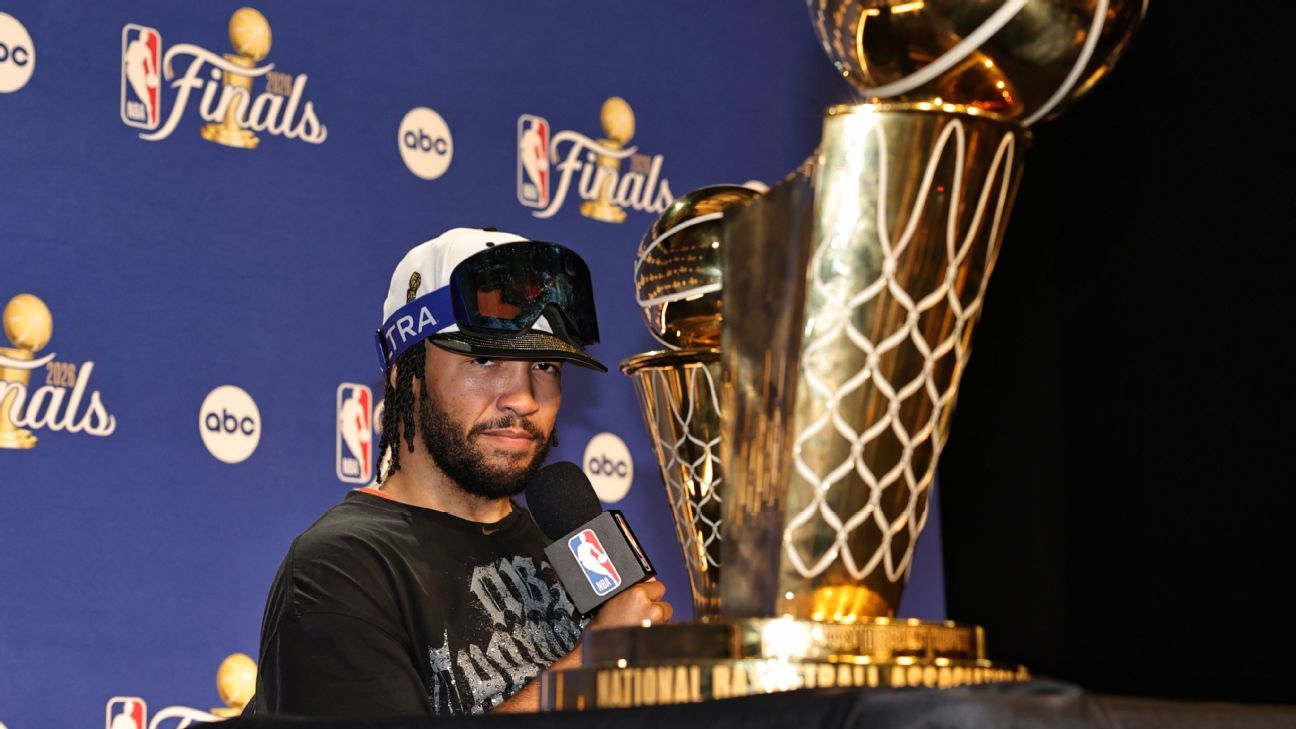
The New York Knicks' 94-90 victory over the San Antonio Spurs on Saturday clinched their first NBA title since 1973, and the numbers that followed suggest the league just witnessed a watershed moment. The Game 5 clincher averaged 24.5 million viewers across ABC and ESPN, peaked at 33 million as Jalen Brunson was sealing a 45-point Finals MVP performance, and positioned this series as the most-watched Game 5 since Michael Jordan's 1998 championship run. The full Finals series averaged 20.6 million viewers—the highest since the 1998 Bulls-Jazz matchup (29.04 million) and the best ABC/ESPN Finals number since the network partnership began in 2003.
The context matters more than the raw number. Last year's Finals between Oklahoma City and Indiana averaged 10.31 million—nearly half this year's total. This represents a structural reset, not a single-game anomaly. The Knicks were a 53-year title drought team with Brunson as a homegrown, marketable lead—a formula the league hadn't accessed since the Jordan-era Bulls. When New York rallied from a 10-point fourth-quarter deficit to close it out, the broadcast hit its peak audience in real time. That's not recency luck; that's viewers tuning in specifically because the stakes were clear and the protagonist was worth watching. The market's response—advertising rates, casino handle, DFS contests—will follow the eyeballs.
For next season's Finals positioning, this viewership reset carries direct implications. Networks and sportsbooks now have explicit proof that star-driven, underdog-narrative Finals generate 2x the audience of recent years. That changes how odds and totals are priced as the 2026-27 season unfolds. A Finals Game 5 or 7 involving a marquee star and a first-time champion will carry inflated viewership assumptions built into pre-series projections. More viewers means higher handle on prop bets in the Finals. More handle means tighter, sharper lines—particularly on high-volume props like star player point totals and assist lines that drive betting volume. The 2025 Finals between OKC and Indiana operated under the assumption that Finals games would average 10-11 million; oddsmakers priced accordingly. The 2026 Finals, assuming a comparable storyline (star player, compelling narrative), may now price in 18-22 million. That assumption shift is baked into futures pricing right now.
Brunson's 45-point Finals MVP performance—delivered in the clincher with the game on the line—is the exact type of star performance that feeds both broadcast appetite and prop-betting action. His assist total in the Finals (season average: 8.2 per game) stayed elevated throughout the series because Knicks ball movement hinged on him as the primary playmaker in pick-and-roll sets against San Antonio's switching scheme. That role doesn't change next season; if anything, a championship team returning intact tends to tighten its most reliable offensive flow. For bettors tracking Brunson's assists prop in next year's playoffs, the precedent is clear: when the Knicks face a team that switches everything (as the Spurs did), his assist floor sits at 8.5+. The Finals just proved that when the moment is biggest, he's willing to hunt assists in crunch time—not just score. That's a behavioral tell worth encoding into assists-over bets when Brunson faces switching-heavy defenses in the postseason.
The narrative arc here also matters for understanding how lines will move in real time. The Knicks opened as slight underdogs in the Finals; the market didn't fully price in their fourth-quarter execution or their ability to execute ball movement against San Antonio's scheme. That's a market inefficiency that persists across Finals series. Teams that are positioned as underdogs but possess elite playmakers (Brunson) and reliable role shooters tend to execute in crunch time better than opening spreads reflect. Next year, when an underdog Finals team with a playmaking anchor faces a Finals Game 7, early betting sentiment will likely be shaped by this year's Knicks precedent. That's a layer of overvaluation worth fading early, before sharp money adjusts the line mid-series.