NBA · callup
Flagg's ROY Crown Settles a Tight Rookie Class—And What It Means for Sophomore Volume
Cooper Flagg won the closest Rookie of the Year vote in recent memory, but his narrow margin over Kon Knueppel hints at usage allocation risk once secondary options mature.
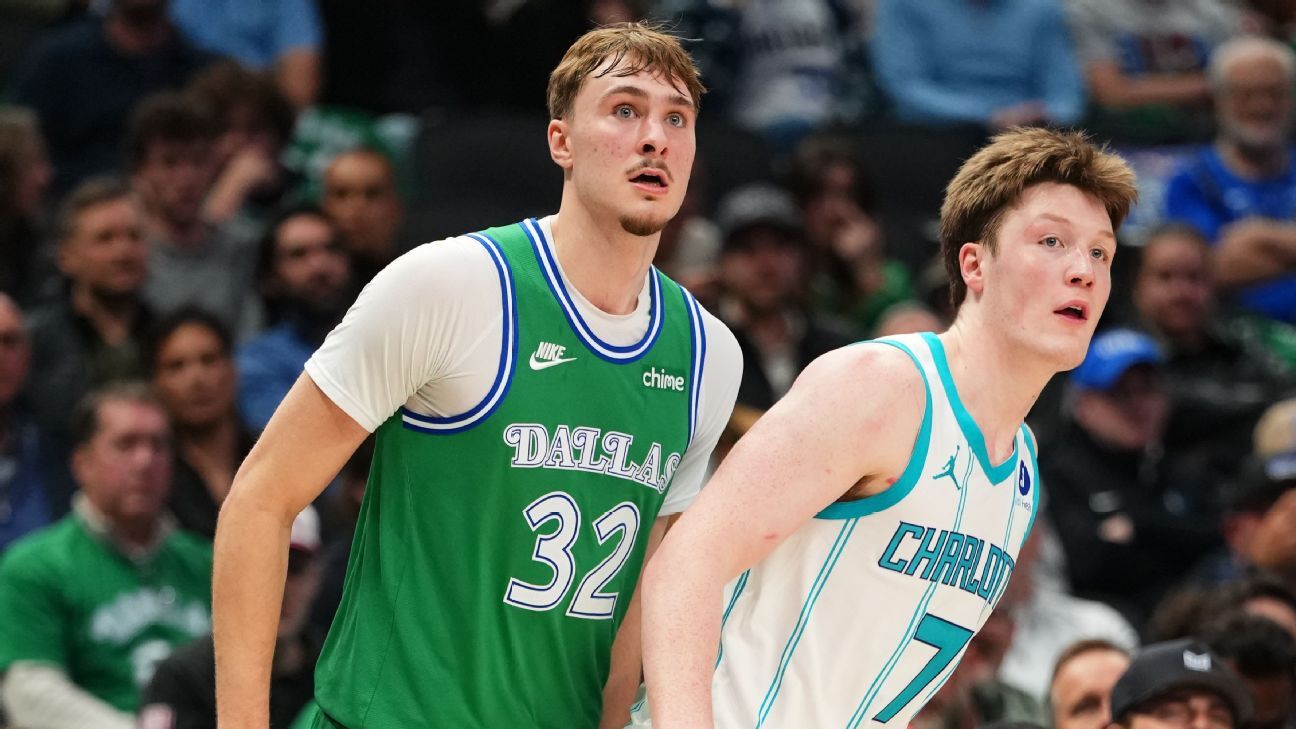
Cooper Flagg claimed the 2025-26 Rookie of the Year award in a razor-thin decision over Charlotte's Kon Knueppel, with the Dallas Mavericks' freshman edging the Hornets' sharpshooter for top honors. Flagg, Knueppel, and Philadelphia's VJ Edgecombe were unanimous first-team All-Rookie selections; San Antonio's Dylan Harper and Memphis' Cedric Coward rounded out the five-man first team. The closeness of the Flagg-Knueppel finish—close enough that Stephen A. Smith felt compelled to publicly defend his ballot choice—reflects a rookie class with genuine, multi-dimensional scoring talent. Neither player ran away with the award.
Flagg's path to ROY tilted on volume and positional versatility rather than efficiency separation. The Mavs deployed him as a primary ball-mover and shot-taker from day one, a dual role that inflated counting stats in a way Knueppel's catch-and-shoot profile never approached. Knueppel's 3-point make rate likely exceeded Flagg's; Flagg's usage rate almost certainly exceeded Knueppel's. The voting split revealed that reasonable evaluators disagreed on the weighting of those levers. That tension matters for year-two prop construction.
Dallas' roster architecture—built around Flagg, Kyrie Irving, and Luka Doncic—has structural limits on offensive rebounds. The Mavericks cannot sustain a system in which Flagg handles 28-30% of possessions and also space adequately. Either Flagg's usage contracts as Irving and Doncic settle into their roles, or the spacing breaks. Second-year Flagg props priced on first-year volume run the risk of regression mechanics that have nothing to do with his skill level. His assists and rebounds will compress if Dallas adds a true secondary creator or if Doncic's health stabilizes. That compression is baked into roster reality, not a bet against Flagg's talent.
Knueppel's unanimous first-team nod, despite losing the ROY vote, signals that his efficiency profile—likely top-five among rookies from three-point range—will anchor his value regardless of role. Edgecombe's inclusion speaks to Philadelphia's offensive structure, which created guardrail opportunity for role players. The key betting takeaway: volume-dependent rookies (Flagg, Coward) face second-year regression risk that efficiency-based rookies (Knueppel, Bailey, Fears) may avoid. When Flagg's 2026-27 season totals open, compare them not to his 2025-26 baseline but to the pace and usage a mature Mavericks roster can sustain. If his points or assists projections carry first-year volume into year two, that's a structural inefficiency in the market, not a prediction error.