Thunder's Defensive Crisis Against Wembanyama Reshapes Conference Finals Odds
By Ty Whitney ·
Oklahoma City's perimeter schemes are breaking down in real time against San Antonio's length, and Shai Gilgeous-Alexander's scoring efficiency collapse signals a deeper structural problem for the favorites.
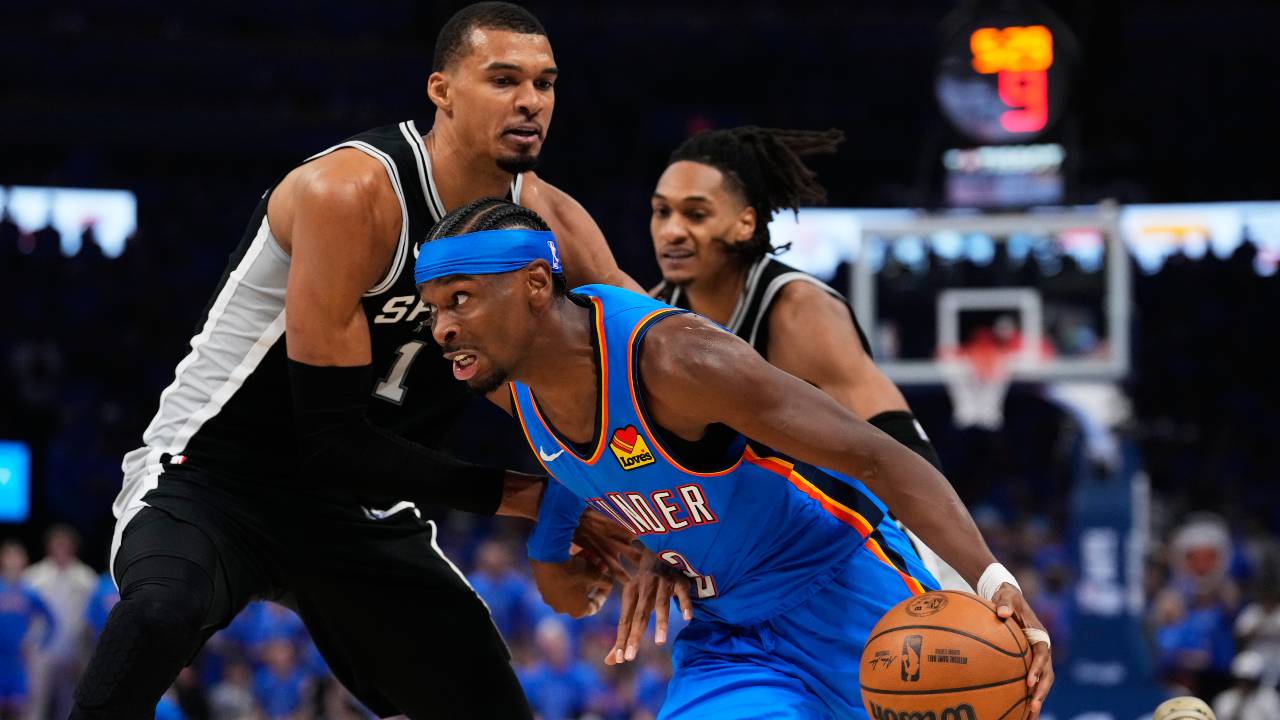
The Thunder walked into Game 4 as the best regular-season defense in the league. They left San Antonio having allowed 103 points on a 36.3 effective field-goal percentage—the lowest-volume, most lopsided offensive output in franchise playoff history. Victor Wembanyama dropped 33 points on 52.6% shooting. De'Aaron Fox added a double-double. The Spurs, trailing in a best-of-seven Conference Finals, seized control through sustained aggression: a 15-0 opening run in Game 3, a 16-0 burst in Game 4. Gilgeous-Alexander's response after Game 4 wasn't defensive bravado—it was acknowledgment. He removed his sunglasses. "They just punched us in the face," he said, and for the first time in a season where he's chased his second straight MVP, the Thunder's lead man sounded genuinely tested.
The mechanical problem is elementary to diagnose but brutal to solve. Wembanyama's 7'4" wingspan collapses passing lanes and forces the Thunder into isolation-heavy offense. Oklahoma City's answer—relying on Gilgeous-Alexander's offensive creation while running switching defense—has inverted into a liability. When forced onto switches, the Thunder's perimeter players either surrender size or rotate into rotational breakdowns that leave cutters unguarded. Wembanyama doesn't need to guard anyone in the traditional sense; he occupies enough vertical space that San Antonio's other four can play with structural freedom. Meanwhile, Gilgeous-Alexander's scoring efficiency has cratered from his season norm. Through four games, he's averaging 24.8 points on 39.2% from the floor and 26.7% from three—a 20-point efficiency gap from his regular season. It's not variance. It's systematic. The Spurs are physically denying him angles, and when he does get space, it's often after the Spurs have reset their defense.
The psychological dimension matters equally. San Antonio's young roster—making their first Western Conference Finals together—is not playing like a Cinderella squad hoping to survive. They're playing like a team with a 7'4" security blanket that allows them to be aggressive from the jump. That confidence translated into those opening minutes where San Antonio outscored Oklahoma City before the Thunder even registered their first field goal. Gilgeous-Alexander's two-game course correction (Thunder won Game 3 away from home after adjusting rotations) suggests some tactical flexibility remains. But every adjustment the Thunder attempt requires Gilgeous-Alexander to generate offense under duress, which is how you arrive at 39% shooting in a playoff series your team is supposed to win.
For bettors, the prop implications are immediate and directional. Gilgeous-Alexander's points line in Game 5 at home likely opened near his season average (29-30 PPG) because books anchor to baseline production. But the Spurs' defensive scheme—built explicitly to compress his operating space—isn't matched by matchup. Home court offers marginal relief: Oklahoma City's fans will create pace advantages, and the Thunder's floor spacing opens slightly. However, Wembanyama's mobility is nearly identical at Paycom Center or San Antonio. If the market hasn't repriced Gilgeous-Alexander's points downward by 2-3 full points from his seasonal norm, the under becomes the sharper play. His last four games saw him at 24.8 PPG; the Spurs' scheme is the constant, not the venue. A line at 28.5 or higher carries structural disadvantage. Conversely, Wembanyama's points total (likely 30+ given his 30.3 series average on elite volume) represents an over with legs—he's not facing adjustment because San Antonio's solution is architectural, not tactical.
The Thunder's path back requires either a personnel rotation that introduces switching flexibility (which Oakland's roster doesn't easily provide) or a return to early-series offensive rhythm that the Spurs' adjustments have successfully suffocated. Neither is probable in a single game. Game 5 at home becomes a prove-it moment for Gilgeous-Alexander, but the evidence from the last two games suggests the Spurs have a durable blueprint. Until Oklahoma City's bench wings can generate consistent gravity against Wembanyama's gravity, Gilgeous-Alexander will continue shooting over 40% from the field and losing.