Joel Embiid's Knee Confidence Is a 2026-27 Prop Setup, Not a 2026 Playoffs Story
By Erik Schwartz ·
Embiid just played 38 games and still helped the Sixers pull off a 3-1 comeback — if he actually stays healthy next season, every prop line he gets will be underpriced.
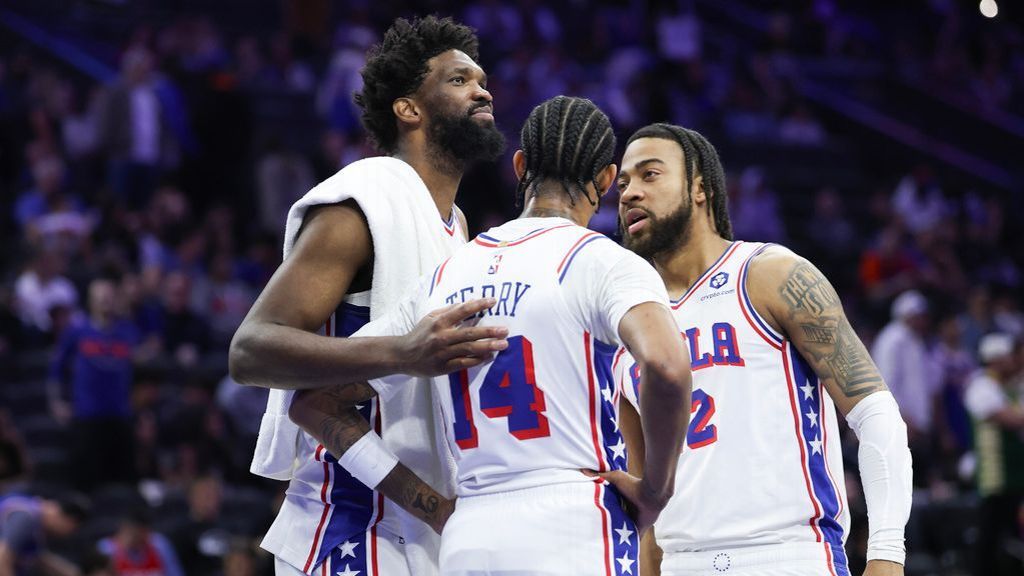
Joel Embiid walked off the Wells Fargo Center floor Sunday after a 144-114 Game 4 demolition at the hands of the Knicks — a sweep that ended Philadelphia's season on its own court in front of a building packed with New York fans — and delivered a message that will matter far more in October than it does today. As ESPN reported, Embiid told reporters he is "as confident as I've ever been" about his knee health and said he is no longer thinking about the injury that has shadowed him for years. Whether you believe him or not is the entire betting question going forward.
The raw numbers on Embiid's availability are brutal and they context everything. Ten seasons in the league, 490 games played — that's a 49-game average before you factor in the two lost years at the start of his career. This postseason alone he returned from an emergency appendectomy, missed Game 2 of the Knicks series with right hip and ankle injuries, and was visibly compromised through Games 3 and 4 after Tyrese Maxey fell into his legs late in Game 7 against Boston. Coach Nick Nurse's postgame praise was honest — "he gave us everything he could" — which is another way of saying Embiid was running on fumes against New York from the opening tip.
The cruel irony is that Embiid flashed the highest ceiling of his postseason career before the Maxey collision scrambled everything. His Games 5-through-7 run against Boston was the best three-game stretch of his playoff career by most measures, and he single-handedly made the Sixers the fourth team in NBA history to overcome a 3-1 deficit as the lower seed. The version of Embiid that existed before that Game 7 collision is a 35-plus point, 11-plus rebound monster on any given night. The version that showed up in the ECF semifinals was a compromised shell — and Vegas knows the difference.
Here is where the prop-bet calculus gets interesting for next season. Oddsmakers set Embiid's per-game lines conservatively precisely because availability uncertainty suppresses sample size and invites injury discount. If Embiid plays 60-plus games in 2026-27 — which his offseason optimism and a full summer of knee work could plausibly support — his points and PRA props will be systematically set too low in the early-season market, before the books recalibrate. His career per-36 numbers sustain a 30-plus point, 11-plus rebound pace when healthy. Early-season points props in the 27-29 range and PRA lines under 40 would carry real over value, particularly in home games where his usage rate historically spikes.
The caveat is real and it is not small: Embiid has given the "next year will be different" speech before, and the injury history is not noise — it is the signal. The smart play is not to go all-in on Embiid health optimism today. It is to bookmark this offseason narrative, monitor his preseason availability in October, and lean hard on his over props in the first two weeks of the regular season if he shows up to training camp intact. Books will be slow to adjust. That lag is the edge.