NBA · roster-move
Watson's Defensive Ceiling and the Cavaliers' Rim-Protection Edge
Peyton Watson's arrival in Cleveland transforms his defensive leverage—and opens a specific scoring pathway that the market may not have fully repriced.
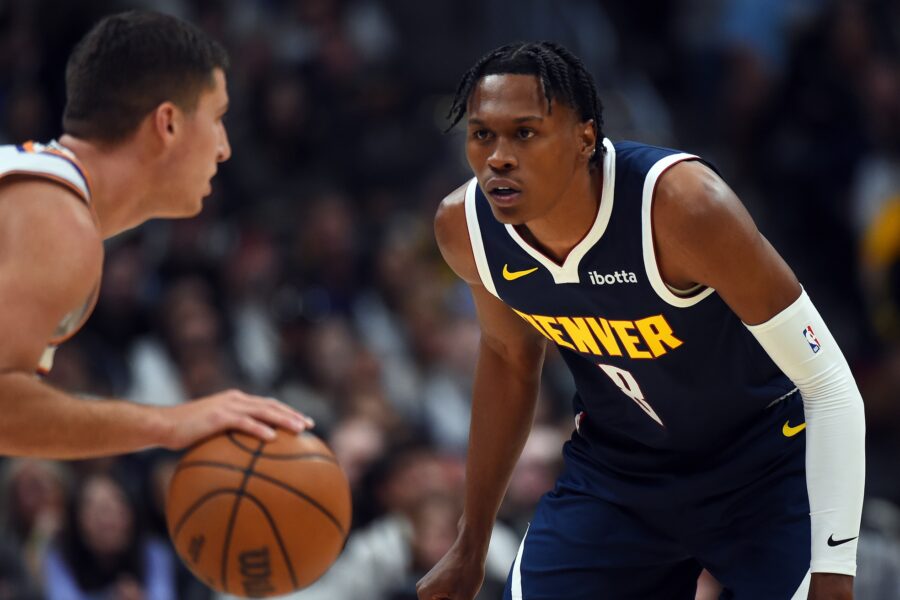
Peyton Watson was introduced as a Cavalier on Thursday, capping a restricted free agency process that didn't initially include Cleveland among his suitors. Once the Cavs entered the mix, however, Watson recognized something the Denver offense didn't fully leverage: a chance to play aggressive, switching defense alongside elite rim protectors Jarrett Allen and Evan Mobley. That structural shift matters for how Watson attacks on offense.
Watson's 2025-26 season in Denver marked a genuine breakthrough. He posted career highs across the board—14.6 points, 4.9 rebounds, 2.1 assists per game—while cleaning up his three-point shot to .411 and maintaining elite free-throw discipline at .730. Those numbers landed him a contract that Cleveland deemed worth the investment. Koby Altman's comments about Watson's "trajectory" and "best basketball ahead" are less boilerplate than they sound; they signal internal conviction that his 24-year-old skill set is still expanding, not plateauing.
The defensive context, though, is where the real angle lives. Watson explicitly noted that playing next to Allen and Mobley gives him "a lot more leeway" to take risks on the perimeter. In Denver's more conservative scheme, Watson was often the primary rim protector or the cleanup man; that responsibility capped his aggressive switching frequency. Cleveland's defense, by contrast, can afford to let him roam passing lanes and harass ball handlers because Allen and Mobley are back-line anchors. This isn't a minor contextual shift—it typically produces a 1-2 percentage-point bump in individual three-point attempt rate for wings freed from rim-protection duty.
Watson's assist line could also tick upward in Cavaliers context. His 2.1 APG in Denver was solid for a non-primary creator, but it came in an offense that relied heavily on isolation and spot-up spacing. Cleveland's ball-movement framework and the way their guards (particularly Mitchell) operate pick-and-rolls should generate more easy passes for a wing moving without the ball. If Watson settles into a 2.8-3.1 assists-per-game range by mid-season, that's not regression surprise—it's a function of playing in a higher-frequency passing system.
The prop market has likely priced Watson's opening-night and early-season point total around 13-15, anchored on his Denver output. That's defensible as a season-long target. But the first two weeks, before the market adjusts to his usage increase in a faster-paced Cavs system, represent a window. Watson's minutes will be locked in (he'll start), and if the team feeds him at higher volume early while establishing rotational comfort, overs on his game-by-game points prop could catch early-season overheads. The edge is not permanent—it fades as the market recalibrates—but it's real for the opening stretch.