George's Celtics Gambit: Injury Recovery Meets Skeptical Fanbase
By PropBetEdge Editorial Team ·
Paul George enters Boston as a proven scorer tasked with healing both his body and a fractured roster, but the production bar is set by the superstar the Celtics surrendered.
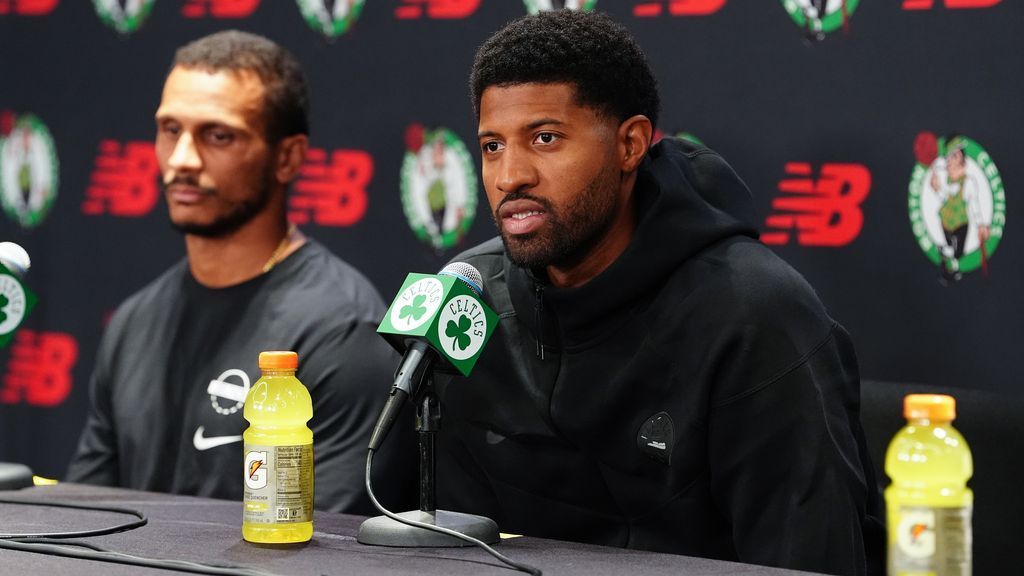
Paul George took the podium at the Celtics' introductory news conference on September 15 and did something deliberate: he acknowledged the elephant in the room without flinching. Boston's front office moved Jaylen Brown—the 2024 Finals MVP—to Philadelphia in July to acquire George, the 36-year-old forward now on his fifth NBA team. The reception from Celtics fans has been skeptical at best. George leaned into that friction rather than dodge it, understanding that credibility in Boston gets earned through performance, not platitudes.
The context matters for projecting his impact. George arrives amid a roster reconstruction led by president of basketball operations Brad Stevens, flanked by 38-year-old Mike Conley (his 20th season, fourth team) and Mitchell Robinson fresh off a Knicks championship. The centerpiece remains Jayson Tatum, who is ramping up following his May 2025 Achilles tear and a late-season shutdown last year that ended with Boston's first-round Game 7 loss to—notably—George and the 76ers. Stevens has had weeks of workouts with his new trio alongside returning Celtics pieces. The composition is one of a veteran recalibration rather than a youth infusion: shooting, spacing, perimeter defense, and continuity around an Achilles-recovery Tatum. Training camp begins in two weeks.
George's own injury narrative is the lens through which his production should be measured. He framed his last few years as "rough, just with injuries" and signaled that he believes he's "turned that corner of dealing with injuries." That's the claim—not just returning, but returning sharp. For a 36-year-old wing, that recovery trajectory is not guaranteed to translate to 30-plus minutes per night or the usage rates he commanded in his prime. Workload management will be real. The Celtics are not gambling on George as a volume creator; they're betting on his efficiency as a secondary scorer and his perimeter defense as a platform to unwind defenses for Tatum.
From a prop perspective, George's scoring line carries embedded volatility. Early-season markets will price him as a star-tier scorer (likely in the 20-23 points per game range), but that's anchored to recency—his reputation—not his current medical or usage reality. The mechanism for an under is structural: he's a 36-year-old forward returning from injury years, working within a Tatum-first system, alongside two other high-touch players (Conley, Robinson). His true-play workload may trend toward 17-20 ppg with spotty consistency until the team's offensive identity crystallizes. His rebounds and assists are likely secondary beneficiaries; the Celtics didn't acquire George to be a playmaker. The first few games will feature him hunting for rhythm and acceptance from the crowd—a distraction that historically inflates shot volume without proportional efficiency. That window (games 1-4) is where an under on George's early scoring has premium juice before the market corrects to his actual role.
The Brown trade's emotional residue also floors his ceiling on certain nights. Celtics fans will cheer when he delivers, but the implicit comparison is built in: every George three-pointer is not a Brown dunk; every George assist is not Brown's perimeter gravity. That psychological undertow is invisible in traditional analytics but visible in betting markets the moment it shows up as a 5-2 shooting night or a quiet third quarter. His assist total (likely 2.5-3.5) is the safer contrarian lever—fewer touches, lower variance, and less subject to crowd sentiment.