All-NBA Honors Signal Confidence in SGA and Murray—But Playoff Pressure Resets the Prop Market
By Erik Schwartz ·
SGA's first-team selection and Murray's inaugural All-NBA nod validate their regular-season excellence, yet postseason leverage and usage patterns in elimination games tell a different story for player prop betting.
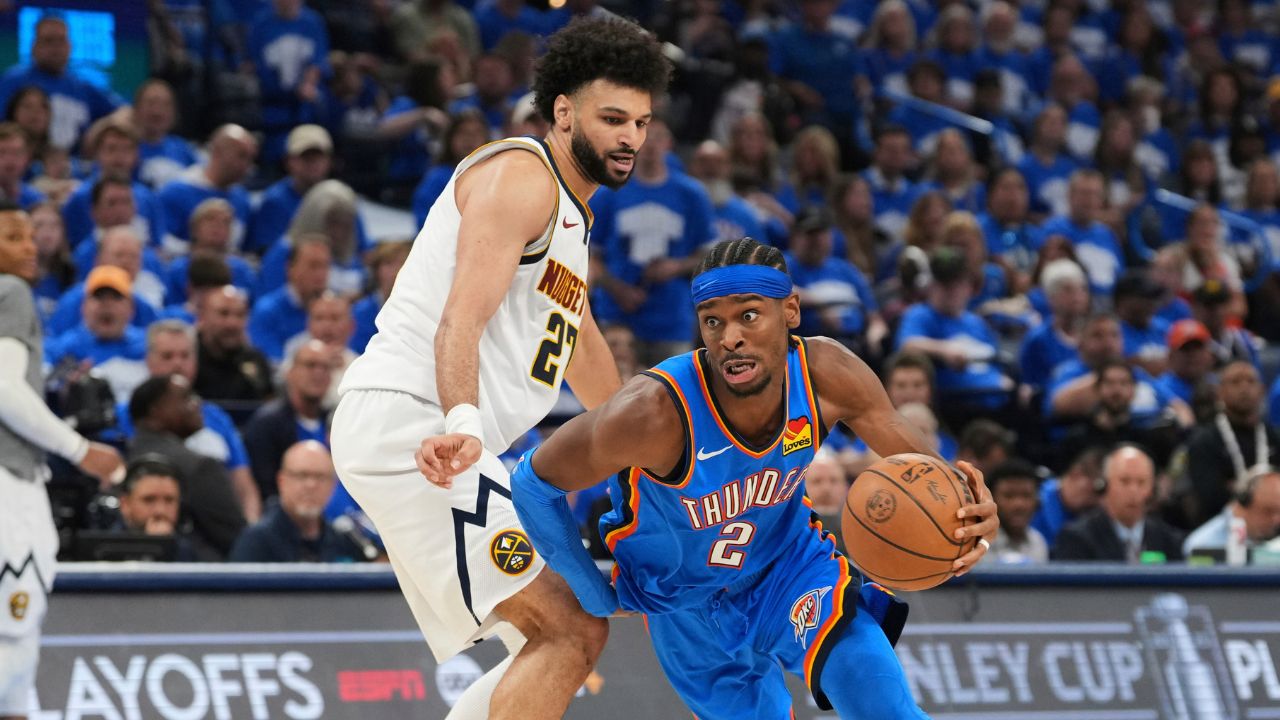
Shai Gilgeous-Alexander and Jamal Murray claimed All-NBA honors on Sunday, cementing their places among the league's statistical elite. Gilgeous-Alexander earned first-team selection for the fourth time in his career—a recognition of his offensive dominance and two-way consistency. Murray's third-team honor marks his first All-NBA appearance, a validation of his Denver tenure and elevated role as a co-star alongside Nikola Jokic, who also landed first-team.
The accolades reflect a regular-season reality: SGA's scoring efficiency, volume, and playmaking all peaked this cycle, while Murray's three-point shooting and offensive efficiency improved markedly under Denver's spacing architecture. Both players' numbers—particularly their assist rates and shooting percentages—stack cleanly against historical peers. Yet All-NBA selection is a rear-view mirror, a regular-season verdict delivered after the playoffs have already begun to reshape opportunity and risk.
Here's where the betting dynamics diverge from the honor roll. SGA operates in a Thunder offense engineered around his isolation touches and pick-and-roll gravity; when Oklahoma City faces defenses built to blunt perimeter creation, his scoring volume and assist rates flatten. Murray's case is more nuanced: his All-NBA run coincided with Jokic's health, and in elimination games where Denver has faced switching defenses, his on-ball touches shrink as the offense consolidates around Jokic's playmaking. All-NBA voters didn't weight playoff pressure or opponent-specific defensive coverage; sportsbooks are already trying to.
The prop implication hinges on volatility and leverage. SGA's regular-season 28.5 PPG line will carry downside risk in tight playoff series where opponents deploy wing defenders comfortable fighting through screens—his scoring floor compresses. Murray's 19.2 PPG season average masks a wider swing between co-star status (when Jokic gets extra attention) and secondary role (when Denver faces rim-running bigs that pull Jokic into defense). The All-NBA naming likely pushed market perception of both players' ceilings higher; the efficient strategy is to fade both players' scoring overs in the next round at opening numbers, anticipating that playoff scheme variation and defensive intensity will compress their regular-season averages by 2-4 points per game.
Neither player's honor changes their talent or role. What changes is the market's confidence in applying regular-season performance to a postseason environment where opponent switching, defensive load, and usage volatility matter more than season-long efficiency.