Caleb Love's Sixers Move: Depth Shooter Joins Contender Off Solid Rookie Year
By PropBetEdge Editorial Team ·
Philadelphia bolsters its perimeter depth with a two-way contract for the Portland guard who averaged 10.4 points as a rookie.
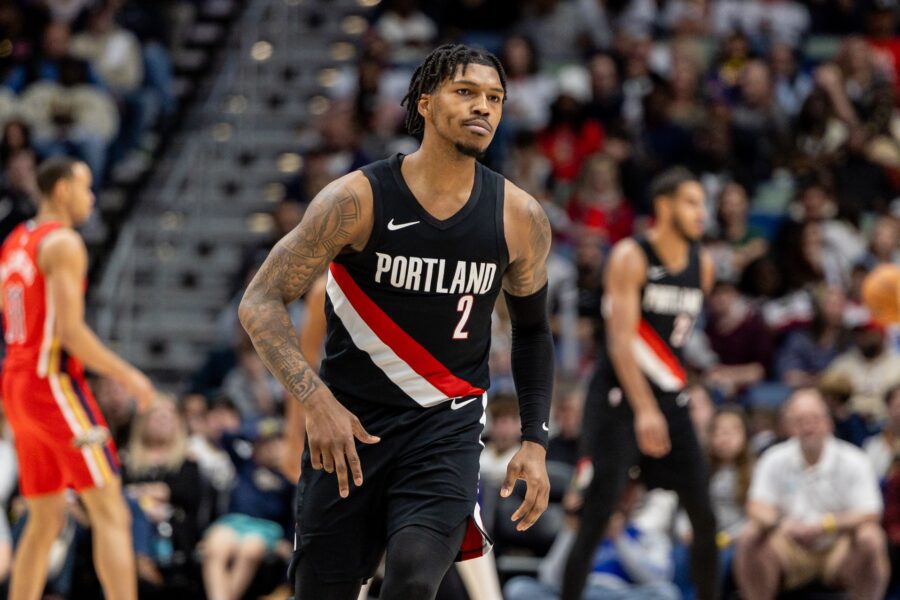
The Sixers have signed Caleb Love to a two-way contract, bringing in the 24-year-old guard after his inaugural season with the Trail Blazers. Love, who spent five years in college across North Carolina and Arizona before signing with Portland last summer, appeared in 49 games for the Trail Blazers as a rookie, including one start, and averaged 10.4 points per game alongside 2.3 assists.
Love's path to the NBA was unconventional—five collegiate seasons is a red flag for most scouts, suggesting either recurring injuries or a slow-burn development arc. The fact that he landed on a two-way contract initially tells you the market valued him as a rotation spare part, not an immediate rotation player. But his rookie year in Portland showed enough to catch Philadelphia's eye: a guard who can knock down perimeter shots and won't lose you possessions when he enters the game. That's the floor value of any NBA depth acquisition, and Love apparently cleared it.
For the Sixers, this is a classic marginal upgrade play. They're not counting on Love to move the needle in a playoff series. They're adding a third or fourth guard who can shoot and won't clog spacing in an already shot-hungry system built around Joel Embiid and Tyrese Maxey. Two-way deals offer front offices optionality without cap commitment—he can spend time in the G League, earn his way into heavy minutes, or sit dormant depending on injury and performance. Philadelphia gets those options at minimal cost.
From a betting lens, Love's role matters less than what his addition signals about Sixers depth strategy. The team is investing in wing and backcourt volume—shooter-oriented depth—which typically favors pace-and-space systems and elevated team totals when all rotation members are healthy. Love's own prop line will likely open depressed given his likely reserve status (his 10.4 PPG in Portland came in a squad lower on the depth chart). However, if he cracks consistent rotation minutes—a scenario that surfaces if injuries strike or if he outplaces competitors in training camp—his scoring line could be mispriced for a single-game exploit. That edge is timing-dependent: it exists only before the market prices in his actual role, a window that closes within the first week of games. For now, treat him as a depth signal, not a featured prop play.