Quinn's Chicago Interview Signals Stability Risk for Heat's Organizational Engine
By Ty Whitney ·
The Heat's loss of their most prominent assistant to a head-coaching search exposes Miami's bench-depth vulnerability at the exact moment their core needs continuity most.
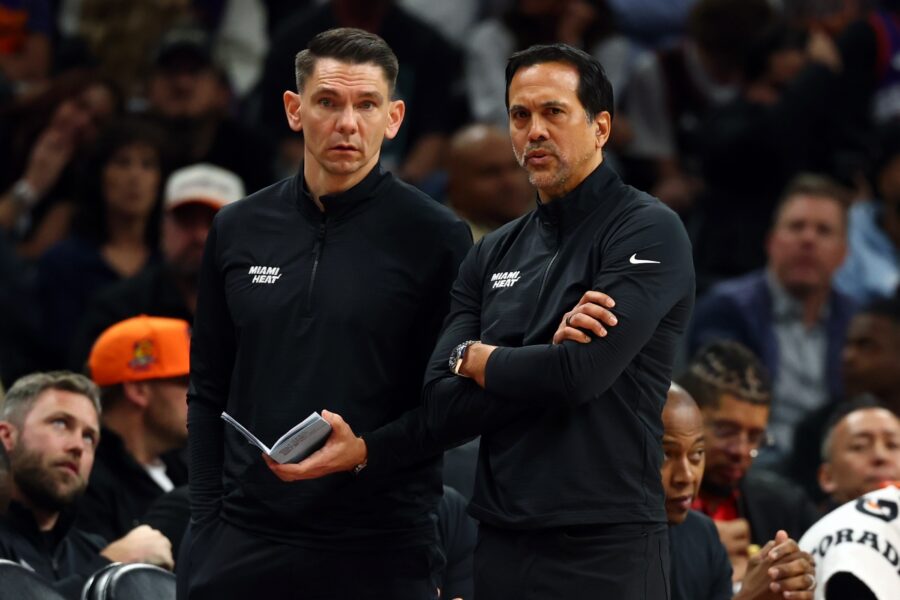
Chris Quinn is interviewing for the Chicago Bulls head-coaching job after the Heat granted permission, per The Miami Herald. Quinn has been Spoelstra's associate head coach since 2024 and a fixture on Miami's staff since 2014—a 12-year tenure that positions him as the organization's second-most visible basketball mind. The Bulls fired Billy Donovan last month and are casting wide for replacements; Quinn joins a crowded candidate list that includes Sean Sweeney, James Borrego, and Wes Unseld Jr.
Quinn's annual appearance on coaching radars reflects real executive respect. He's been connected to Phoenix, Los Angeles, Cleveland, Milwaukee, Detroit, and Toronto openings over the past three seasons. That sustained interest from multiple franchises isn't noise—it's a market signal that Quinn's fingerprints on Miami's defensive schemes, player development, and game planning carry tangible weight. His background as an NBA point guard (2006–13) gave him on-court credibility with guards; his transition through Northwestern and into Spoelstra's system created a pipeline for organizational knowledge that's harder to replace than the typical assistant spot.
What matters for Miami's prop ecosystem is the timing and infrastructure fragility underneath. The Heat won 46 games last season with a core rotation that depends on health and execution discipline—the exact areas where coaching continuity shows up. If Quinn departs to Chicago, Spoelstra loses an associate who's handled player relations, offensive conceptualization in certain lineups, and institutional memory on opponent tendencies. The Heat would need to promote internally or raid another staff mid-offseason, a disadvantage that typically manifests in early-season execution variance and communication lag in pick-and-roll situations and transition defense.
For prop bettors, this creates a tradeable window. Miami's team total and moneyline prices will likely stabilize once a new associate is named, but uncertainty about coaching-staff depth can suppress preseason projections artificially. If Quinn takes the Chicago job, Miami's win total and first-half point spreads may trade soft relative to their actual roster quality—the market fears a coaching void, not a talent void. Conversely, if Quinn stays (or Miami's front office quickly promotes someone credible from inside), those same numbers will reprrice upward sharply. The mechanism is simple: coaching continuity compounds with player health to determine execution quality. Loss of continuity = variance spike = flatter team pace, slower offensive sets, delayed defensive rotations. Bettors should monitor Quinn's decision closely over the next 5–7 days; once it resolves, Miami's season-long pricing will recalibrate decisively.