Porter Jr. Stays Put in Milwaukee: A $5.4M Validation of Depth-Starved Backcourt Reality
By PropBetEdge Editorial Team ·
Kevin Porter Jr.'s decision to pick up his player option signals the Bucks are banking on continuity in the backcourt—but his value proposition carries real constraints.
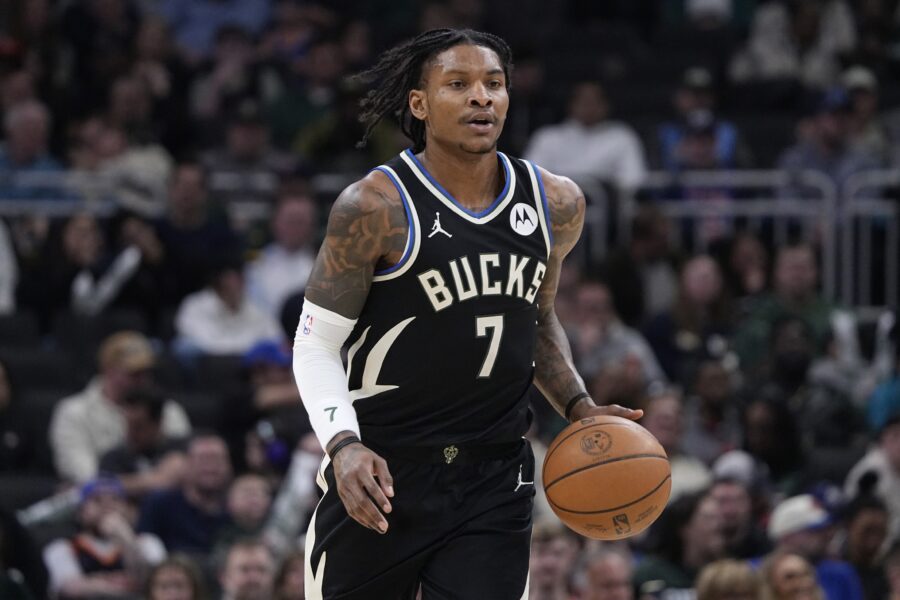
Kevin Porter Jr. has exercised his $5.39 million player option to remain with the Milwaukee Bucks for the 2026/27 season, per Michael Scotto at HoopsHype. The move locks him into the roster alongside Damian Lillard as the Bucks attempt to stabilize after a disappointing 2025/26 campaign that fell short of championship aspirations. Porter's willingness to stay at that salary point—well below what he might command on the open market—reflects both organizational continuity and a sobering reality about the guard rotation's depth.
Porter appeared in 38 games last season before a knee injury short-circuited his availability down the stretch. When he was on the court, he functioned as the secondary ball-handler in Milwaukee's offense, a role that inflated his usage metrics relative to his actual impact tier. The Bucks' guard depth suffered significant attrition, making Porter's playmaking and size advantage at the position (6'2", with legitimate handles) more valuable by necessity than by absolute talent ranking. His per-game numbers benefited from high-volume opportunity in a limited talent ecosystem—a crucial distinction when projecting forward.
The persistent gap in his game remains his three-point shot consistency. Porter has never shot north of 32% from deep over a full season, a genuine constraint on his ceiling as a wing guard in modern spacing-dependent offenses. Paired with Lillard, who demands considerable offensive gravity, Porter is destined for secondary creation duties rather than primary scoring burdens. That role definition—third option, run-the-offense-when-Lillard-rests—is precisely where a $5.4M salary makes sense for both sides.
From a prop-betting lens, Porter's injury history and limited three-point reliability create a ceiling on his playmaking volume. In games where Milwaukee goes small and pushes pace, his assists could spike above 5.5 given the Bucks' backcourt scarcity; in half-court, half-court sets where spacing suffers, his touches compress. The real edge lies in fading his three-point make totals (he's unlikely to sustain 1.8+ threes in heavy minutes) and instead targeting assist props during uptempo matchups where his ball-handling becomes the primary offensive engine. His points props offer minimal edge given the volatility around his minutes and the Bucks' tendency to load those touches onto Lillard in tight games.
Porter's decision to stay also anchors the Bucks' pivot away from major free-agent spending at the guard spot. They're committing to internal continuity—Lillard plus a high-variance secondary playmaker rather than a third-star acquisition. That organizational lean-in matters for total-offensive output: expect Milwaukee's team totals to remain conservative relative to historical benchmarks, a byproduct of forced role consolidation rather than elite roster construction.