Duren's Postseason Collapse Reshapes Pistons Contract Math—and Playoff Prop Leverage
By PropBetEdge Editorial Team ·
A 55% scoring drop in the playoffs has gutted Detroit's interior presence and handed a max-contract escape clause to teams with cap space—but the real betting angle lies in how the Pistons will respond to forced bench minutes.
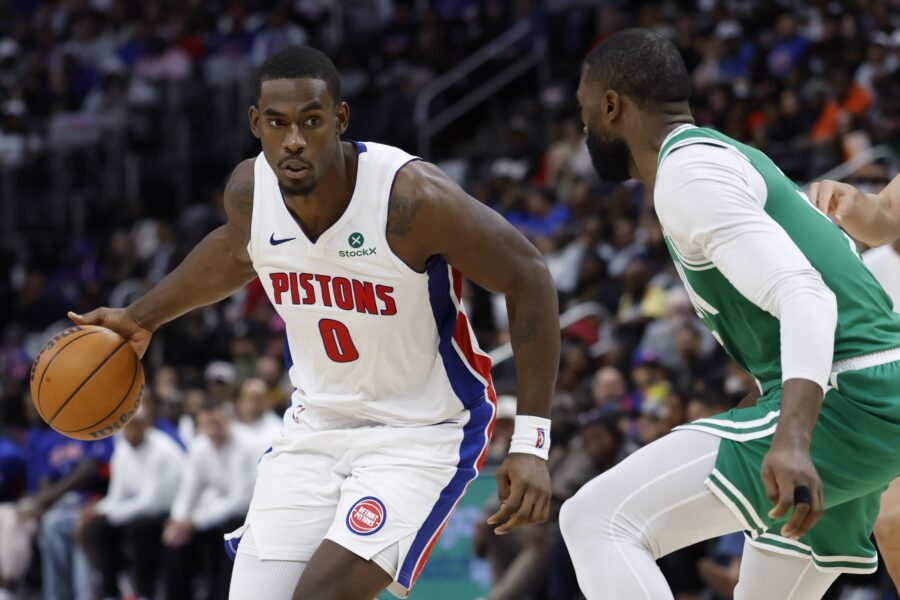
Jalen Duren's postseason implosion has become the Pistons' most costly problem. The 23-year-old center logged 22.6 points and 10.7 rebounds on 67.8% shooting in the 25-game stretch following the All-Star break, a statement of dominance for a team banking on interior size. In the playoffs, he has evaporated: 10.1 PPG and 8.3 RPG across 12 games, shooting efficiency cratering while Detroit's spacing and rebounding margin have suffered proportionally. By the fourth quarter of Game 5, Duren was riding the bench entirely—benched for Paul Reed—a public indictment of his impact when stakes matter most.
The timing compounds the Pistons' structural problem. Duren enters restricted free agency this summer in a weakened negotiating position. Per ESPN's Brian Windhorst, one Eastern Conference executive spelled out the trap: the Pistons likely have to offer him max money to ward off offer sheets from cap-flush teams like Chicago or Brooklyn, even though his postseason tape suggests he doesn't deserve one. The new NBA apron rules make matching those bids more expensive than ever. It's a forced transaction, not a choice—a tax on poor playoff execution.
What the market hasn't fully priced is Duren's bench-heavy deployment going forward. The Pistons, after witnessing his fourth-quarter disappearing act, will rotate him off the floor in closing situations. This shifts usage patterns across the roster. Backup centers get minutes that compress Duren's volume; guards gain offensive freedom without interior gravity. For bettors tracking the Pistons' next playoff run or regular season following this offseason, Duren's prop ceilings—rebounds, points—should trend downward relative to his pre-All-Star baseline. He's not suddenly less talented; he's operationally less reliable in the moments that decide games.
The same arc applies to Ausar Thompson, Detroit's defensive-first wing. Despite Defensive Player of the Year candidacy, Thompson made six three-pointers all season and shot 57.1% from the free-throw line—elite-level offensive liability. He too has been benched in crunch time, a signal that the Pistons' coaching staff doesn't trust his closing value. Yet league insiders peg his rookie-scale extension at $25 million annually, matching what Dyson Daniels and Christian Braun received. The Pistons may well pay it anyway, trapped by the same cap mechanics that force the Duren max. Both men will carry inflated salary expectations relative to their actual postseason utility—a marker that their individual prop lines will widen (less confidence in projections, wider margins) even as their roles narrow on court.
For prop bettors, this creates a distinct edge: Pistons role players will receive a temporary minutes boost as the team experiments with other frontcourt combinations. Center Paul Reed, who forced Duren to the bench, will spike in short-term availability. Rebound totals for Detroit's bench units should lean over early-season projections before the market reprices the team's likely full-roster reset. But Duren and Thompson's individual prop ceilings—points, assists, rebounds—should be faded in any future matchup where the Pistons are competitive, because the coaching staff has already demonstrated it will remove them in tight games. That's not a performance issue; it's an operational blueprint now exposed on tape.