Reaves Opt-Out Sets Lakers Up for a Summer of Hard Choices
By PropBetEdge Editorial Team ·
Austin Reaves declining his player option transforms the Lakers' offseason from roster tinkering into potential roster reconstruction.
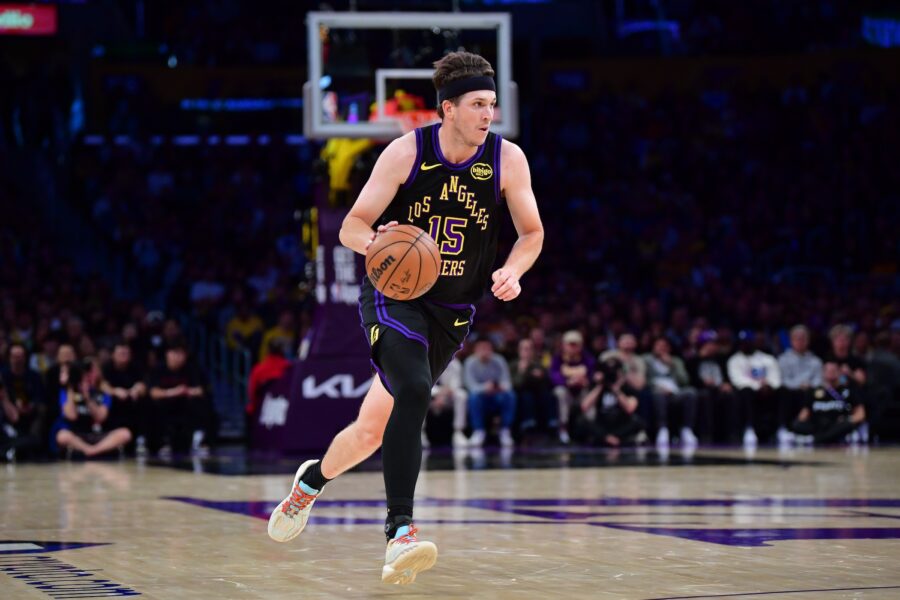
Austin Reaves is expected to decline his 2026/27 player option within weeks and hit the unrestricted free-agent market, per reporting from Broderick Turner of The Los Angeles Times. That decision, while not yet official, opens a window onto the Lakers' salary structure and their willingness to spend for continuity at guard.
Reaves has evolved into more than a complementary piece since the Lakers acquired him in 2021. Over the last two seasons, he's averaged 15.2 points and 5.8 assists, operating as a secondary playmaker and a switchable defender who can handle both guard and wing assignments. His efficiency—52% from the field, 38% from three, 82% from the line last season—sits well above league average across all three zones. That skill set, paired with his age (27) and positional flexibility, makes him one of the more coveted free agents available. The max contract market for a player of his profile typically starts around $25 million annually, with some franchises willing to push higher.
The Lakers face a classic constraint: keeping Reaves at top-market rates requires either shedding salary elsewhere or accepting a deeper luxury-tax bill. LeBron James is signed through 2027/28, and Anthony Davis carries a full no-trade clause. Both are untouchable. That means any Reaves extension crowds out secondary moves—depth signings, mid-tier trade acquisitions, or flexibility in the draft. The franchise has to choose between paying a guard his market rate or using that capital for frontcourt depth or a speculative trade target.
From a betting perspective, this clarifies the Lakers' likely composition through the 2026/27 season. If Reaves re-signs, the team's offensive production tilts back toward ball-movement and three-point volume; his assist rate and three-point frequency anchor the spacing that allows LeBron and Davis to operate in more efficient positions. If he walks, expect the offense to become more isolation-heavy and potentially more turnover-prone, as the playmaking burden shifts to James or deeper into the rotation. The team total and pace-of-play markets react to roster construction shifts like this. A Reaves exit could depress the Lakers' projected offensive rating by 2-3 points per 100 possessions, depending on who fills the vacated minutes.
Markets will overshoot once a decision is announced. The instinct will be to treat a free-agent departure as a net negative and reprice team totals downward reflexively. But context matters: if the Lakers retain Reaves, you're paying for a known quantity and higher payroll. If he leaves and they redirect that money toward a secondary scorer or a defensive upgrade in a different position, the team's ceiling might not crater as much as early-line movers suggest. The real edge surfaces after the first round of market adjustment settles—when you can compare the Lakers' projected starting five to the line the public has already moved.