Towns Extension Standoff Signals Knicks Cap Strategy Shift
By PropBetEdge Editorial Team ·
Karl-Anthony Towns faces a $272MM extension offer that could reshape New York's roster flexibility and championship window timing.
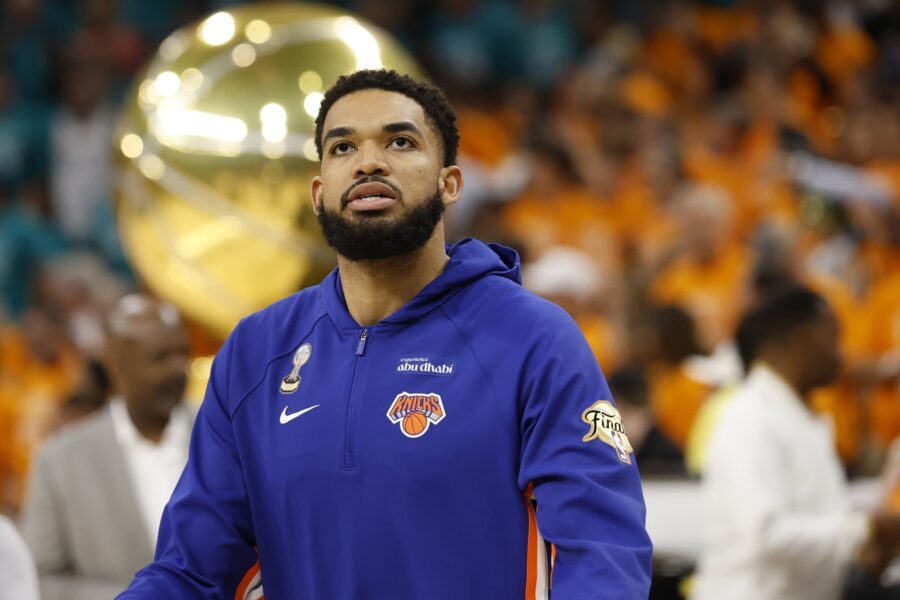
The Knicks are confronting a rare leverage problem: they won a championship in June with their current core, yet their star power forward is positioned to demand maximum-level compensation that could handcuff the front office for years. Per reporting, Towns will earn $57.1MM next season with a $61MM player option for 2027-28, but he's eligible for a four-year extension worth approximately $272MM—a $68MM annual value that would rank among the league's richest contracts. The decision towns makes in the coming weeks will determine whether New York operates as a closed roster or retains flexibility to upgrade the margins.
The math creates a genuine fork. If Towns declines his option and tests free agency next offseason, he'd command roughly $266.6MM over four years—essentially the standard veteran maximum. If he exercises the option and waits until 2028 to hit the market, he could extract an even larger deal as a free agent than he'd receive as an extension candidate today. This structure inverts the usual team advantage in extension negotiations. Towns holds the information and the timing, which explains why the Knicks' front office is likely hoping he'll follow Jalen Brunson's lead from his own recent deal: accepting below-market value to preserve organizational cap space. Brunson's discount was framed as championship-team loyalty. There's no indication Towns intends to replicate that sacrifice.
Philadelphia's aggressive roster construction—adding LeBron James to a core already featuring Joel Empiid, Jaylen Brown, and Tyrese Maxey—raises the implicit pressure on New York's decision-makers. The Knicks chose not to pursue James after he commuted from Manhattan to Philadelphia, a choice predicated on confidence in their existing roster's ability to repeat. That confidence will be tested immediately in the postseason. If the Knicks stumble in the playoffs while Philadelphia's superteam gels, the organization will face criticism for both failing to trade for additional star power and failing to lock Towns into an extension while his market value was still determinable. A championship roster's championship window is notoriously narrow; the Knicks are betting theirs remains open longer than conventional wisdom suggests.
From a betting perspective, Towns' contract status directly influences New York's team total volatility and individual-player prop ceilings. A franchise forced to operate under hard cap constraints will struggle to add scoring depth off the bench, which compounds the offensive load on the backcourt and Towns himself. If Towns signs the extension—accepting the $68MM annually—the Knicks signal they're committed to this exact roster composition through 2029-30, removing future trade flexibility and cementing a "go small" wing-and-stretch-four identity. That locks in Towns' usage rate and three-point volume: fewer ball-handlers competing for touches, more reliance on his shooting to create spacing. Conversely, if Towns allows his option to vest and pursues 2028 free agency, the Knicks will operate this season with uncertainty hanging over the roster, potentially limiting mid-season acquisitions and creating internal tension on long-term commitments. Towns' scoring and three-point totals should remain sticky regardless, but the extension outcome shapes whether those totals climb or plateau over the next three seasons.
The Sixers' LeBron signing is the shadow over this negotiation. Philadelphia just signaled it believes in championship construction through superstar accumulation; New York's counter-signal is "we believe in continuity." One of those philosophies will be vindicated in June 2027. For prop bettors, that vindication timeline matters: take Towns' team-total unders with caution until his extension status is resolved, as cap paralysis is a silent drag on offensive ceiling that may not immediately appear in trading volumes or line adjustments.