Ajay Mitchell's $9M Deal Shows Why the Thunder Keep Winning the Roster-Building Game
By Ty Whitney ·
Oklahoma City's second-year guard is posting MVP-caliber efficiency in the playoffs—and he's locked in at near-minimum wages, a structural advantage that will ripple through betting markets for years.
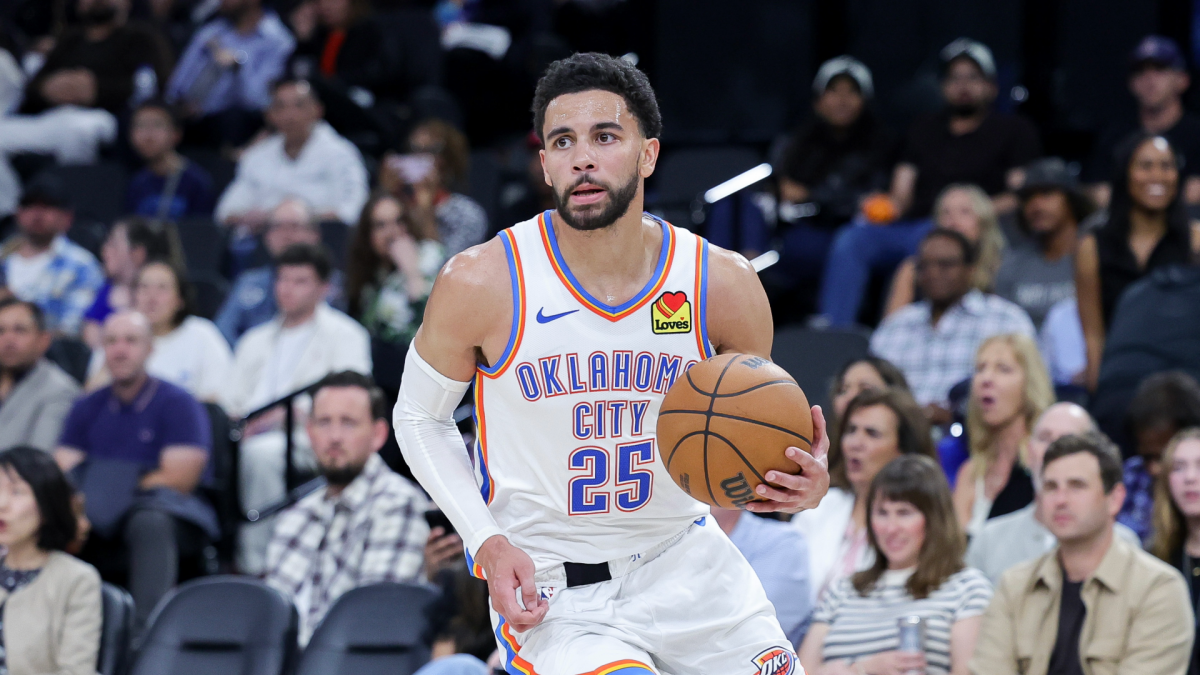
Ajay Mitchell is playing like a future star. In OKC's second-round series against the Lakers, the second-year guard has matched the reigning MVP's production on better efficiency, and the frequent comparisons to Jalen Brunson are no longer hyperbole. The Thunder converted his two-way deal midseason, then extended him to a three-year, $9 million contract—a move that now looks like one of the shrewdest cap maneuvers in basketball.
Mitchell's origin story is unconventional. A 38th-overall pick who grew up in Belgium, played overseas, and attended UC Santa Barbara, he arrived in Oklahoma City with minimal pedigree. Summer league performance and early-season flashes earned him regular rotation minutes, but a toe injury in January 2025 derailed his trajectory. That injury proved crucial to the Thunder's strategy: with Mitchell sidelined and his future uncertain, OKC pivoted. Rather than convert him to a standard minimum deal—the default path—they leveraged their mid-level exception to offer a two-year, $6 million commitment with a team option. An injured, unproven second-rounder took the security. The Thunder got a three-year asset locked in at cap-friendly rates.
This is Sam Presti's blueprint in miniature. Oklahoma City systematically identifies talent before the market does, then uses strategic timing and information asymmetry to secure long-term control at below-market rates. Mitchell was a high-variance prospect when signed to the extension; the Thunder were betting on trajectory, not current production. That bet is already paying off in real time. His playoff efficiency and playmaking are forcing defenses to account for him differently, which reshapes how opposing teams game-plan against the Thunder's three-star core.
For bettors, Mitchell's locked-in contract has structural implications. OKC's payroll efficiency with Mitchell, paired with similar deals on role players, gives the franchise flexibility to maintain a championship roster without hitting the second apron. That translates to roster stability—fewer mid-season trades, fewer desperate additions. A stable Thunder roster favors consistent team-total and spread pricing; the fewer surprise rotational changes, the more reliable prop models become. Mitchell's playoff emergence also shifts the scoring distribution within OKC's offense. He's now a reliable secondary scorer behind Shai Gilgeous-Alexander, which could compress point-total ranges for the All-Star guard while creating value in team-total unders if models haven't fully adjusted to the new pecking order.
The larger picture is about competitive advantage. The Thunder have extracted superstar-adjacent value at rotation-player wages. That structural edge compounds. Mitchell locked in at $3 million annually means OKC retains flexibility to chase other undervalued talent in future offseasons—the exact strategy that built this roster in the first place. For teams chasing the Thunder, the gap isn't just talent; it's the financial architecture that allows talent to stay together.