Spurs-Thunder Game 3: Home-Court Pace and Bench Depth Push Totals Higher
By Ty Whitney ·
San Antonio's return to the Frost Bank Center tilts the offensive math, even as injuries shadow both backcourts.
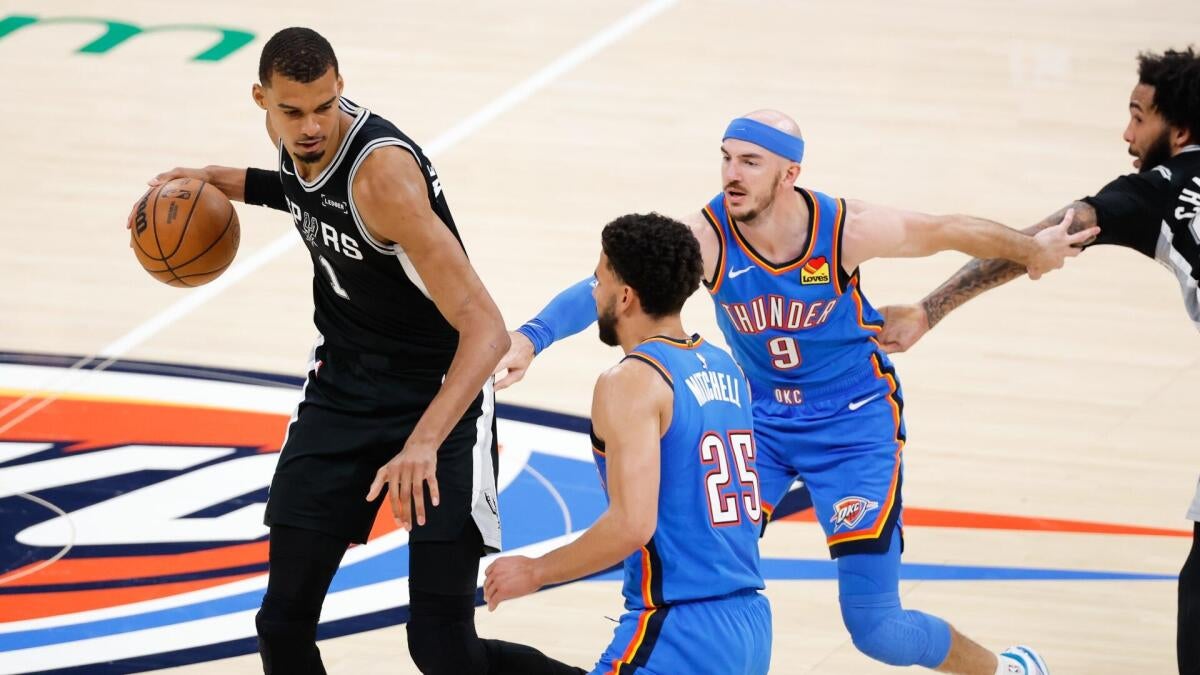
The Spurs stole a split in Oklahoma City and now host Game 3 of the Western Conference Finals on Friday with a chance to seize series control. Both teams arrive banged up: San Antonio is without De'Aaron Fox (ankle) and has Dylan Harper (adductor) questionable, while OKC's Jalen Williams (hamstring) is also in doubt. That injury profile matters less for the spread than it does for pace and efficiency on the periphery—the areas where totals live.
The first two games have tracked remarkably consistent: Game 1 went to double overtime and finished 237 combined points, while Game 2 hit 235 in regulation despite Fox's absence and Williams playing just seven minutes. That second datapoint is the mechanical tell. With the primary guard options limited or out, both offenses leaned on secondary creation—Ajay Mitchell found rhythm running Thunder pick-and-roll looks, and San Antonio's bench unit compensated for lost backcourt depth. The Spurs' role players are historically more efficient at home; the Thunder's reserves, specifically Mitchell, have thrived when the primary ballhandler sits. Four of the seven meetings between these teams this season cleared the total. Thunder games independently went Over at a 57% clip in the regular season.
Here's the ownership trap: the market opened Spurs at a slight favorite (-1.5) because home-court advantage in a series is worth something. But totals didn't climb as aggressively as the scoring pattern would suggest. At 217.5, the line sits below the average of the prior two games and assumes some version of defensive tightening in Game 3—a regression that doesn't match the personnel reality. If Fox or Harper is ruled out again, the Spurs' bench fills more minutes at home. If Williams doesn't go, Mitchell's usage spike is essentially guaranteed. Neither scenario depresses scoring; both expand it.
The causal chain is direct: injuries force bench players into higher-leverage roles → bench players perform better at home → efficient bench output drives pace and offensive efficiency → totals clear. The Thunder's 57% Over rate this season includes road games where role players underperformed and defensive intensity was higher. A Game 3 at the Frost Bank, with injuries still present and both benches expected to shoulder heavy offensive loads, doesn't fit that depressed-scoring profile. The market hasn't fully repriced the combination of home-court bench boost and continued injury-driven backup usage.
The spread (-1.5 Spurs) carries less edge—home-court advantage is already baked into that number. But the total at 217.5 reflects a split-the-difference assumption rather than the true run rate. When role players get minutes in front of friendly crowds and both teams have demonstrated 235-point capabilities even short-handed, waiting for a dip to 217 is a timing error.