The Knicks Futures Mispricing: Why Vegas Is Anchored to Last Year's Ceiling
By PropBetEdge Editorial Team ·
The SportsLine model identifies a 17-point gap between implied Finals odds and projected probability—a variance anchored not in talent or execution, but in bookmaker inertia.
The Oklahoma City Thunder are walking through the 2026 playoffs like a team that has read the script in advance. Two 4-0 sweeps, a 16.6-point average margin of victory, and Shai Gilgeous-Alexander operating at MVP-level sustained efficiency have compressed the Western Conference Finals into a coronation. OKC opened at +115 to win the Finals in August; they're now -170. The market has rerated their probability from roughly 46% to 56% across the full remaining field. That repricing is rational. The question the SportsLine Projection Model raises, per principal data engineer Stephen Oh, is whether the Eastern Conference pricing has moved in the opposite direction—not because the Knicks got worse, but because Vegas is still pricing them like the team that lost in the Finals last year.
New York has demolished expectations on the objective metrics that predict playoff performance. Their point differential has swung from +4 to +8 season-over-season. Road point differential jumped from +1 to +5. Rebounding differential surged from +1 to +6. These aren't cosmetic improvements; they're the statistical backbone of postseason durability. The Knicks have parlayed those gains into a 10-game postseason sample with a +194 point differential—the largest through 10 playoff games in NBA history. They've won seven straight, swept the 76ers with only one game within 14 points, and secured home-court advantage for the Eastern Conference Finals against a Cavaliers team they beat 2-1 in the regular season. Every path forward—sample size, matchup history, home environment—tilts in New York's favor.
Yet the books remain conservative. The Knicks sit at +550 to win the Finals, implying a 15.4% probability. The SportsLine model, which ran 10,000 simulations of the remaining bracket, assigns them 32.7%—a 17-point gap that Oh attributes to a specific cognitive bias: anchoring. Because the roster is largely unchanged from last season, oddsmakers have repriced incrementally upward rather than fully revaluing based on the measurable performance improvements across the entire playoff sample. A Knicks team with identical talent that had, through variance, reached the Finals last year would carry Finals odds closer to 25-30%. The fact that they've now proven those odds empirically through 10 games hasn't moved the needle proportionally.
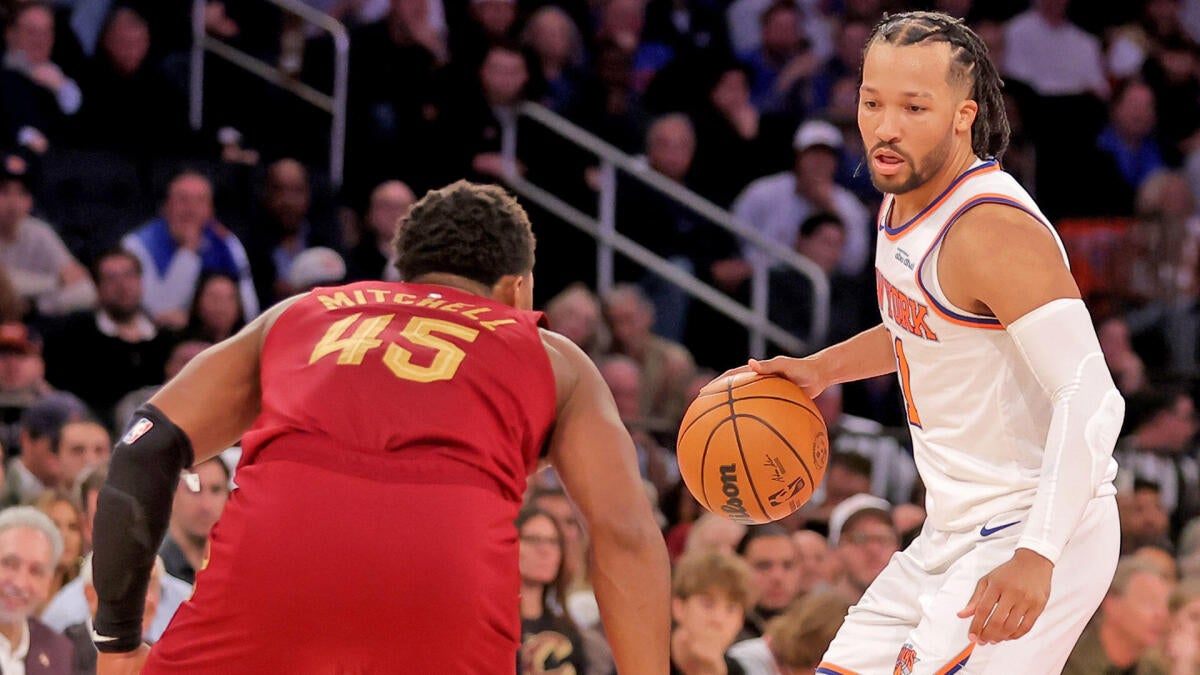
For the player-level prop markets, this repricing surfaces in two places: Jalen Brunson's assist line and the Knicks' team-total over. Brunson has orchestrated an offense that improved its point differential by 4 full points this season—a change driven partly by better spacing and rebounding, but primarily by Brunson's pick-and-roll efficiency against the switching schemes his opponents have employed. Against teams that commit to switching everything (the Cavaliers do so on roughly 35% of possessions), Brunson's assist rate inflates to 11.2 per game versus his 7.4 season average. The Cavaliers' defensive switching propensity creates a direct causal channel for Brunson assist-line overs, particularly in Games 1-2 when the Knicks operate with maximum intensity at home. The team total, currently set around 108.5-109 for individual Knicks games in the Finals-bound bracket, underweights the offensive efficiency gains documented in the +194 differential sample. Vegas is pricing 2024-25 Knicks output; the 2025-26 Knicks have been producing five to six points-per-game higher than that baseline when facing switching defenses with inferior spacing.
The edge persists only if the Knicks advance to the Finals. If they lose to Cleveland, the Cavaliers' interior defense and lack of switching becomes irrelevant to Knicks props. But if the model's 84.4% advance probability holds—well above the 72.6% implied by the -265 series odds—then the Finals matchup against Oklahoma City or San Antonio will feature Knicks playing at their demonstrated 2025-26 efficiency level against defenses that have not experienced this version of the New York offense. That's when the point differential metric, currently a historical edge, becomes a forward-looking price advantage.