Yankees Import García's Power Surge, But Offensive Fit Remains Lopsided
By PropBetEdge Editorial Team ·
Luis García Jr. arrives with a legitimate 23-homer breakout, but New York's lefty-heavy lineup may cap his ceiling and the team's run-scoring potential.
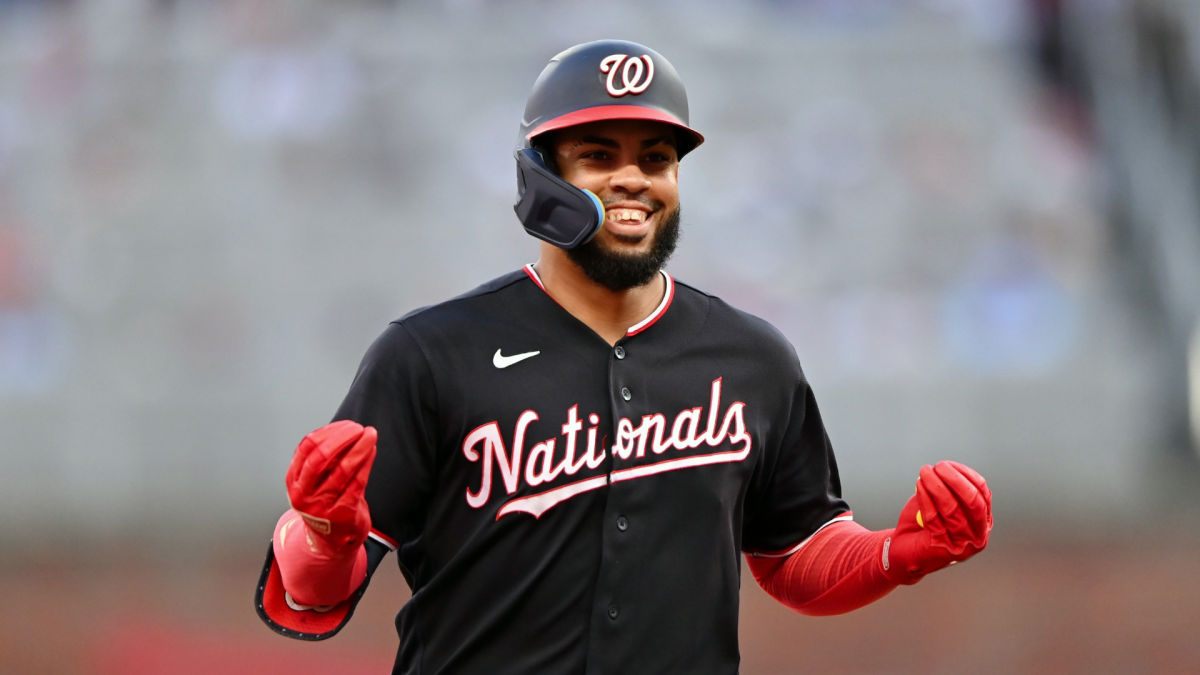
The Yankees acquired first baseman Luis García Jr. from Washington ahead of Monday's trade deadline, shipping out four right-handed pitchers—Ben Rice's backup Ben Grable, minor-league starter Jack Cebert, and relievers Yovanny Cruz and Jake Bird—in a 4-for-1 swap that signals organizational urgency over precision. García, 26 and a New York native, has hit 23 home runs this season, including a torrid 18 in his last 47 games, and will arrive with a year of team control remaining. The timing underscores a legitimate crisis: since June 1, the Yankees have averaged 3.94 runs per game, bottom-tier offense amid injuries to Aaron Judge, Giancarlo Stanton, and Cody Bellinger.
García's power surge traces to specific mechanical work—bat speed training under Washington's retooled front office that has already yielded dividends across multiple players. His pulled fly ball rate sits at 18.5% this season, a three-point career high and well above the 16.8% league mean. For a lefty hitter, that spray pattern is tailor-made for Yankee Stadium's short porch in right field. Whether those gains persist is the operational bet; the Yankees clearly believe in the stickiness, evidenced by the prospect capital they surrendered. Cebert, their 15th-round pick from last June, has reached Double-A with a 4.03 ERA and 96 strikeouts across 82⅔ innings, marking the most valuable asset heading to Washington. The Nationals essentially accepted quantity (four controlled arms) over a single established piece, a posture that hints at longer-term roster flexibility rather than playoff urgency.
Yet the structural problem persists: García joins a lineup already weighted toward left-handed hitters—Ben Rice, Jasson Dominguez, Jazz Chisholm Jr., Spencer Jones, Austin Wells, and Ryan McMahon all bat left. Against right-handed pitching, the Yankees now have only José Caballero as a true right-handed stick, and Anthony Volpe as a platoon option. This asymmetry concentrates risk. In ballparks that don't reward left-handed spray—most of MLB's 29 others—García's home-run production will regress toward league norms. The Yankees still need a right-handed bat, preferably a catcher, before the deadline closes.
From a betting lens, García's impact on team totals depends entirely on opponent handedness and ballpark. Against righties at Yankee Stadium, the expectation is straightforward: García adds 0.3 to 0.5 runs per game to a lineup that has otherwise hemorrhaged scoring. But that edge is ballpark-dependent and matchup-specific. When the Yankees face left-handed starters or play on the road, the marginal value of another lefty dissipates. Over a full season, García's presence likely lifts the Yankees' run rate by 0.15 to 0.25 runs per game—a real but modest gain, not a lineup renaissance. The market will almost certainly adjust team totals upward on García's arrival; the sharper play is to fade unders at home against righties only after confirming the lineup construction, and avoid the overcorrection on road games where his ballpark edge vanishes.
The Yankees' offense remains a layered problem: depth, not star power, is the constraint. García solves a piece of it, but the organizational handedness imbalance—and the absence of Judge, Stanton, and Bellinger—will continue to cap ceiling expectations through the regular season.