Wood's 446-Foot Grand Slam Caps Nationals' Offensive Explosion; Seventh-Ranked Home Run Pace Demands Respect
By Erik Schwartz ·
James Wood's second career grand slam signals the Nationals have finally assembled the offensive firepower to compete in the NL East — and the betting market may be underpricing their ceiling.
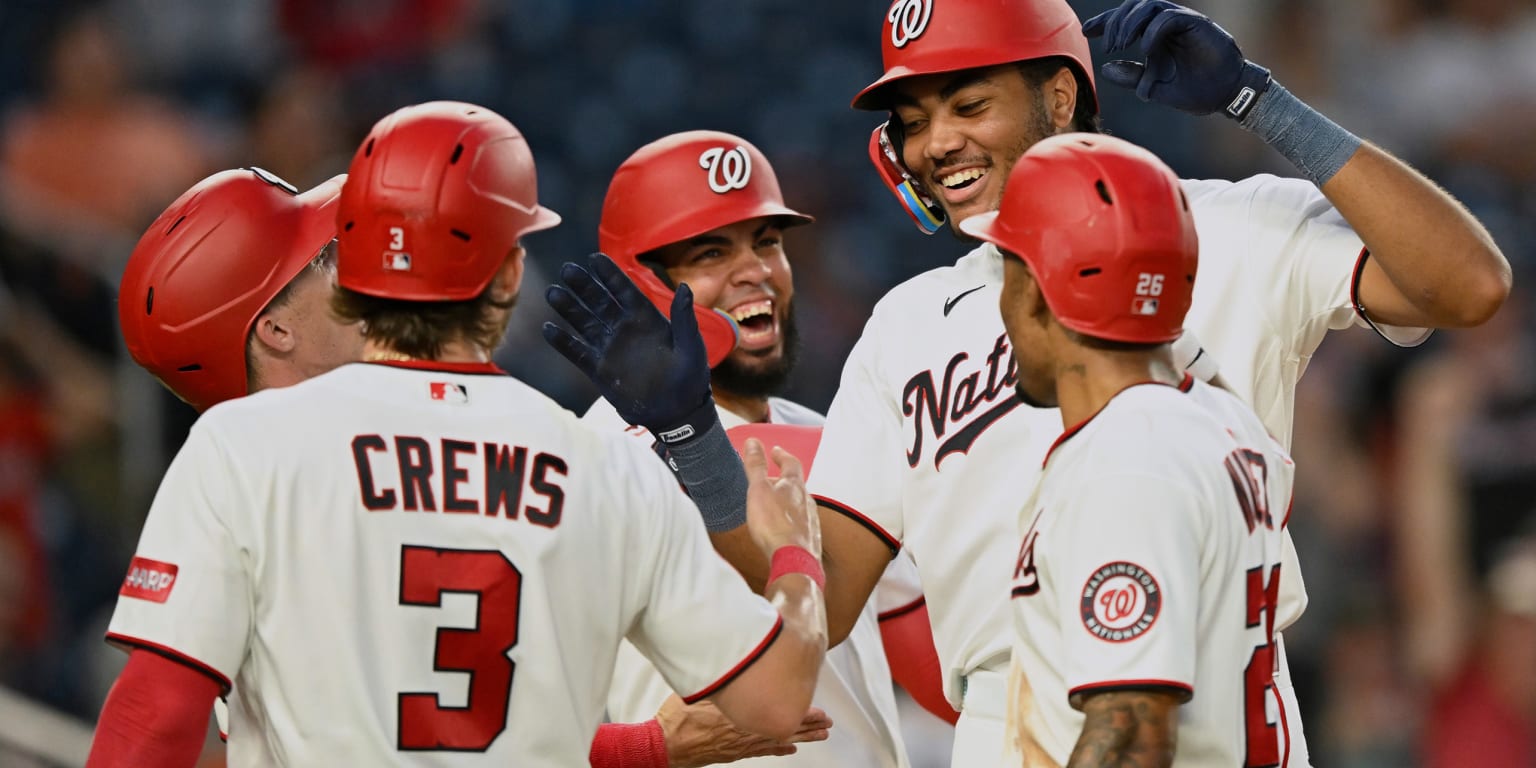
James Wood crushed a 446-foot grand slam off Astros reliever AJ Blubaugh on Monday night, capping a 12-11 Nationals comeback win at home. Unlike his first career grand slam — an inside-the-park sprint on May 19 — this one hung in the air long enough for Wood to savor it. The ball traveled at 109.8 mph and tied Michael A. Taylor's Statcast-era record for the longest grand slam by a Nationals player, matching Taylor's May 2015 blast against Arizona.
The grand slam was the punctuation mark on an offensive barrage that revealed why Washington has become a threat in the late-season marketplace. Trailing 6-1 midway through the third inning, the Nationals scored five runs in that frame, then added six more in the fifth. Wood's hit brought in Dylan Crews, Jacob Young, and Nasim Nuñez to reach the 60-RBI mark on the season. The supporting cast delivered: CJ Abrams homered for his 19th of the year (matching his entire 2025 total), and Curtis Mead added his 15th. That fourth home run in one game gave Washington four players with 15+ homers — tying the Dodgers for the most on any team this season.
Wood himself is now tracking at a 43-homer pace through the full season, sitting at 24 with roughly two-thirds of the schedule remaining. His seventh-place ranking in MLB homers matters because it reflects sustained, not random, production. Wood earned his second All-Star selection this year, a formal acknowledgment that the market had already begun to price in. The Nationals' offensive depth — multiple 15+ homer threats operating simultaneously — flips the traditional Washington narrative. For years, they were a low-variance, playoff-hopeful team leaning on elite starting pitching and defensive efficiency. Now they have both tiers operating at above-average rates.
For bettors, the implication is straightforward: Nationals team totals and over props in remaining games should be considered durable edges rather than weather-dependent lottery tickets. When a team generates four 15+ homer hitters AND the lead hitter is on a 43-homer pace, the offense isn't a one-game aberration driven by a trash-fire opponent (the Astros were competitive going into Monday). A 12-11 scoreline in a comeback win creates a visual memory of chaos, but the underlying pattern — multiple power sources working in sequence — persists across matchups. Lineups with this kind of distributed home-run generation carry lower game-to-game variance than lineups anchored by one or two stars. That durability is precisely what the betting market tends to under-reward in mid-season price corrections.