Holliday's Detroit Breakthrough Signals Sustained Offensive Shift, Not a Hot Streak
By Ty Whitney ·
Jackson Holliday's plate discipline has fundamentally rewired his approach—and the walks are coming from pitchers, not coincidence.
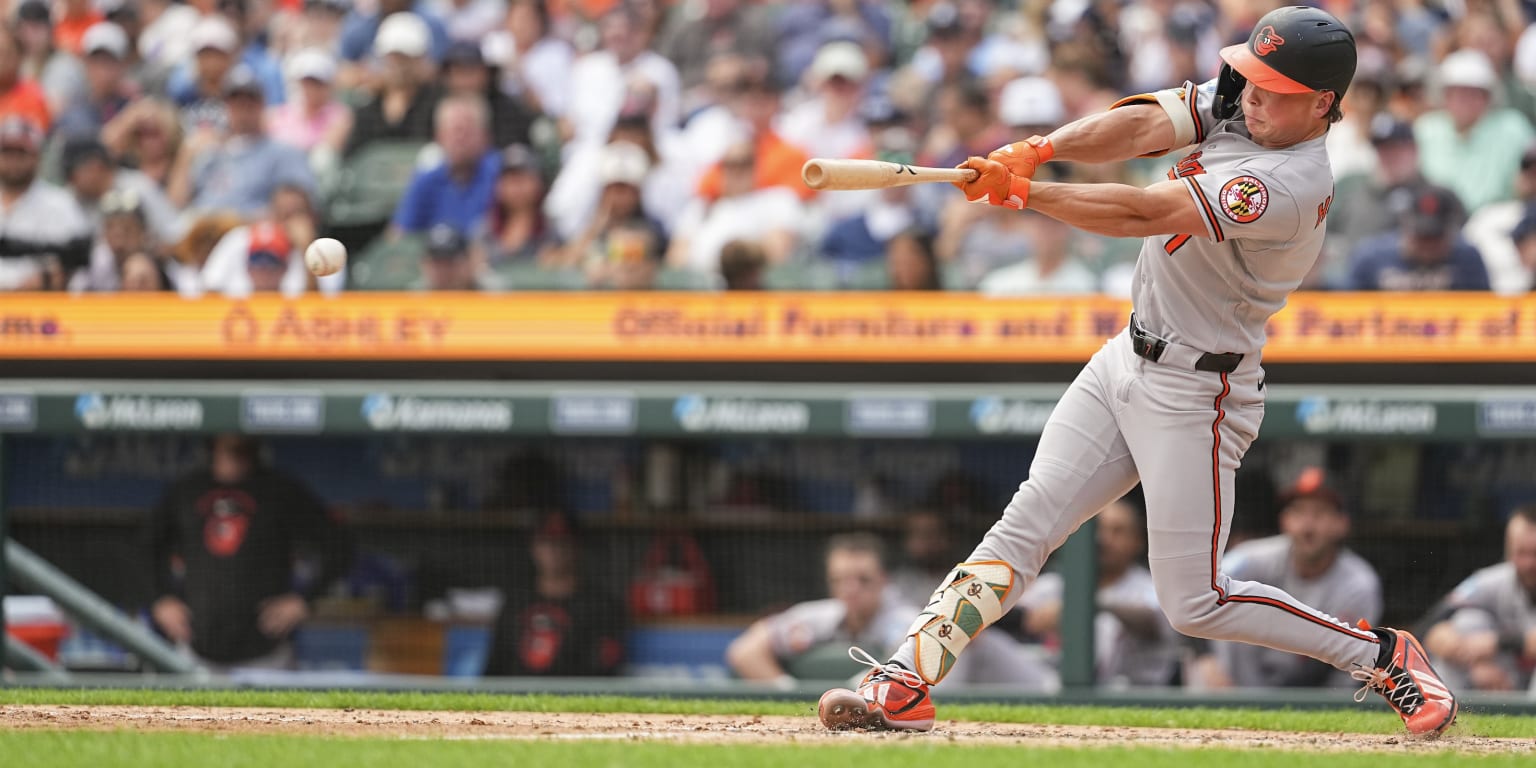
Jackson Holliday went 8-for-11 with three RBIs in Baltimore's series win over Detroit this week, but the headline stat undersells what's actually happening. The 22-year-old Orioles infielder, still five months removed from right hamate surgery in mid-February, has engineered a measurable shift in how he's being pitched to and how he's responding. This isn't a three-game hot spell; it's a structural recalibration.
The evidence sits in Holliday's walk rate, which has become the most revealing diagnostic of his maturation. Over his first two MLB seasons (209 games), he drew 71 walks total—a pedestrian 4.1 per 100 plate appearances. This year, in just 57 games through late July, he's already earned 27 walks in 184 plate appearances, a 14.7-per-100 clip. More telling: 15 of those walks came during the month of July alone, suggesting the trend is accelerating rather than stabilizing. Manager Craig Albernaz credits a cleaner approach—Holliday is no longer chasing out of the zone and is instead attacking pitches he can hit hard. That discipline allows him to work deeper counts, which in turn forces opposing pitchers into harder situations. The left-handed batter's ability to use the entire field—pull-side power, middle, opposite field—has also widened his effective strike zone. Pitchers can't pound him inside or away without risk; that forces them to live on the edges, where walks breed.
The performance surface reads as a 22-point jump in batting average over the last seven games (.522), a .919 OPS over 15 contests, and a .851 OPS over 30 days. But the underlying driver—improved selectivity and expanded hitting zones—is durable. This isn't a blowout-inflated stat line that reverts within a week. Holliday's swing has tightened. His timing window has lengthened because he's not committing early. When a player's discipline metrics shift this sharply and persist across multiple weeks, they tend to stick around until the opposition adjusts defensively or adjusts pitch selection. Albernaz's observation that Holliday is "being a complete hitter" is not hyperbole; it's a functional description of someone operating at a higher cognitive level.
For bettors, the prop angle hinges on two mechanisms. First, Holliday's walk rate suggests his on-base opportunity is inflating in a league where bettors typically price walks as secondary. If he sustains a 14-15 per-100 walk clip in August, his OBP will track closer to .380-.400 than his career .330, which most pre-deadline markets didn't fully price. Second, his improved barrel access and willingness to go the other way has elevated his expected batting average without inflating his strikeout rate—a rare combination at 22. Lines on his hits or runs scored likely haven't adjusted proportionally to his new walk volume. Over his last 15 games, he's scoring 6+ runs in a lineup that's offensively capable; if Holliday is reaching base at a 14.7-per-100 clip while also maintaining a .390 batting average, his runs-per-game profile is moving north of his preseason projection.
The caveat: Holliday missed spring training and the first 7.5 weeks of the season due to surgery. Pitchers have limited film on this version of him. Once the league adjusts—tighter strike-zone management, different sequencing—the walk spike may compress to a more sustainable 10-12 per-100 clip. That doesn't erase the discipline gain, but it does mean the edge is present in August prop lines before September correction sets in. The offensive talent was always there. Now the approach is catching up.