Red Sox Offense Wakes Up: How Boston's Momentum Survives the Break and Reshapes the Second Half
By Ty Whitney ·
After a 16-win surge in 18 games, Boston's lineup has transformed from a liability into an engine—and the market hasn't fully priced what that means for team totals down the stretch.
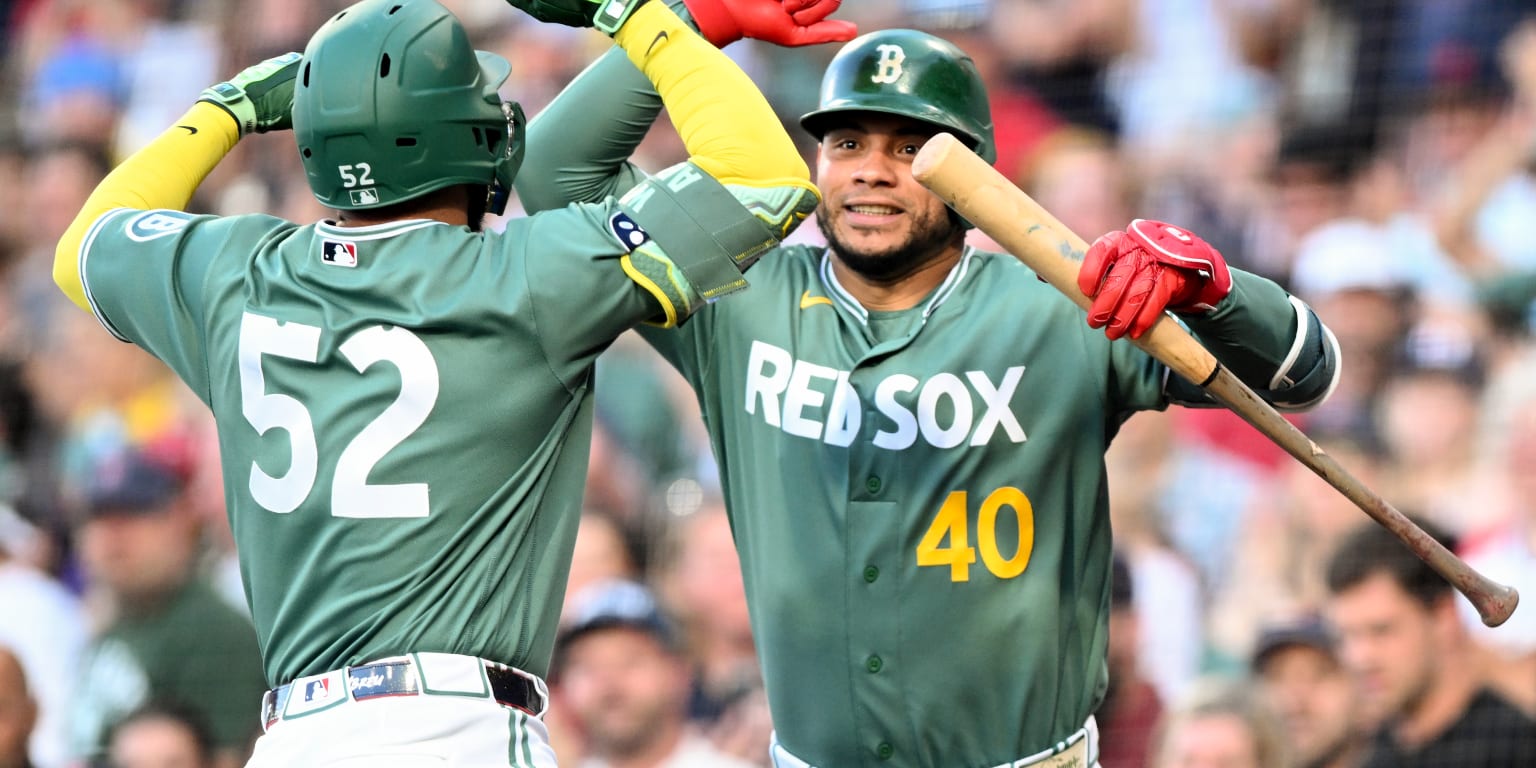
The Boston Red Sox are not the team that was 14 games under .500 on June 24. They're not even the team that limped to the All-Star break. On Friday, they swept Tampa Bay in a doubleheader to reach 48-48 and notch their first 11-game winning streak since September 2016—a stretch when Mookie Betts, David Ortiz, and Dustin Pedroia anchored a perennial contender. The current Red Sox have none of those names, yet they've engineered a resurrection that looks structurally different from the one that preceded it.
Craig Breslow's organizational blueprint tilted toward pitching and defense. That foundation remains: the bullpen has stayed reliable, and Boston's defensive infrastructure hasn't changed. But the critical shift happened in June and July: the offense woke up. Wilyer Abreu's two-homer night against Mason Englert wasn't a fluke—it was a symptom of broader alignment. After hitting .673 OPS against righties in the first half, Abreu went deep twice on Friday. Willson Contreras, returning from a five-game suspension, homered immediately and reasserted himself as Boston's most productive hitter. The Red Sox went 5-0 without him; they're a different animal with him. Over their last 18 games, Boston has won 16. That's an 88-win pace over a full season—not a contender's rate, but a team that competes every night. The Rays, leading the AL East at 56-40, suddenly look vulnerable in a four-game set they're splitting with a club that should be sellers.
The market has been slow to internalize what this surge means. Most sportsbooks still price Boston's team totals as though the early-season offensive collapse defines the team's ceiling. It doesn't anymore. When a club goes from 14 games below .500 to .500 in fewer than three weeks and does so while winning games with their lineup—not just grinding out 2-1 pitchers' duels—the baseline for offensive output has shifted. Abreu's performance against righties represents a specific mechanic: he's been overexposed to fastballs from righty starters who assumed they'd get him out low in the zone. Contreras' return adds a disciplined bat that doesn't chase. The combination means Boston's run production in close games, which used to fall short in the fourth and fifth innings, now arrives.
For prop bettors, the angle is plain. Boston's team total has been held artificially low by narrative inertia—the early-season collapse still haunts the odds, even though the roster performing now is not the roster that collapsed. The Red Sox are averaging 4.8 runs per game over their last 18 contests. Against sub-.500 pitching staffs and in home games (where they've won eight of their last ten), that number trends toward 5.2. The All-Star break usually resets momentum; instead, it provided the Red Sox a rest before their second-half grind. Books may offer team totals at 4.5 or lower for the next week or two, pricing in either fatigue or reversion to the mean. Both assumptions are stale. The reversion already happened—it's the reversion upward.
The durability of this edge depends on opponent quality. Against first-division pitching (Orioles, Blue Jays coming next), the run-production line will compress slightly. But the structural advantage—a lineup that now scores in bunches rather than sporadic games—persists. Contreras' presence alone is worth 0.3-0.4 runs per game added to Boston's baseline. Abreu finding his stroke against righties removes a weather-dependent outcome. This is not a single-outlier surge about to fade in 48 hours; it's a reconstitution of how Boston competes. The market hasn't caught up.