Painter's Fastball Crisis Keeps Phillies Stuck With a Sinking Starter
By Erik Schwartz ·
Philadelphia has no rotation depth to shelter Andrew Painter's catastrophic fastball, forcing Don Mattingly to keep deploying a 23-year-old whose stuff is betraying him.
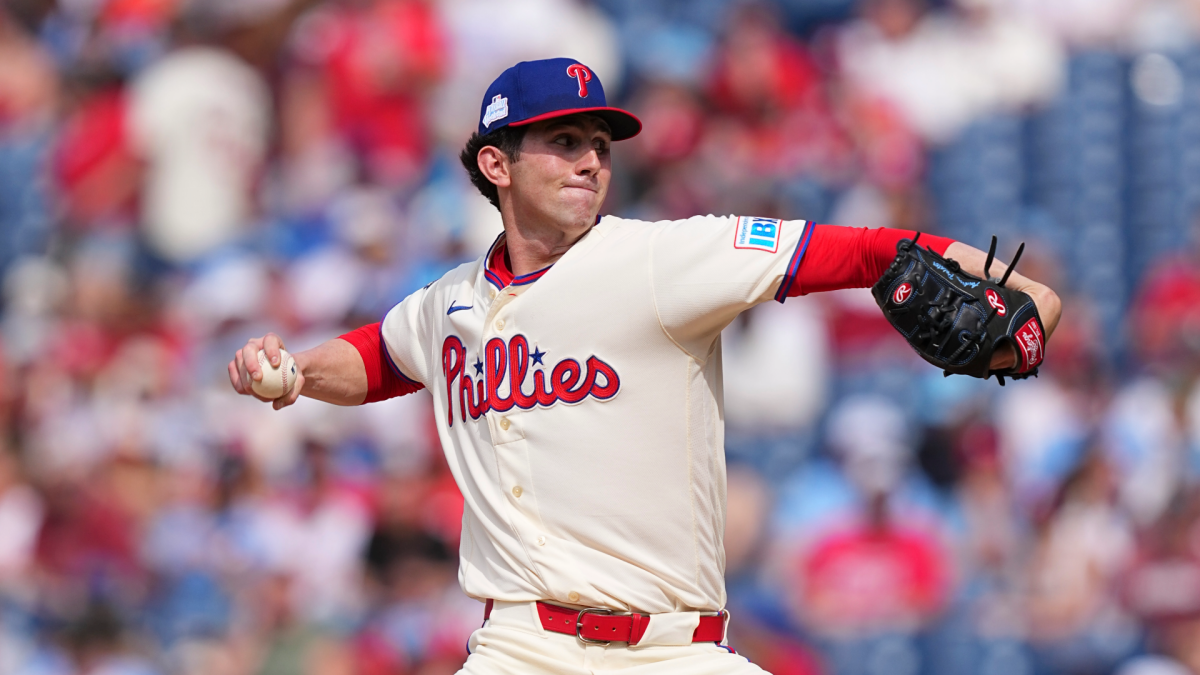
Andrew Painter took a loss Saturday against Chicago after surrendering six runs in 4⅔ innings, extending a nightmare run that has saddled the Phillies with a 6.21 ERA across 11 starts this season. When interim manager Don Mattingly was asked if the team would consider skipping Painter's next turn to reset or explore alternatives, the answer was blunt: no. The Phillies lack the rotation depth to absorb even a short respite for their 23-year-old starter.
Painter's underlying performance reveals why benching him—even temporarily—would require roster options the Phillies simply don't have. His FIP of 5.09 suggests his actual 6.21 ERA isn't solely a product of bad luck or sloppy defense; the mechanics are genuinely broken. He's allowed 11 home runs in 58 innings, striking out just 18% of hitters in an era when high strikeout rates are table stakes for survival. Opposing batters are slugging .585 against his fastball—a pitch he throws roughly one-third of the time—despite an expected slugging percentage of .559. The gap is minimal, meaning batters aren't simply getting lucky; they're ambushing a pitch that lacks the shape and movement to induce swings and misses. Painter himself acknowledged the core problem after Saturday's outing: he doesn't know what his fastball will do, which makes commanding it nearly impossible.
The mechanics behind the fastball's failure are instructive for understanding why the Phillies are trapped. At 96.2 mph, the velocity is respectable for a starter, but velocity without induced vertical break is a fastball begging to be hit in the air. Painter's extension off the mound is modest, a geometric constraint that prevents the pitch from playing up the way it should at that speed. He generates a 9.9% whiff rate on that fastball—abysmal for a lead offering, especially when thrown a third of the time. In today's environment, you either need elite command to locate around the zone or elite whiff rates to miss bats. Painter has neither.
The Phillies' inability to demote him stems from a Triple-A rotation that has combined for a 5.04 ERA across 40 starts. Those Triple-A starters average 29 years old and occupy no roster prospect rankings worth noting. Moisés Chace, the only age-relevant alternative, is still ramping from 2025 Tommy John surgery and may not stay a starter long-term. This structural weakness forces Mattingly's hand: Painter stays in the rotation not because the team believes in him, but because the alternative—cycling in backfill arms from a drained minor-league system—represents organizational failure at a different level.
For bettors, Painter's inclusion in the rotation signals both his next start-specific vulnerability and the Phillies' broader pitching instability. Every Painter start becomes a fade opportunity on multiple prop angles. His strikeout rate (8.7 K/9) means his strikeout totals will consistently undershoot market expectations built on rotation-average baselines. More broadly, the Phillies' starting pitching—with Aaron Nola posting a 5.55 ERA and Painter imploding—makes their team total runs lines attractive as overs when facing competent offenses. The rotation's inability to provide length or reliability makes those games unpredictable, but the directional pressure on scoring environments leans toward elevated run environments as defenses face higher pitch counts and earlier bullpen usage.