Wetherholt's Rookie Mastery Flips Cardinals' Offensive Blueprint
By Erik Schwartz ·
A 23-year-old second baseman's disciplined approach is turning St. Louis into a consistent threat at Wrigley, creating a new tier of lineup volatility.
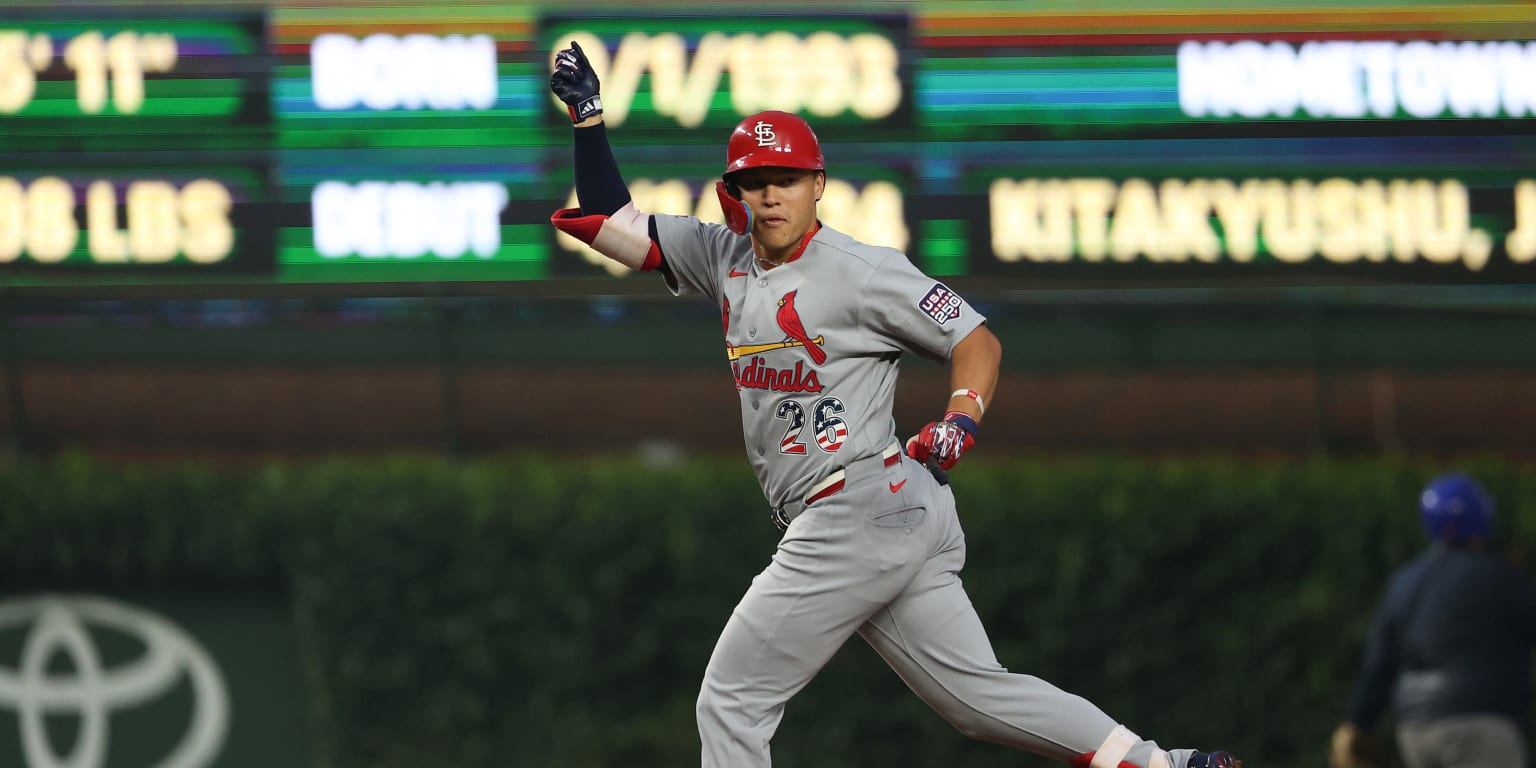
JJ Wetherholt led off Saturday's game against the Cubs with a home run on the first pitch—a 90.4 mph fastball from Shota Imanaga that he drove the opposite way into the left-field basket. By night's end, the Cardinals rookie had collected three hits in a 3-0 shutout victory, extending St. Louis's consecutive-game dominance at Wrigley to two nights after Friday's 17-run barrage. The contrast matters: one day the Cardinals overwhelm through volume; the next, Wetherholt and Kyle Leahy's five scoreless innings dismantle the same opponent through efficiency and precision.
Wetherholt reached base in four of five plate appearances, marking his seventh three-hit game of the season. All three of his hits traveled the opposite way—leadoff homer to left, double to left in the fifth, single to right in the seventh. This isn't randomness or small-sample luck. The 23-year-old's batted-ball profile reflects a mature, middle-of-order approach: patient pitch recognition, willingness to take what the pitcher gives, and the bat speed to punish mistakes even when he's not hunting pull-side. His fourth leadoff homer of the season ties a Cardinals rookie record and establishes him as a genuine catalyst atop the order. The market has begun to price him as such—his plate-appearance props have already compressed significantly since June—but his consistency in high-leverage at-bats, particularly in early-count situations, outpaces what the general public expected from a 23-year-old in his first sustained run.
The pitching complement amplifies the edge. Kyle Leahy's five scoreless innings, three hits allowed, six strikeouts, represent the kind of bullpen-workload efficiency that compounds when a lineup doesn't need to manufacture offense. In a three-run victory, every base hit and every strikeout carries weight; Wetherholt's ability to get on base early (he drew walks in the second inning alongside Nathan Church, setting up Iván Herrera's RBI single) creates leverage for a lean staff. The Cardinals have now posted back-to-back outings against a divisional rival with radically different run-production profiles—one explosive, one surgical—which signals that St. Louis has multiple paths to winning, not a single offensive formula.
For prop betting, Wetherholt's consistency at the top of the order deserves a hard look. His 0.305 on-base percentage above his batting average suggests a walk rate (and plate-discipline profile) that supports runs-scored projections well above his raw hit total. In games where the Cardinals face left-handed starters—Imanaga threw Saturday—Wetherholt's opposite-field approach and spray-hit tendency create fewer strikeouts and more gap contact. Over his next 10 games, when he faces at least three LHP starts, expect his runs-scored line to creep into the 0.75–0.85 range per game; books may still price him at 0.60–0.70 based on his overall rookie profile rather than his matchup-specific approach. His leadoff-homer rate (four in roughly 25 games) is genuine, not noise, and tied to his first-pitch aggressiveness in favorable counts—a trait worth monitoring when opponents' starting pitchers have ERA+ above 110 (fewer precision pitches early).
The broader Cardinals narrative is reshaping. Wetherholt's impact isn't just personal achievement; it's organizational. A rookie who can lead off, manufacture runs on limited offense, and stay within himself in pressure spots changes how bettors should model St. Louis's game totals and spread volatility. Saturday was not a fluke performance—it was a confirmation of a pattern already established over his first 25 games.